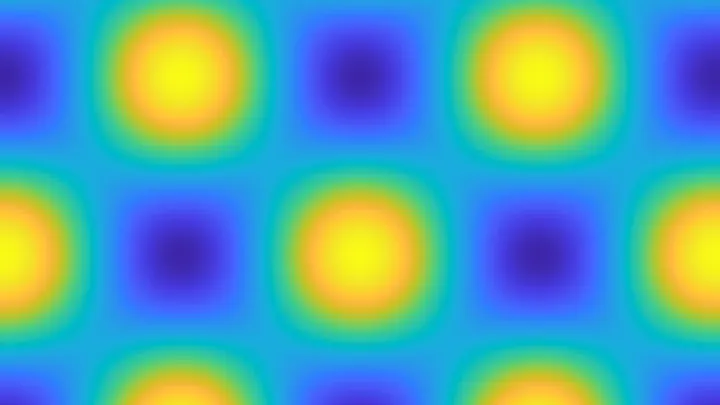
In a conventional superconductor, electrons form pairs that all move together with zero total momentum, creating a uniform quantum condensate that conducts electricity without resistance. A pair density wave (PDW) is a more exotic superconducting state where these electron pairs carry a nonzero total momentum, meaning the condensate itself is spatially modulated — its density varies periodically like a standing wave. This modulation is a form of quantum order that breaks translational symmetry, something not seen in standard superconductors.
History
The concept was theoretically proposed in the 1960s by Fulde and Ferrell, and independently by Larkin and Ovchinnikov, for superconductors in strong magnetic fields. The idea was later extended to zero-field cases in high-temperature superconductors, but direct experimental evidence remained elusive for decades.
How it works
The key mechanism is that electron pairs condense into a state with a finite center-of-mass momentum, rather than zero. This happens when the electronic interactions favor pairing at a nonzero wavevector, often due to competing magnetic or charge orders. The result is a superconducting order parameter that oscillates in space, creating a periodic pattern of superconducting and normal regions. This modulation can coexist with other orders, such as charge density waves, and can lead to unusual phenomena like vortices that carry fractional flux.
In practice
PDW states are studied in the context of high-temperature superconductors and ultracold atomic gases, where they may help explain the pseudogap phase and other anomalous properties. They are also relevant for designing superconducting devices with spatially varying properties.
Fun fact
In a PDW, the superconducting condensate can have a density that varies with a period much larger than the atomic spacing, creating a sort of 'supersolid' for electron pairs.
At first glance, a city of blocks looks orderly, but its rhythm is set not by the streets themselves but by the houses that line them. In cuprates, layered copper oxides, a mysterious periodicity of eight unit cells (8a0) has long been observed, as if the streets were laid out with a spacing of 8.
An empty dance floor where people occasionally appear. Each moves on their own, chaotically, with no connection to the others. But when the right music starts and the hall cools down a bit, the dancers suddenly begin to form long chains and move in unison. That's roughly how electrons behave in a dilute three-dimensional gas.
A layered cake where each tier conducts electricity differently: that's the structure of the crystal La3Ni2O7, a compound of nickel, lanthanum, and oxygen. Current flows differently along the layers than across them.
A polar molecule is like a tiny dumbbell with opposite charges at its ends. Normally, such particles quickly stick together or fly apart when they meet — electric forces are too strong. But the authors of the work found a way to turn this aggressiveness into a controlled game.
In superconductors, electrons pair up and flow without resistance. Usually, these pairs are distributed uniformly, like water in a calm lake. But sometimes ripples appear in the material — pairs bunch up and thin out with a certain period. This state is called superconductivity with pair-density waves.
Superconductivity is often pictured as a frozen dance of electrons: they pair up and move without resistance, like figure skaters on perfect ice. But in high-temperature superconductors, that ice turns out to be not so smooth.
Graphene, a two-dimensional carbon crystal, has long tantalized physicists with the hope of high-temperature superconductivity. Its electrons obey the relativistic equation of Paul Dirac, racing at tremendous speed, barely noticing each other.
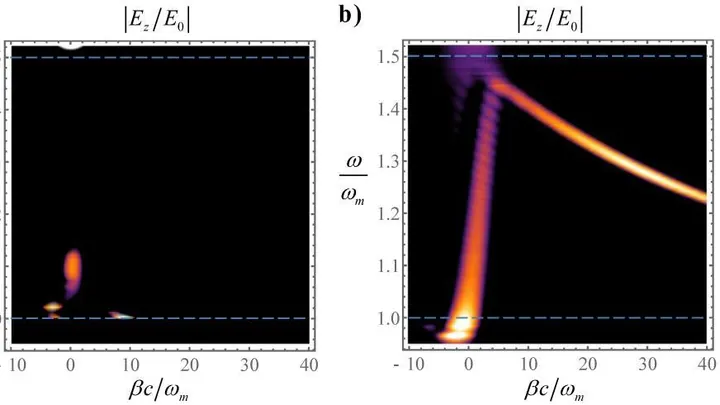
An ordinary microwave cavity resembles a music box: it responds only to strictly defined frequencies: its own notes. But what if you could make it sound different? Scientists changed the rules of the game by making the walls "one-way." Inside such a cavity, a wave can only run forward, never reflecting back.
Imagine a skyscraper assembled not from individual bricks but from entire studio apartments. That's exactly how the Au₆Te₁₂Se₈ crystal is built: its nodes are not atoms but superatomic clusters of gold and chalcogens that behave as single quantum objects.
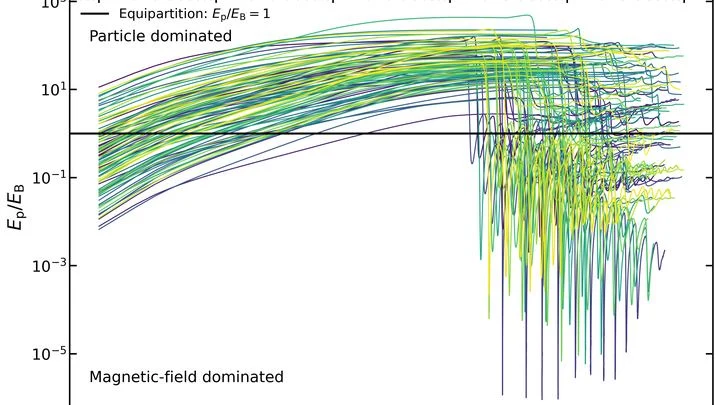
Blacksmith's bellows fan the fire by forcefully pushing out air. In space, the shock wave from a supernova, a concept introduced by Fritz Zwicky, acts like such bellows: it catches up with a giant bubble of charged particles and magnetic fields formed around a spinning neutron star…
A stone falls into a pond, and ripples spread across the water. Long waves and short ones travel at the same speed: that's how ordinary sound behaves in almost any medium. But in quantum liquids, things can be different.
Physicists considered a superfluid where particles move along a "flat" energy band.
An ordinary diode in electronics works like a one-way street: current flows in only one direction. In superconductors, where electricity flows without resistance, such behavior has long been elusive — current is usually symmetric.
The authors of the new work found a way to create a perfect superconducting diode using light.
Inside the EuRbFe4As4 crystal, layers of iron and arsenic alternate with spacers of europium and rubidium. When cooled below 15 Kelvin (–258°C), europium atoms align their magnetic moments into a spiral: each successive layer is rotated by 90 degrees, like steps of a spiral staircase.
A superconductor carries current without resistance, like water running through a pipe without friction. The secret lies in electron pairs: two electrons stick together as one, even though they normally repel. In an ordinary superconductor, the spins of the electrons in a pair point in opposite directions: this is the singlet state.
A layered cake of atomic planes of nickel and oxygen: that's how bilayer nickelates are built. Two such planes are separated by a spacer layer. If an oxygen atom sits in that spacer, it acts as a bridge: it links the layers and triggers a state in which electrons move without resistance.
Imagine a line of people holding hands but facing in opposite directions: some look north, others south. That's how a p-wave magnet is arranged. Electrons in it align their magnetic moments (spins) not randomly but in a strict wave-like pattern.
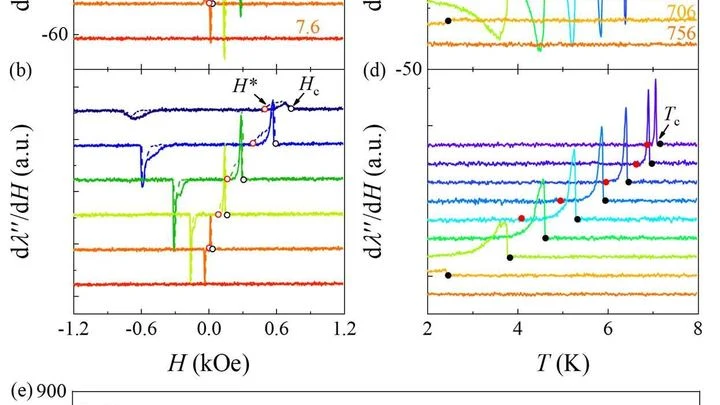
Ordinary magnetic measurements only see the surface of a superconductor, where barriers and viscous flows of magnetic field get in the way. Inside, in the so-called intermediate state, superconducting and normal domains coexist, separated by thin walls. These walls can oscillate, but hearing them directly has been difficult.
An ordinary crystal is like an apartment building: electrons move through shared hallways and staircases, influencing each other through the walls. Now, imagine removing all the walls, leaving just a single line of apartments. How would the residents behave?
Hydrogen has nothing to do with it, but the collective behavior of electrons takes center stage.
The dance floor is packed with people, each moving on their own. Suddenly, some of them break into pairs (spinning around, barely noticing their neighbors) while the rest line up in chains. That's roughly how atoms behave in the metal CsCr₃Sb₅, a member of the kagome metals, whose crystal lattice resembles a woven basket.
Picture a packed bus where every passenger is an electron. In a superconductor, passengers pair up and move in sync, losing no energy. But in high-temperature superconductors like cuprates, this idyll only works when extra passengers are added. If you drop some off, the pairs start acting strangely.
In the world of superconductors, electrons don't like to be alone. They typically pair up into Cooper pairs and move without resistance, like figure skaters holding hands. But you can make them dance in fours. The authors of this work propose a scheme where Cooper quartets, groups of four electrons exchanging partners in a rapid rhythm, are born.
A thin wire of the new material conducts electricity without loss when cooled to three degrees above absolute zero. It's like water flowing through a pipe without any friction against the walls. The material is called PtPb3Bi, and its hallmark is an internal structure resembling a bundle of threads: electrons run freely along a thread but struggle to jump between threads.
Electrons in a crystal sometimes behave like a stadium crowd doing the wave: areas of higher density alternate with nearly empty ones. This wave blocks the free flow of charges — under normal conditions, the material is not superconducting. But apply pressure, and the wave vanishes, letting electrons move without resistance.
A sheet of graphene one atom thick is twisted at a small angle, and it starts behaving like a layered pie with layers slightly rotated relative to each other. At a certain twist angle, this material becomes a superconductor: electrons begin to move in pairs, like dancers in a waltz, without losing energy. But what exactly happens inside has remained a mystery.
A crystal is like a city where houses stand in neat rows. But if you slightly stretch the ground beneath the city, the houses may tilt, and the tilt can ripple as a wave from block to block. In SrTiO3 and SrMnO3 crystals, scientists have found exactly such a hidden mode: a soft wave of tilting oxygen octahedra that had gone unnoticed before.
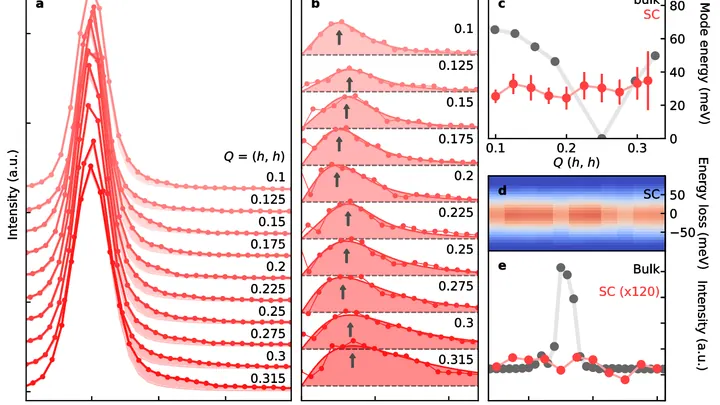
In a superconductor crystal, electrons sometimes arrange themselves into charge waves, like ripples on water, but made of the particles themselves. Some waves stretch far, while others live only over short stretches. Scientists took the material YBa$$_2$$Cu$$_3$$O$$_{6.67}$$ and hit it with short X-ray pulses to observe both types of waves.
The surface of the uranium compound UTe2 crystal looks like a frozen sea: in some places, electrons move freely; in others, they get stuck near atoms. A scanning tunneling microscope, a device that probes the surface with an atomically sharp tip and senses individual electrons, revealed that this landscape is not random.
A cooled layered crystal resembles a stack of thin sheets, with electrons wandering between them. At around 17 K, tiny regions appear where electrons line up into a wave, like ripples on water frozen in place. These regions are called charge puddles, and they were previously thought to be static.
Sound on a crystal surface is like ripples on water, but traveling through a solid. This ripple is called a surface acoustic wave: it moves a hundred thousand times slower than light, so it can be compressed into very short segments and fit on a tiny chip. Usually, such waves are launched by metallic combs made of aluminum or gold.
In two mirrored rooms, set at right angles, lives a cloud of atoms. Each atom is like a singer in a choir: on its own, it may stay silent, but when neighbors start to sing, it joins in. Here, the conductor's role is played by geometry itself: one room helps the atoms emit light together, while the other gently nudges them toward that — not directly, but through a clever detour.
The layered material (SnS)1.15(TaS2) resembles a stack of paper, where the sheets conduct electricity and the interlayers prevent them from sticking together. At ambient pressure, this material conducts current without resistance, making it a superconductor.
Layered cuprate crystals resemble a stack of pancakes: each pancake is a plane of copper and oxygen atoms, with spacer layers of other elements in between. Usually, superconductivity is studied in the whole stack, where layers influence each other.
Quantum particles in a strongly disordered environment behave like dancers executing steps in sync: each knows its own move and never collides with others. This kind of coordinated, frictionless flow, superfluidity, unexpectedly emerged in an experiment on a superconducting quantum chip.
A supersolid is ice that flows. Think of a pond with a frozen crust, but beneath it, a liquid depth without friction. Usually, creating that crust means changing the liquid's properties throughout its entire volume.
In 1976, Gerard 't Hooft noticed that the vacuum of a gauge theory is not as simple as it seems: it possesses a topological structure that manifests itself in a nonzero topological susceptibility.