A scanning tunneling microscope (STM) is an instrument that images surfaces at the atomic scale by measuring the quantum tunneling current that flows between a sharp metal tip and a conductive sample. When the tip is brought within a nanometer of the surface, electrons can 'tunnel' across the gap—a purely quantum phenomenon that would be forbidden in classical physics. The tunneling current is extremely sensitive to the tip-sample distance, changing by an order of magnitude for every angstrom of separation, which allows the STM to resolve individual atoms on a surface.
History
The scanning tunneling microscope was invented in 1981 by Gerd Binnig and Heinrich Rohrer at IBM's Zurich Research Laboratory, who were awarded the Nobel Prize in Physics in 1986 for their achievement. The first successful atomic-resolution image of a silicon surface was published in 1983, demonstrating the instrument's unprecedented capability.
How it works
The STM operates by scanning a sharp tip across the sample surface while maintaining a constant tunneling current using a feedback loop that adjusts the tip height. As the tip moves, the voltage adjustments needed to keep the current constant map out the surface topography with atomic resolution. The technique works only for conductive or semiconductive samples, since a tunneling current must flow. Beyond imaging, the STM can also manipulate individual atoms by applying voltage pulses or by dragging atoms across the surface, making it a tool for both observation and nanoscale construction.
In practice
STMs are used in surface science to study atomic-scale structures, in nanotechnology to manipulate individual atoms and molecules, and in the semiconductor industry to characterize the quality of silicon wafers and other materials.
Fun fact
The STM's tip is so sharp that it typically ends in a single atom, and the tunneling current it measures is only about a billionth of an ampere—yet it is enough to produce images with atomic resolution.
Inside a microscope that sees individual atoms, it's cold and silent: the temperature is around -268°C, and the interior is in perfect vacuum. To place individual iron atoms on such a stage, you usually need a direct 'corridor' from the evaporator to the sample. But in the coldest instruments, that corridor is blocked by thermal shields, making deposition a puzzle.
A shipping container is a steel safe the size of a room, packed with goods. X-rays struggle to see through it: thick walls and dense cargo block the rays. Enter muons — particles born high in the sky that constantly rain down on Earth. They can pass through even lead, but they veer slightly off course when they encounter something heavy.
Drop by drop from a faucet, or a steady stream without a single splash. That's roughly what the two regimes of current in a superconducting contact look like. Only here, the role of water is played by Cooper pairs — bound electrons that move without resistance.
Photographing hummingbird wings with an ordinary camera gives a blurry smudge. For a sharp picture, you take many rapid shots from different angles and piece them together: that's how a quantum 'snapshot' is made. In the lab, scientists 'feel' the vibrations of a tiny mirror with a laser beam.
A flat crystal of charged atoms suspended in an electromagnetic trap behaves like a perfectly calm pond. The slightest breeze, and ripples spread across its surface. This 'pond' catches the splashes from dark matter particles and the ripples of spacetime — high-frequency gravitational waves.
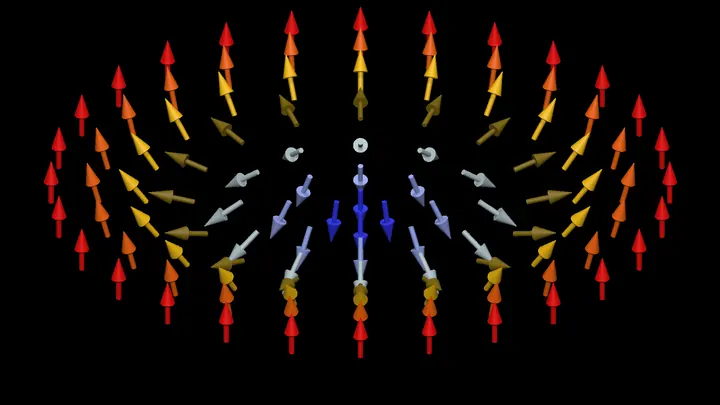
In a field trap, scientists assembled a crystal — 150 ions at ultra-low temperature. Each ion behaves like a tiny magnet, capable of rotating in any direction. By controlling forces that depend on this rotation, physicists made all the magnets swirl into a common vortex called a skyrmion.
Biologists often tag cells with glowing molecules — it's like searching for a dim light in the smoke. The light quickly fades, and the smoke creates interference.
Think of a stack of paper: when the sheets lie perfectly aligned, light passes through them uniformly. But turn one sheet by a few degrees, and the picture changes. Something similar happens with layers in certain materials: rotate them relative to each other, and their properties change — sometimes dramatically.
Spectroscopy isn't the key here, or rather, it's not the method used.
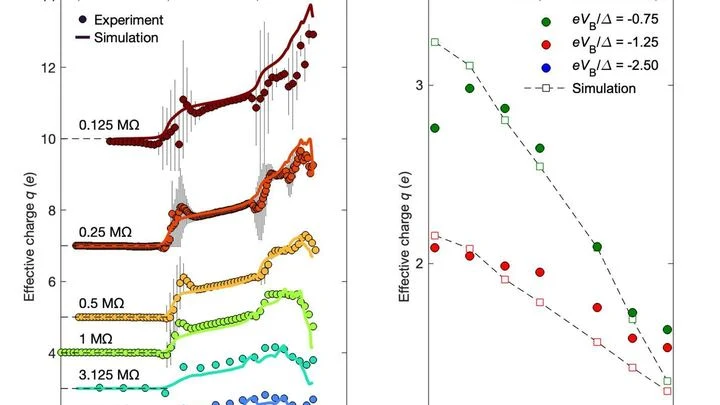
Current flowing through a wire is never perfectly smooth. If you listen closely enough, you hear a rustle — shot noise. It arises because charge is not carried as a continuous stream but in discrete portions, like raindrops on a roof. From the character of this noise, you can tell how much charge each 'drop' carries.
A scanning tunneling microscope probes a molecule with an ultra-fine tip and maps its relief. But the image is flat, while the molecule is three-dimensional. How do you guess a person's pose from their shadow on a wall?
An ion channel in a cell membrane is a gate just a few atoms wide. Every second, millions of charged particles, sodium and potassium ions, pass through it. Classical physics said that to get through, an ion must jump over an energy barrier, like a traveler crossing a high mountain pass.
A fridge magnet attracts a paperclip: we can feel that field with our hands. Now shrink that field by a billion times. Atoms inside our bodies emit such weak signals, and they are very hard to catch.
Scientists built the sensor from special molecules that themselves behave like tiny magnets.
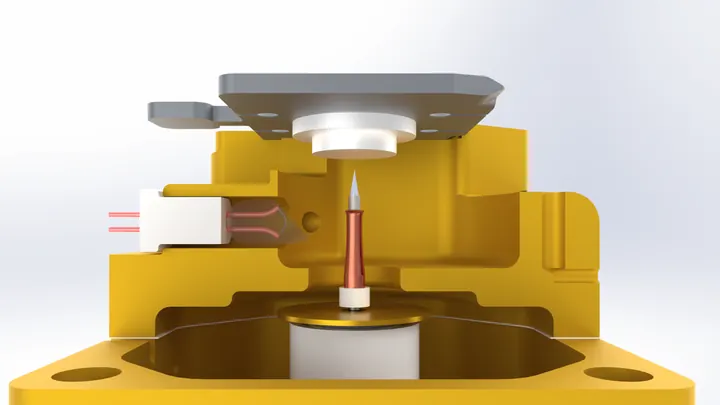
A tiny needle glides over the surface like a finger over a page written in Braille. That's how a scanning tunneling microscope works: it feels the atomic landscape and turns bumps into a picture. But when you need to add a magnetic field, the design hits a wall.
The tip of a scanning tunneling microscope approaches a crystal surface so closely that an electric current jumps between them. Electrons from the needle are injected into a layered semiconductor and land in an atomic vacancy — a spot where one atom is missing from the lattice. This void acts as a tiny trap for charge.
In twisted bilayer graphene, electrons behave like people on a crowded bus: each takes up space and gets in the way of neighbors. The strength of this "reluctance to share space" is called the Hubbard parameter U. It determines whether the material will be a conductor or an insulator, but measuring U directly is very difficult.
A short flash of light hits a graphene sheet, and at the point of impact, an energy gap momentarily opens, as if a pocket were cut into a continuous fabric.
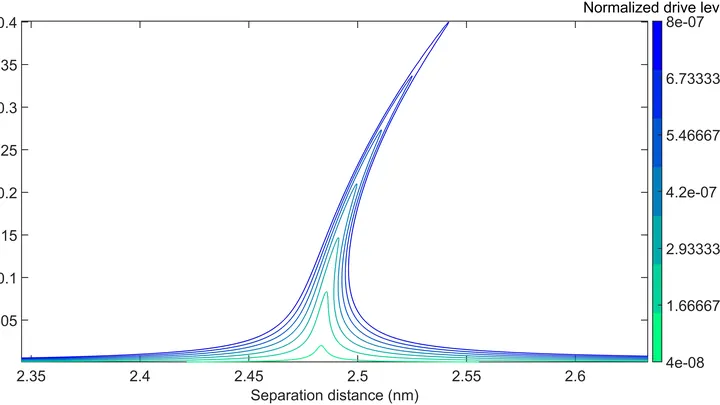
The tip of a tunneling microscope hovers above a surface at a distance smaller than the diameter of an atom. Usually, it feels out the topography like a finger reading a page of Braille. Now, that same tip has learned to listen to how a membrane the size of a fingernail trembles.
Two pendulums linked by a spring of light begin to swing in unison without ever touching. In the quantum world, such synchronization means something more: particles lose their individuality and become a single object.
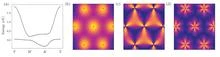
Electronic charge is a tumbleweed that moves camp depending on energy. In tungsten selenide (WSe₂) crystals, this is seen with utmost clarity: at a bias of −1.4 V, near the K point of the Brillouin zone, the maxima of tunneling current sit in the centers of hexagons, where there are no atoms.