Popular

Strongly Correlated cond-mat.str-el

24 articles

Quantum magnetism, non-Fermi liquids, spin liquids, quantum criticality, charge density waves, metal-insulator transitions.

articles

How Electrons, Repelling Each Other, Tie Knots in an Atomic Chain

In a simple atomic chain, electron repulsion ties knots that alter the collective charge. It turns out that apart from the usual 'blurring' of charge due to tightness, an extra contribution appears—like a knot on a rope that you can't untie. This brings us closer to creating materials where current
arXiv:2408.01421 · 2024-08-02

Magnetic Dance Under Pressure

In a vanadium-based material, electrons interacting with magnetic moments form a heavy liquid. Under pressure that turns graphite into diamond, the liquid freezes and magnetism vanishes—this is a quantum critical transition, opening the door to new states of matter.
arXiv:2408.09956 · 2024-08-19

Dance of Bosons: From Chaos to a Checkerboard Pattern

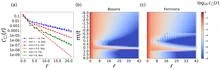
Traditional models of fundamental forces rely on fermions—particles that avoid their neighbors. An experiment with bosons, which, on the contrary, are drawn to each other, unexpectedly revealed a structure with perfectly alternating vortices. This discovery reduces computational costs and brings the
arXiv:2504.17000 · 2025-04-23

One-Way Door: How Quantum Magnets Reconcile Order with Chaos

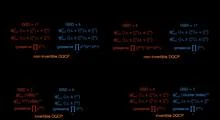
The study reveals an unusual transition in one-dimensional magnetic chains, where ordered and disordered states coexist. The key was nonreciprocal symmetries—rules with no reverse path, like a door that only opens one way. This allowed them to not only describe a single critical point but also gener
arXiv:2506.01131v1 · 2025-06-01

Quantum Chaos Accelerates Beyond the Limit

In some quantum systems, information spreads not gradually but like an avalanche. Additional symmetries act as 'super-spreaders' of rumors. This overturns previous ideas about the maximum speed of chaos and promises a breakthrough in quantum technologies.
arXiv:2506.01957v3 · 2025-06-02

Taming Quantum Chaos through Learning

To control many quantum particles, scientists used trial and error: a computer agent, seeing only part of what's happening, learned to limit the growth of connections between particles. Normally, these connections (entanglement) quickly fill all space, like chaos. But the agent places 'bottlenecks'
arXiv:2508.06612 · 2025-08-08

Spring Crystal: Giant Response Without Coils

Crystal Mn3Si2Te6, exposed to a magnetic field and a weak current, pushes back like a spring refusing to let the current change. Inside, microscopic whirlpools of electron flow rearrange in sync. This could miniaturize components for quantum electronics without tricky fabrication.
arXiv:2509.05492 · 2025-09-05

Math shuts the door on twin-particle quantum computers

Scientists have rigorously proven that special states in superconductors are not mysterious particles identical to their antiparticles, but ordinary electron blobs with charge. This negates the idea of using them for robust quantum computing via 'braiding'. Now physicists may have to revisit the the
arXiv:2509.09663 · 2025-09-11

Noise That Helps: A Quantum 'Pendulum' on a Chip

Scientists simulated a magnetic material with a kagome pattern on a quantum computer. They found that noise from extra qubits doesn't disrupt but actually prolongs periodic oscillations (a time crystal), and sometimes even creates them. This is a way to control quantum states using unavoidable error
arXiv:2510.13577 · 2025-10-15

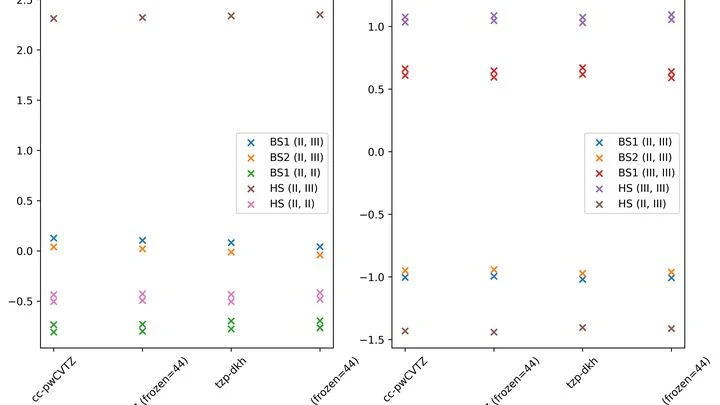
Quantum Computer Reveals Hidden Electron Pairs in Materials

Using a quantum computer, researchers simulated a material and for the first time observed how electron pairs form—the ones responsible for superconductivity. Previously they were only detected indirectly. The experiment proves that quantum machines bring us closer to superconductors that work witho
arXiv:2511.02125 · 2025-11-03

Trapped Particles on a Quantum Carpet

On a lattice that resembles a woven carpet, particles settle into entirely immobile states. Through quantum interference, they don't mix with their surroundings, like pulled-tight knots. These 'locked' particles are perfect candidates for ideal memory—and when pairs of them are looped around each ot
arXiv:2511.05105 · 2025-11-07

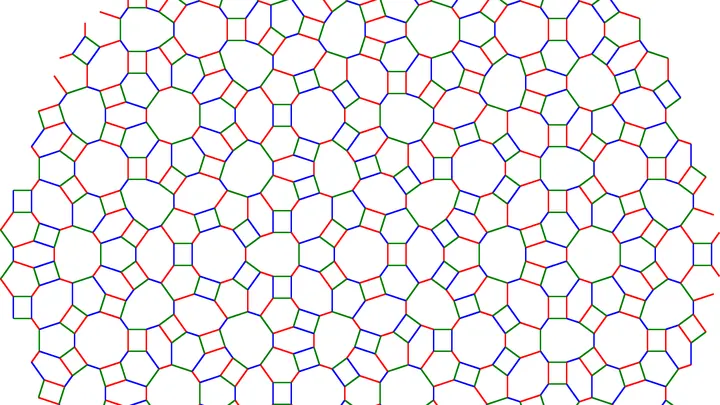
Magnetic Mosaic: How Non-Repeating Patterns Trap Tiny Quantum Waves

Scientists placed a model of a quantum spin liquid on a quasicrystal and found that a weak magnetic field forces anyons—particles with fractional charge—to move in closed loops or freeze entirely. This proves that geometric patterns can control exotic particles, promising for quantum computers.
arXiv:2511.17144 · 2025-11-21

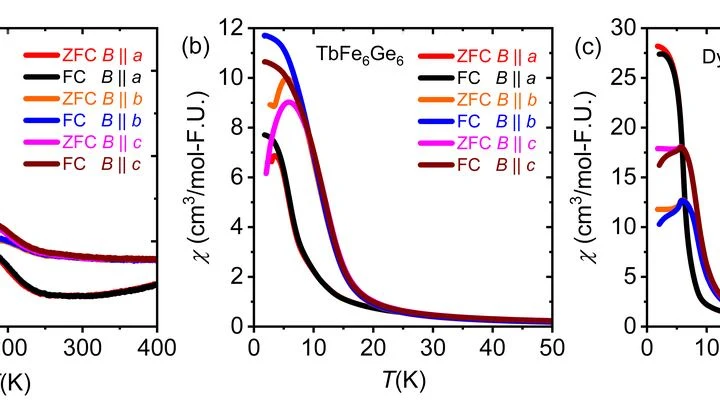
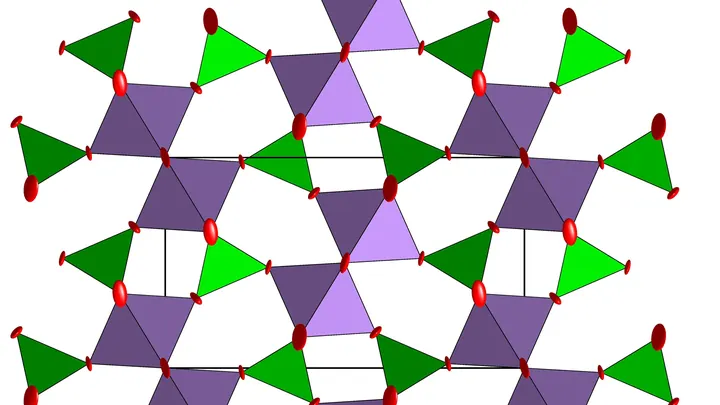
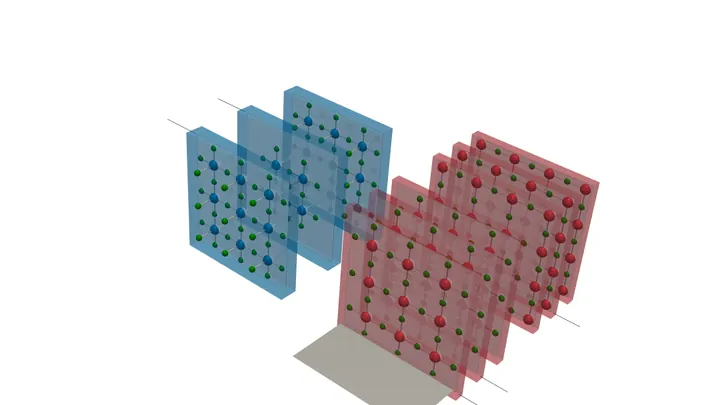
Magnetic Construction Set: Unexpected Flexibility of Atomic Layers

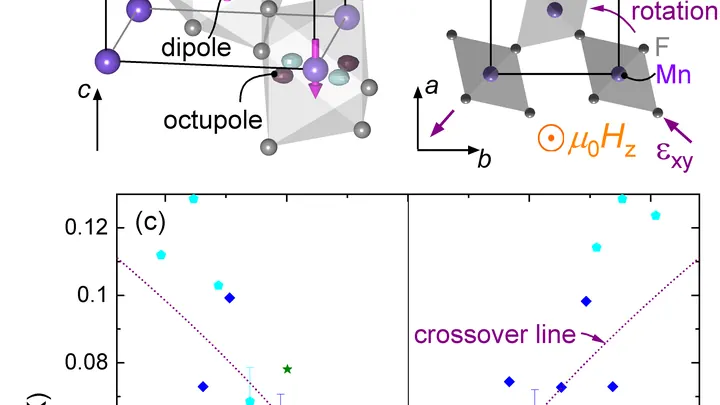
A magnetic material where layers are magnetized alternately, like a stack of pancakes. A tiny distortion of the triangular lattice (kagome) by germanium dumbbells makes flipping the whole layer energetically costly, while flipping a single chain is almost free. This opens the door to controlling mag
arXiv:2511.17398 · 2025-11-21

The Invisible Sea of Quantum Particles Has Taken Shape

What it's about: studying the shape of the Fermi sea — a state where particles, following the Pauli principle, fill energy levels like a fluid. What's new: for the first time, the Euler characteristic — a measure of through-holes in this structure — has been experimentally obtained. Why it matters:
arXiv:2511.23353 · 2025-11-28

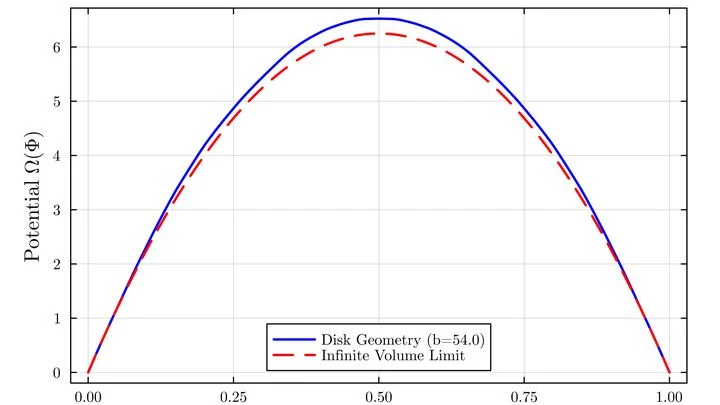
Why some bubbles grow and others collapse

Physicists modeled the behavior of true vacuum bubbles inside a false vacuum using a simplified particle system. It turned out that a bubble either expands indefinitely or collapses, depending on its initial size and the strength of internal bonds. A similar mechanism could have triggered the Big Ba
arXiv:2601.04305 · 2026-01-07

Quantum Particle Defies the Law of Friction

The experiment showed: contrary to theories, an impurity in a one-dimensional system moves without resistance. After a quick adjustment, the speed becomes constant, no energy is wasted. A breakthrough for quantum communication.
arXiv:2602.12320 · 2026-02-12

Quantum Soup of Atoms: A New View on Spin Liquid

Atoms were arranged in a honeycomb pattern, their interactions tuned, turning a magnetic crystal into a flowing, boiling broth. In this chaos, hidden order emerged: excitations race like light. Such a 'spin liquid' could become the foundation for future quantum computers.
arXiv:2602.14323 · 2026-02-15

How Bosons Help Superconductors Beat the Heat

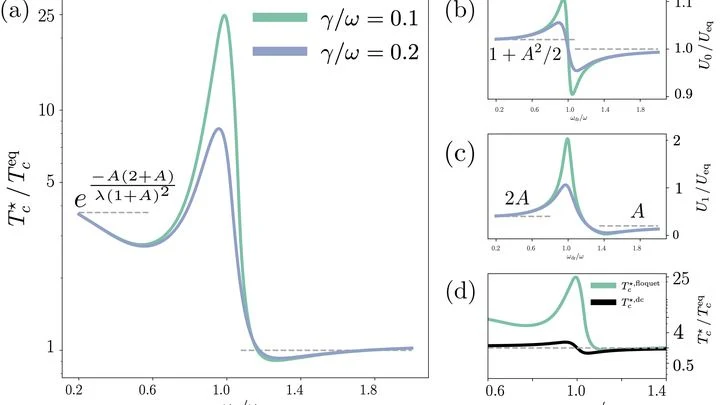
Adding bosons, nature's social particles, glues electrons into tighter pairs, so superconductivity survives at higher temperatures. The effect holds widely and could be tested with ultracold atoms and layered materials.
arXiv:2603.06796 · 2026-03-06

The Synchronous Dance of Quantum Tops

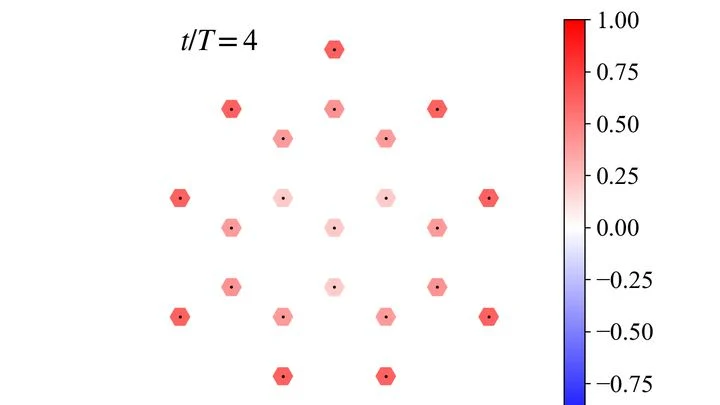
On an IBM quantum processor, scientists cyclically rotated 28 quantum tops. Without any external force, their spinning synchronized. A symmetry, like a hidden rule, protected this rhythm. With 156 tops, some synchronized while the rest spun chaotically—a quantum chimera paving the way to ultra-stabl
arXiv:2603.11910 · 2026-03-12

Quantum Particles Remember Their Past

Quantum systems usually quickly forget their initial state, but physicists found a way to slow this process. On an IBM processor, 144 qubits evolved for 5000 cycles, and entropy — a measure of disorder — grew so slowly it resembled a black hole evaporating in slow motion. This proves the ability to
arXiv:2603.12675 · 2026-03-13

Heat-Resistant Quantum Memory

Scientists have created a three-dimensional structure that, like a Russian doll, shields quantum information from thermal noise layer by layer. The qubit stays stable for a very long time, paving the way for quantum computers that operate without extreme cooling.
arXiv:2605.10943 · 2026-05-11

Time Crystals: The Eternal Timer of the Quantum World

About the work: Physicists explore time crystals — a state of matter that cyclically changes, even without energy input. What's new: A classification of these phases has been developed: discrete, continuous, and exotic — akin to different minerals. Why it matters: This will help purposefully create
arXiv:2605.27211 · 2026-05-26

A Trap for 11,000 Atoms: A Step Towards a Quantum Computer

Using a flat metasurface the size of a coin, replacing bulky lenses, scientists trapped 11,000 atoms for the first time. This breakthrough paves the way to quantum computers with tens of thousands of qubits, capable of solving problems beyond the reach of ordinary machines.
arXiv:2606.02715 · 2026-06-01

Noise Gives Birth to Quantum Order

Physicists have discovered that coordinated noise creates a stable pattern of particles moving strictly in one direction. It resembles a stadium wave frozen in one direction. The finding overturns the idea that interference always ruins quantum effects: noise can be the architect of order.
arXiv:2607.07801 · 2026-07-08