Eight-unit-cell modulation in cuprates is born from molecular orbitals ✛
Context
The pair density wave (PDW) has long been considered a key candidate for the primary order in cuprate superconductors. However, its nature has remained the subject of fierce debate: it is unclear whether it is a long-range order or a short-lived modulation, whether it is primary relative to other phases, and how it emerges upon doping a Mott insulator. This work is in line with studies where neighboring efforts examined quantum memory, superconducting pairs, and charge waves in superconductors, but this study stands out for directly observing 8a0 modulations over a wide energy range and in both phases, which allows linking them to local molecular orbitals.
Methods
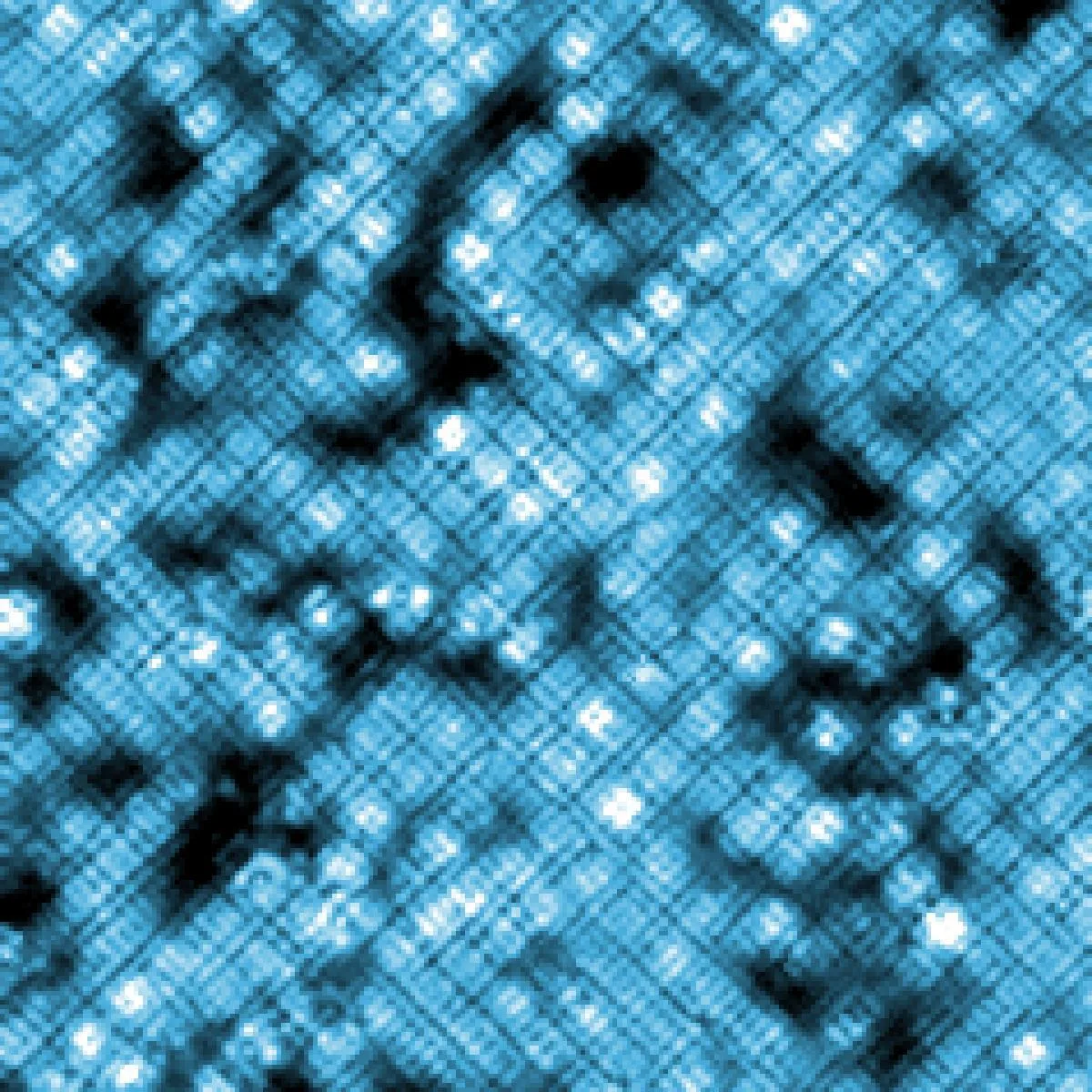
The researchers used spectroscopic scanning tunneling microscopy (STM) on alkali-doped Ca2CuO2Cl2 crystals with hole concentrations p = 0.10 (superconductor, Tc = 14 K), p = 0.05, and p = 0.03 (insulators). Maps of differential conductance dI/dV were measured at various bias voltages, giving the spatial distribution of the local density of electronic states. Fourier analysis of the maps was used to identify periodicities. In addition, a minimal model of rigid 4a0×4a0 plaquettes was constructed and Monte Carlo (MCMC) simulations were performed to test the mechanism behind the emergence of 8a0 modulations.
Results
In the superconducting sample (p = 0.10), dI/dV maps showed pronounced peaks in the Fourier spectrum at wave vectors q ≈ 1/4 and q ≈ 1/8 (in units of 2π/a0), corresponding to real-space modulations with periods of 4a0 and 8a0. The 8a0 modulation was observed over a wide energy range from 10 mV to 150 mV and appeared both in conductance maps and in maps of the depth and sharpness of the superconducting gap. In the insulating sample (p = 0.05), a clear 8a0 modulation was also found, and the spectra had a U-shaped gap, indicating no direct link to d-wave pairing. Analysis showed that the 8a0 periodicity arises from the alternation of bright 4a0×4a0 plaquettes and dark voids about 4a0 in size, which form when the surface is incompletely covered by doped holes. Monte Carlo simulations reproduced the observed Fourier peaks at q = 1/4 and q = 1/8, confirming that the 8a0 modulation is a spatial subharmonic of the plaquette order.
Implications
This work overturns the hierarchy of orders in cuprates. Unlike neighboring studies that focused on superconducting properties or charge waves, it shows that the fundamental building block is a molecular orbital measuring 4a0×4a0 and containing roughly two holes. The pair density wave with a period of 8a0 turns out not to be a primary order parameter but a secondary effect arising from the actual spatial arrangement of these blocks. This shifts the focus from momentum space to real space and offers a unified explanation for many observed modulations.
Future development
Further research could aim to directly confirm the molecular nature of the plaquettes using atomic-resolution methods such as high-resolution scanning tunneling spectroscopy or resonant inelastic X-ray scattering. It is also important to study how these molecular orbitals interact with magnetic excitations and how they evolve with changes in temperature and magnetic field. The discovery could stimulate theoretical work on constructing effective models in which the plaquettes act as quasiparticles.
Impact
The results will influence research on high-temperature superconductivity, the physics of strongly correlated electrons, and the development of new quantum materials. They may also be useful for interpreting neutron and X-ray scattering experiments in cuprates.
Next steps
The immediate next step will be a detailed comparison of the predictions of the molecular orbital model with data from other spectroscopic methods, such as ARPES and resonant inelastic X-ray scattering. It is also necessary to test the universality of the mechanism in other cuprate families.
Key open problems
This work is directly related to the unsolved problem of the origin of the pseudogap and the mechanism of high-temperature superconductivity. If molecular orbitals are indeed the elementary blocks, then understanding their formation and interaction could become the key to explaining the phase diagram of cuprates.
The knowledge machine's view
This section is addressed to the author of the paper and their colleagues. Neighbouring works were found by meaning-based search across our archive, not by word overlap. We do not review: we show the field around the work.
What the work does
The work shows that in Ca2CuO2Cl2, as it is doped from insulator to superconductor, modulations with a period of 8a0 appear, arising from the self-assembly of hole molecular orbitals into 4a0×4a0 plaquettes. Using STM and Fourier analysis, the authors detected 8a0 modulations over a wide energy range and in both phases, and Monte Carlo simulations confirmed that the 8a0 periodicity is a subharmonic of the plaquette order.
Where its strength is
The strength of the work lies in directly observing 8a0 modulations in both the superconducting and insulating phases and in establishing their connection to local molecular orbitals, which allows a rethinking of the hierarchy of orders in cuprates.
Where it could go next
- It might be interesting to compare the observed plaquette states with the mechanisms of superconductivity discussed in a neighboring work on the birth of superconductivity, to understand how local molecular orbitals relate to the formation of the global superconducting state.based on: How Superconductivity Is Born arXiv:2606.11056
- A nearby work on fractional charge from a quantum well could suggest how to view the 4a0×4a0 plaquettes in terms of fractional charges or topological defects, which might deepen our understanding of their role in the cuprate phase diagram.based on: Fractional Charge from a Quantum Well arXiv:2602.08468
- It would be interesting to look at the work on charge waves in superconductors, where modulations with different periods are discussed, to compare how 8a0 modulations relate to other types of charge or spin orders in cuprates.based on: Lone Electrons and Pairs with a Twist: A New Look at Superconductors arXiv:2604.16293
Worth trying
- Check whether the 4a0×4a0 plaquette order persists under changes in temperature or magnetic field, to reveal its connection to the pseudogap phase.
- Test the Fourier analysis method for STM maps to identify subharmonic modulations in other cuprate materials with different lattice symmetries.
- Use Monte Carlo simulations to study the influence of disorder on the formation of 8a0 modulations and their stability.
Why this may matter
If plaquette order is indeed a fundamental building block, this could change our understanding of the pseudogap phase and the mechanism of high-temperature superconductivity, opening new avenues for theoretical models and experimental searches.
Nearby works in our archive
- How Atoms Themselves Create a Mosaic That Never Repeatssimilarity 0.50
- Fractional Charge from a Quantum Wellsimilarity 0.49
- Crystals that absorb light backwardsimilarity 0.48
- How Superconductivity Is Bornsimilarity 0.48
- Terahertz resonator strengthens superconductivitysimilarity 0.48
- Cosmic Strings in a Nanocomposite: How to See the Echo of the Big Bangsimilarity 0.48
- Lone Electrons and Pairs with a Twist: A New Look at Superconductorssimilarity 0.47
The archive is sparse around this work: the closest review is only 0.50, against a usual 0.64. It looks like few have drilled nearby.
The 8a0 periodicity in cuprates was first noticed in vortex halos under a magnetic field, but now it has been detected without a field as well, and in an insulator, where superconductivity is entirely absent.
Key numbers
- modulation period: 8a0 (about 3.2 nm)
- plaquette size: 4a0×4a0 (about 1.6 nm)
- superconducting transition temperature: 14 K
- hole concentration in the superconductor: p = 0.10
- hole concentration in the insulator: p = 0.05 and p = 0.03