A unit cell is the smallest repeating structural unit of a crystal lattice that defines its periodicity. It is the fundamental building block of a crystal, and by repeating it in three dimensions, the entire crystal structure is generated. The unit cell is characterized by its lattice parameters—the lengths of its edges and the angles between them—and the arrangement of atoms within it.
History
The concept of the unit cell emerged in the early 20th century with the development of X-ray crystallography. Max von Laue's discovery of X-ray diffraction by crystals in 1912, and the subsequent work by William Henry Bragg and William Lawrence Bragg, established that crystals are periodic arrays of atoms, leading to the formalization of the unit cell as the repeating unit.
How it works
The unit cell acts as a template. The crystal is formed by translating this cell along three independent directions, filling space without gaps or overlaps. The choice of unit cell is not unique; any parallelepiped that tiles space can serve, but the conventional unit cell is chosen to reflect the symmetry of the crystal. The positions of atoms within the cell, along with the lattice translations, completely determine the crystal's structure and its properties, such as cleavage planes and X-ray diffraction patterns.
In practice
Unit cells are essential in materials science for designing new materials, understanding their mechanical and electronic properties, and in pharmaceutical development to determine the crystal structure of drug compounds.
Fun fact
The largest known unit cell in a naturally occurring mineral belongs to the mineral icosahedrite, a quasicrystal with a structure that does not repeat periodically, but its approximant crystal has a unit cell containing over 1,000 atoms.
At first glance, a city of blocks looks orderly, but its rhythm is set not by the streets themselves but by the houses that line them. In cuprates, layered copper oxides, a mysterious periodicity of eight unit cells (8a0) has long been observed, as if the streets were laid out with a spacing of 8.
The triptycene molecule resembles a three-pointed star with rigid arms. When such stars are scattered on a lead surface, they spontaneously assemble into a pattern like a woven basket: triangles and hexagons alternate, and at each node sits not one star but a pair.
A slice of eucalyptus a tenth of a millimeter thick is placed under a polarized light microscope, and the wood suddenly blooms: blue, yellow, and pink bands twist into spirals, forming rings and swirls. This is not paint but the play of light: the cellulose fibers that make up cell walls transmit light differently depending on their orientation.
Water in a glass looks continuous, but it's actually a dance of trillions of molecules constantly breaking and forming bonds. Seeing this dance in full detail was previously impossible: accurate calculations that account for the quantum properties of electrons could only handle tiny droplets of a few hundred atoms. The new model UBio-MolFM changes the game.
An orchestra of billions of cesium atoms struck a single note, and it sounded for 17 hours without fading. That’s no exaggeration: Chinese physicists created a continuous time crystal with a record-breaking lifespan. A time crystal is a system that breaks time symmetry, spontaneously pulsating in an unchanging rhythm.
Tile a floor with identical triangles, and you get a boring repeating pattern. But what if you want the pattern to never repeat, yet use just one tile? For a long time, mathematicians were sure it couldn't be done: you'd need at least two different shapes. The famous Penrose mosaic is a case in point: rhombi with acute and obtuse angles arrange into an infinitely varied but strictly ordered pattern.
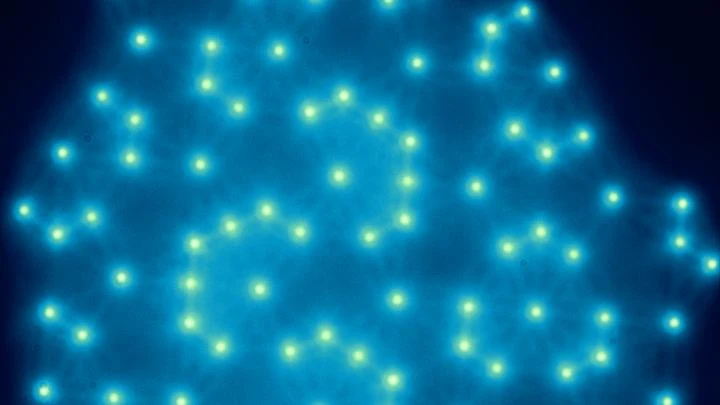
An optical tweezer is a laser beam that holds an atom in place, much like fingers holding a pea. Arrays of these tweezers form the basis of future quantum computers. But there's a catch: not every tweezer catches an atom. Typically, only half of the traps get filled, and for molecules, even fewer. Empty spots break the whole setup.
If you scatter seeds haphazardly, the seedlings will tangle into chaos. But if you lay them out in neat rows, the field will grow in an orderly fashion. A similar principle works with bacteria. Colonies of elongated cells usually churn with disordered flows, but scientists have found a way to impose order from the very start.
A crystal the size of half a matchbox was grown in a furnace, where a molten zone slowly crept along a rod, leaving perfectly ordered layers behind. Inside this crystal, copper ions sit at the nodes of a triangular lattice, but the triangles are slightly skewed, as if someone pressed on one corner. Each copper ion behaves like a tiny magnetic needle that can point up or down.
Neutrinos are the most elusive of all known particles. Every second, trillions of neutrinos from the Sun fly through your body, but you never notice: they barely interact with matter. To catch even one, physicists build giant detectors — pools of water or liquid argon deep underground.
A steel plate with an 8×8 grid of cells dampens elastic waves in two frequency corridors at once. This is not a lucky accident but the outcome of a calculation using a new scheme: first a coarse template for the low frequency, then fine-tuning within free pixels for the high frequency.