Electron Fluid in a Ring: How a Magnetic Field Reveals Viscosity ✛
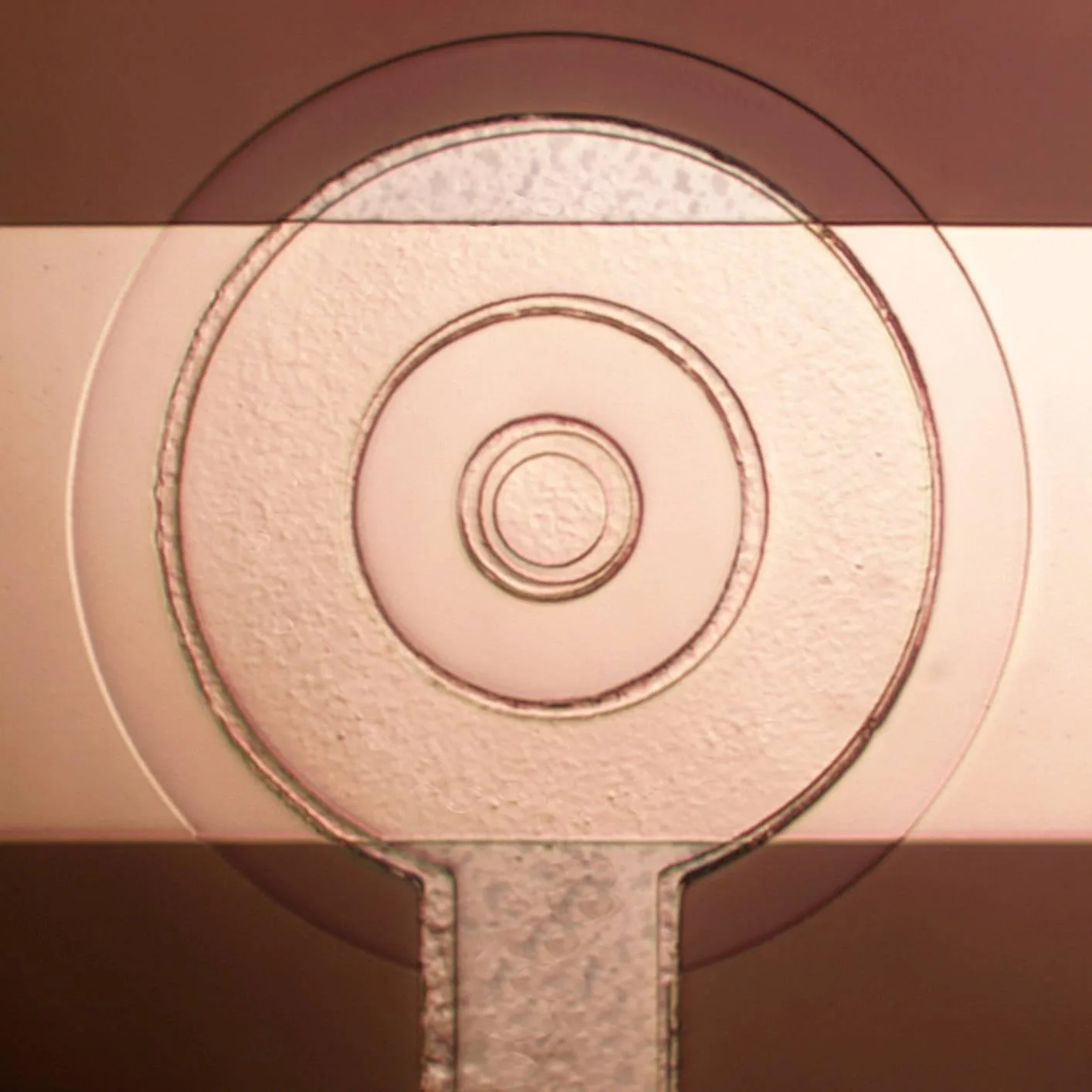
A ring-shaped channel of gallium arsenide is like a round pool with no rim: electrons flow in through the inner bank and out through the outer one. In an ultraclean material, they collide with each other more often than with lattice defects, and they begin to behave like a fluid. Turn on a magnetic field, and it swirls this flow, and the channel's resistance grows. What's more, it grows in proportion to the square of the field, and from this growth one can judge the viscosity of the electron fluid.
Researchers fabricated several rings with different outer radii and measured resistance at temperatures from 4.2 kelvin and above. It turned out that the coefficient in front of the square of the field grows with radius and falls with temperature. This is exactly what hydrodynamic theory predicts: in a larger ring, the fluid has more room to manifest viscosity, while on heating, electrons collide more often and viscosity decreases.
From the data, the researchers extracted a characteristic length at which viscosity becomes comparable to friction against the lattice. It decreased with temperature from several micrometers to fractions of a micrometer. This agrees with independent measurements on Hall bars, devices of a different shape, where the viscosity contribution is often masked by edge effects. In a ring-shaped channel there are no such edges, so the viscous response is seen in pure form.
So the ring-shaped channel has become a new tool for measuring the viscosity of the electron fluid. Previously, Hall bars were mainly used for this, but there the result depended on how electrons interact with the side walls. In a ring, this source of uncertainty disappears, and only the bulk flow remains. Now physicists can test theories of electron hydrodynamics on a cleaner platform.
The relative magnetoresistance in these devices reached $10^4$%, which means a hundredfold change in resistance in a field of just 0.2 T. By comparison, ordinary metals change their resistance by fractions of a percent in such fields.