Hydrodynamic Magnetoresistance in GaAs Corbino Disks ✛
Context
The hydrodynamic regime of electron transport arises when momentum-conserving electron-electron collisions occur more frequently than momentum-relaxing events. In this regime, the collective dynamics of carriers are described by equations similar to the Navier–Stokes equations for a fluid. Most experiments have been performed on Hall bars, where interpretation is complicated by the influence of side boundaries and unknown microscopic boundary conditions. The Corbino disk, which lacks extended side edges, offers a cleaner platform for studying the bulk hydrodynamic response. In a perpendicular magnetic field, viscous flow is converted into a measurable magnetoresistance, which makes the Corbino geometry attractive for testing hydrodynamic theories.
Methods
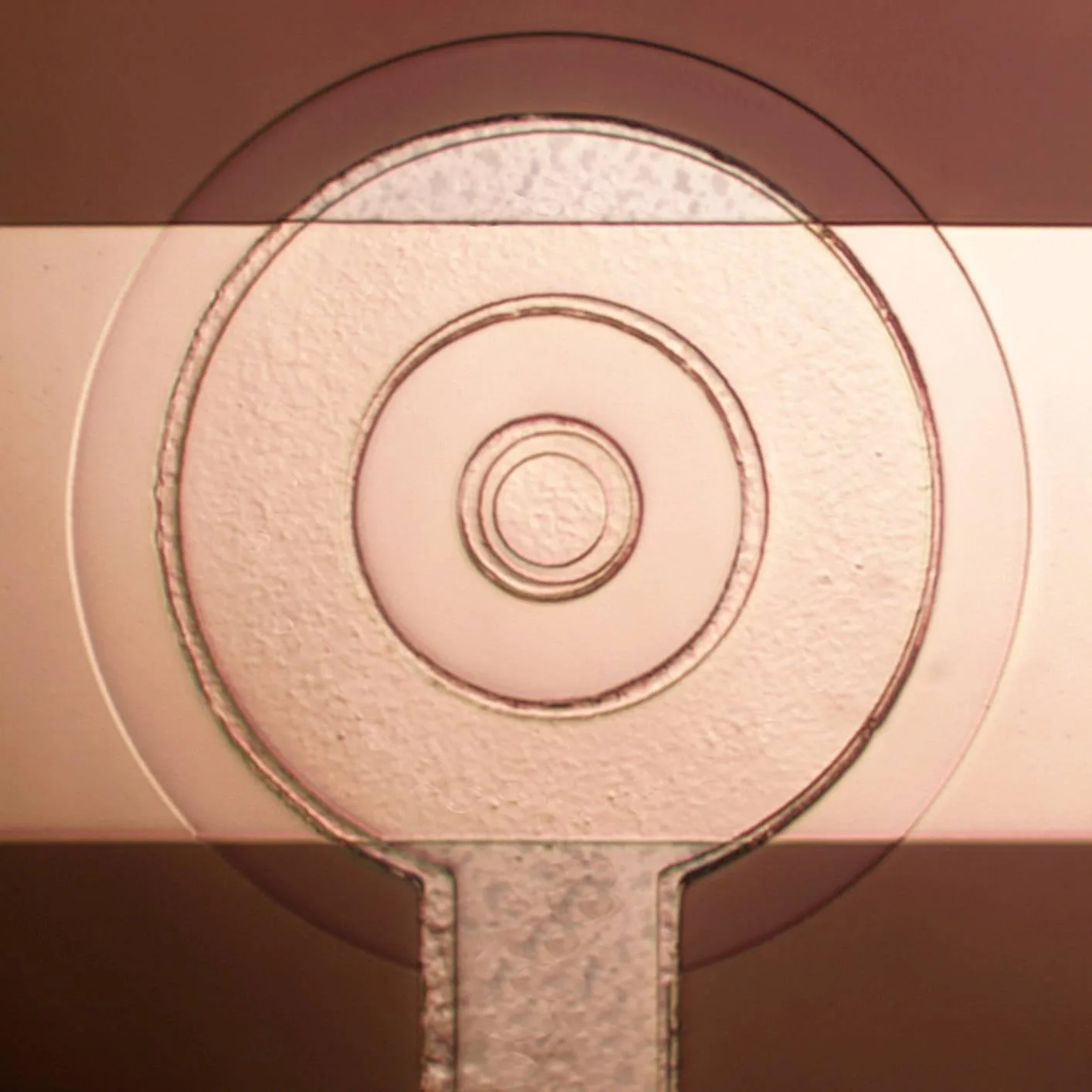
Corbino disks were fabricated from GaAs quantum wells 14 nm wide with an electron density of about 7.1×$10^{11}$ cm^-2 and a mobility of 2×$10^6$ cm^2/V·s at 4.2 K. The inner radius of all devices was 6 µm, while the outer radius varied: 11, 12, and 18 µm. Measurements were performed in a VTI cryostat at a constant current of 1 µA to avoid electron overheating. Resistance was measured as a function of magnetic field up to 0.2 T and temperature. Hall bars from the same wafer were used to independently determine the parameters of the two-dimensional electron gas. The data were analyzed within the Stokes–Ohm crossover theory extended to the case of finite slip at current-transmitting contacts.
Results
Positive magnetoresistance, strictly quadratic in the magnetic field, was observed in all devices: R(B)-R(0)=αB^2. The coefficient α decreased with increasing temperature and increased roughly linearly with the outer radius of the disk. The relative magnetoresistance reached $10^4$% compared with the intrinsic resistance of the two-dimensional gas. Analysis within the finite-slip Stokes–Ohm crossover allowed the Gurzhi length to be extracted; it decreased monotonically with temperature from several micrometers to submicron values. The relaxation rate of the second angular harmonic contained a contribution proportional to $T^2$, consistent with electron-electron scattering. The residual relaxation rate was comparable for different radii and of the same order as values obtained from Hall bars.
Implications
The work demonstrates that a Corbino disk can serve as a bulk-sensitive probe of viscous electron flow, complementing Hall bars. Unlike the Hall geometry, where the viscosity contribution is often masked by edge effects, the Corbino disk is dominated by the bulk hydrodynamic response. Finite slip at the contacts quantitatively modifies the Stokes–Ohm crossover, and the field-dependent jump in the electrochemical potential gives a separate correction. The agreement between different geometries and independent measurements on Hall bars confirms that the electron system is indeed in the hydrodynamic regime.
Future development
Further experiments on smaller and narrower Corbino structures should enhance sensitivity to boundary effects. Multi-contact Corbino devices could help separate the contribution of series contact resistance, provided that additional concentric interfaces are included in a multi-boundary hydrodynamic treatment. Developing the theory for the full crossover of the boundary contribution will allow more accurate extraction of viscous parameters. Exploring other materials, such as graphene, where the hydrodynamic regime is reached at higher temperatures, is also promising.
Impact
The results are important for the physics of mesoscopic systems and electron hydrodynamics. They provide a new tool for measuring the viscosity of the electron fluid in semiconductor heterostructures.
Next steps
The next step could be the fabrication of Corbino disks with smaller radii and a multi-contact configuration for direct measurement of viscous stresses. It would also be useful to perform similar measurements in graphene, where hydrodynamic effects manifest at room temperature.
Key open problems
The work links the observed magnetoresistance to the fundamental problem of determining the viscosity of the electron fluid in a solid. It clarifies the role of boundary conditions at current-transmitting contacts, which remains an open question in electron hydrodynamics.
The knowledge machine's view
This section is addressed to the author of the paper and their colleagues. Neighbouring works were found by meaning-based search across our archive, not by word overlap. We do not review: we show the field around the work.
What the work does
The work fabricated Corbino disks from high-mobility GaAs quantum wells and measured a positive magnetoresistance that is quadratic in the perpendicular magnetic field. The data were analyzed within the framework of the Stokes–Ohm crossover hydrodynamic theory with finite-slip boundary conditions at current-permeable contacts, which made it possible to extract the viscous relaxation parameters and their temperature dependence.
Where its strength is
The strength of the work lies in the clean Corbino geometry, which eliminates the influence of side boundaries and allows the bulk hydrodynamic response to be isolated, as well as in the quantitative account of finite slip at the contacts, which makes the analysis more accurate compared with Hall bars.
Where it could go next
- It might be interesting to see how nonlinear effects analogous to turbulence in classical fluids manifest themselves in this geometry. A nearby paper in the archive deals with electron vortices in a semiconductor, where vortex motion is studied that could also be observed in the Corbino disk at large currents.based on: Electron Whirlpools in a Semiconductor arXiv:2604.27860
- Another direction could be studying the role of electron-phonon interaction at elevated temperatures, where the hydrodynamic regime gives way to the ballistic one. A neighboring work examines how the electron liquid heats up and changes its viscosity, which could help interpret the temperature dependence of the Gurzhi length in your data.based on: Electron liquid heats up and thickens arXiv:2603.21346
- It could also be productive to consider the influence of the contact microstructure on the boundary conditions. The archive contains a paper on the quantum 'chef' and the superfluidity of the Hall effect, where unconventional boundary conditions for the electron liquid are discussed, which could provide ideas for controlling slip in the Corbino disk.based on: The Quantum 'Cook': Superfluidity of the Quantum Hall Effect arXiv:2603.05341
Worth trying
- Try increasing the current through the disk to check whether deviations from the quadratic law appear because of nonlinear hydrodynamic effects.
- Perform measurements at higher temperatures and compare the temperature dependence of viscosity with predictions for electron-phonon scattering.
- Study how modifying the shape or material of the contacts changes the slip length and, consequently, the magnetoresistance.
Why this may matter
Developing these directions could broaden the applicability of the hydrodynamic description of electron transport in semiconductor structures and offer new ways to control viscous flow, which matters for future electronic devices that exploit collective effects.
Nearby works in our archive
- Electron Whirlpools in a Semiconductorsimilarity 0.58
- The Quantum 'Cook': Superfluidity of the Quantum Hall Effectsimilarity 0.53
- Electronic Vortices Sang on Nanostringssimilarity 0.51
- Magnetic Patterns Visible Only Up Closesimilarity 0.50
- Electron liquid heats up and thickenssimilarity 0.50
- Pressure Separates Superconductivity and Charge Ordersimilarity 0.50
The archive is sparse around this work: the closest review is only 0.58, against a usual 0.64. It looks like few have drilled nearby.
The relative magnetoresistance in these devices reached $10^4$%, which means a hundredfold change in resistance in a field of just 0.2 T. By comparison, ordinary metals change their resistance by fractions of a percent in such fields.
Key numbers
- mobility: 2×106 cm^2/V·s at 4.2 K
- electron density: 7.1×1011 cm^-2
- outer radii: 11, 12, and 18 µm
- magnetic field: up to 0.2 T
- slip length: about 4 µm