Gallium arsenide (GaAs) is a compound semiconductor formed by equal parts gallium and arsenic. Unlike silicon, which dominates the electronics industry, GaAs offers far higher electron mobility, meaning electrons can move through it faster. This makes it the material of choice for high-speed electronics, such as the transistors in mobile phone amplifiers and satellite communications, and for photonic devices like laser diodes and light-emitting diodes (LEDs).
History
Gallium arsenide was first synthesized and studied in the 1950s, with early work at institutions like Bell Labs and RCA. Its potential for high-frequency and optoelectronic applications was recognized quickly, and by the 1960s, GaAs laser diodes were demonstrated.
How it works
In GaAs, the crystal lattice is a zinc-blende structure, where each gallium atom bonds with four arsenic atoms. The key advantage is its direct band gap: when an electron drops from the conduction band to the valence band, it can emit a photon directly. In silicon, this transition is indirect, requiring a phonon (lattice vibration) to conserve momentum, making light emission highly inefficient. GaAs's direct gap allows efficient conversion of electrical current into light, and vice versa, enabling lasers and photodetectors.
In practice
GaAs is used in high-frequency radar systems, smartphone power amplifiers, laser pointers, and the infrared LEDs in optical mice and remote controls. It also underpins the photodetectors in fiber-optic communication networks.
Fun fact
GaAs solar cells are so efficient that they are used on nearly all spacecraft, including the Mars rovers, despite being more expensive than silicon cells.
You can make light turn on command, like water in a hose — if you know where to squeeze. That's what electro-optic circuits do: they change the direction of a beam inside a chip using an electric field. The classic material for such tricks is lithium niobate, a crystal that responds to voltage like a string to a pluck.
A bridge where pedestrians and cyclists flow together without getting in each other's way. That's roughly how hybrid systems of superconductors and semiconductors work: the former carry current without loss, the latter control that current.
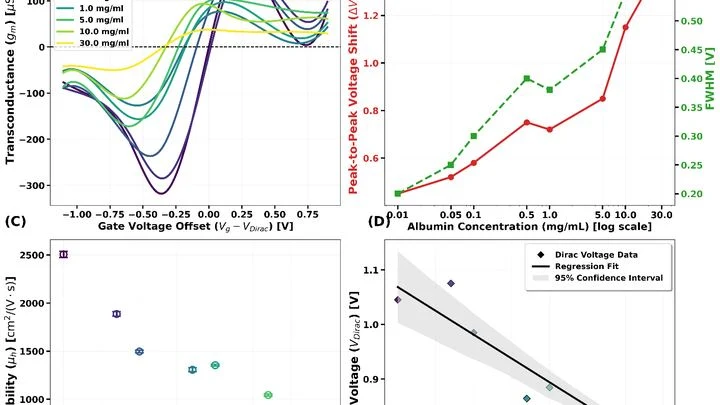
In a drop of blood float millions of albumin molecules — the main transport protein. Its level drops in kidney and liver diseases, so doctors need a fast and accurate way to measure it. Engineers have proposed a detector the size of a dust particle: a graphene transistor that works directly in liquid.
Graphene is a sheet of carbon one atom thick.
In absolute silence, you need to hear a feather drop. But someone keeps rustling a plastic bag. For the space-based LISA observatory, that 'rustling' will come from charged particles in space.
A quantum computer is like an orchestra where every musician must play their part without missing a beat. The musicians are qubits — carriers of quantum information. For the orchestra to sound harmonious, you need qubits that are reliable, controllable, and not too sensitive to noise.
A factory laser that cuts and welds metal on production lines has been made to work as a particle accelerator for the first time. Physicists took a standard ytterbium laser, its heart is a crystal the size of a palm, and turned its flashes into a tool for accelerating electrons to nearly the speed of light.
In an oven, a huge loaf of bread is baking. Inside the dough, there is a tiny, hottest spot: that's where the future loaf begins to rise. A hot molecular core (a region the size of the Solar System, where gas is heated to hundreds of degrees and compressed to billions of times the density of ordinary clouds) works in much the same way.
River water often swirls into funnels. But in semiconductors, the foundation of microchips, electrons at low temperatures and high purity also turn into a fluid. If you create a circular cavity, vortices appear, just like in a river backwater.
An alpha particle is a helium nucleus that flies out when heavy atoms decay. When it hits a gallium nitride crystal, it deposits its energy and creates an electrical pulse. The pulse height tells you how much energy the particle had.
A mosaic floor made of many small tiles, each turned in a different direction. It seems that any pattern trying to cross such a floor would get scrambled and vanish. That's how people usually think about disorder in crystals: if atoms aren't arranged in a perfect lattice, delicate quantum effects should fall apart.
A silicon wafer as thin as half a human hair catches a passing particle the way a palm catches a raindrop. But if that drop is a proton accelerated to enormous energy, the palm can get burned. Inside the detector, an avalanche of charge is born, and sometimes it's enough to burn a microscopic hole. This is called single-event burnout.
An ordinary transistor in a phone is made in a vacuum chamber, where atoms are deposited layer by layer. Expensive and slow. But indium oxide can be printed like ink — from a drop of liquid metal that, in air, coats itself with a thin oxide film.
The authors took indium, melted it, and rolled it over a substrate at 250 degrees.
Dirty water laced with antibiotics isn't just waste: it's a hidden energy source. Chemists built a material from two components: titanium oxide nanorods (the white pigment in paints and sunscreens) and carbon nitride nanosheets.
A rug lies flat, but if you push it from the edge, wrinkles run across it. In a thin film of tantalum sulfide (1T-TaS2), wrinkles made of electrons, charge waves, freeze as if the rug were stuck to the floor. To move them, you need to apply force. Scientists have found a way to control this force using an electric field and a magnet.
A conventional graphite anode in a sodium battery is like a cramped garage that barely fits a large truck. Sodium is larger than lithium and doesn't fit well between graphite layers, so batteries quickly lose capacity.
A film as thin as a spider's web, made of five metals, took the hit from a laser. Inside, the pressure soared to 55 gigapascals — imagine a hundred elephants balanced on your thumbnail. The alloy withstood it, compressing for a fraction of a nanosecond without breaking.
One gigapascal is a thousand megapascals.
A piece of silver antimony telluride is like a sponge: it readily soaks up heat and turns it into electricity. Such materials are called thermoelectrics, and they already work in space probes and car refrigerators. But if you squeeze this sponge, it starts behaving like a superconductor — current flows with zero resistance.
Physicists trapped a cloud of lithium atoms between mirrors. Light bounces inside, like in an echo chamber, forcing the atoms to emit synchronously — resulting in superradiance, akin to a choir where voices merge into a single thunder. Like a stadium chanting in unison: each whisper turns into a deafening rhythm. The secret is density.
The microchips inside smartphones and computers are getting denser: billions of transistors are packed onto a sliver of silicon the size of a fingernail. When they work, they give off heat like tiny stoves. If that heat isn't drawn away, the chip overheats, starts glitching, or fails outright.
A sharp tug on a twisted cord sends a spiral wave along it. Similarly, an ultrashort laser flash in a RhSi crystal gives birth to light instantly twisted into a three-dimensional corkscrew.
A quantum computer is like an orchestra where every musician must come in exactly on the beat. The faintest rustle in the hall throws off the violinist, and the melody falls apart. In silicon chips, that rustle is electrical noise: random fluctuations of charge inside the material. They make quantum bits err.
When treating epilepsy, doctors adjust the drug dose almost blindly. Too little, and seizures continue; too much, and side effects appear. Usually, a patient's blood is sent to a lab, and the result comes back a day or two later. Now, the same test can be done on a tiny silicon chip.
The sensor works like a highly sensitive nose.
Sound on a crystal surface is like ripples on water, but traveling through a solid. This ripple is called a surface acoustic wave: it moves a hundred thousand times slower than light, so it can be compressed into very short segments and fit on a tiny chip. Usually, such waves are launched by metallic combs made of aluminum or gold.
The layered material (SnS)1.15(TaS2) resembles a stack of paper, where the sheets conduct electricity and the interlayers prevent them from sticking together. At ambient pressure, this material conducts current without resistance, making it a superconductor.
An ordinary piece of semiconductor weakly changes the color of light passing through it. For decades, physicists worked around this limitation by placing the crystal in clever surroundings, but the material itself remained the same.
Now researchers have assembled a "sandwich" of alternating thin layers of gallium arsenide and aluminum gallium arsenide.
A quantum bit is like a spinning top that must keep spinning steadily for a long time. In germanium, researchers have learned to set such tops spinning, but the floor around them is always trembling: electrical noise knocks the spin off course.
A blazing furnace in a workshop or the hot exhaust of a turbine is not just heat: it's light, invisible to the human eye. Regular solar panels catch visible light, but here you need a receiver for invisible thermal radiation.
A crystal is like a perfectly laid mosaic of atoms. But growing such a mosaic is a tricky task: if the order slips even slightly, 'seams' appear — boundaries where rows of atoms don't align. For ordinary electronics, that's a minor issue, but for a quantum computer, it's a disaster.
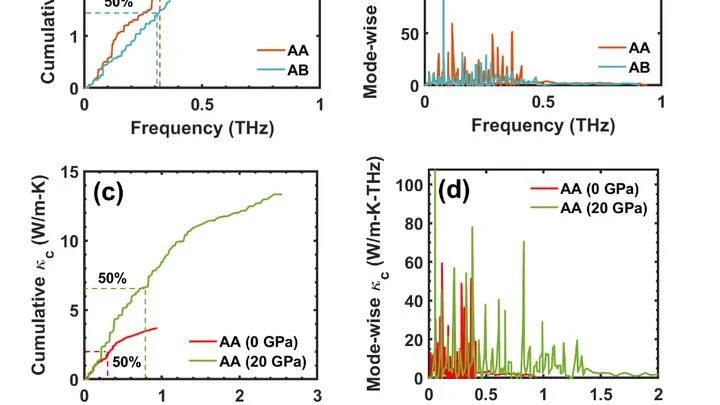
Heat dissipates poorly in thin layered materials, like a crowd in a narrow corridor. In ReS2 crystals, layers lie on top of each other, and heat can travel across them. Scientists measured how quickly this happens and found a surprise: when the layers are stacked directly one above the other, heat passes almost twice as fast as when they are shifted.
Sunlight hits a rooftop, and electrons are born in a thin film. They must reach the wires before they cool down and lose their energy. In tin sulfide, a cheap and accessible material for batteries, this sprint and cooldown has now been captured with unprecedented sharpness: frames follow every billionth of a billionth of a second.
An X-ray photon hits the detector like a pebble dropping into still water. The water is a thin film of aluminum and manganese, cooled to near absolute zero. The impact sends a heat wave rippling across the film, and by measuring its height, you can tell how much energy the photon carried.
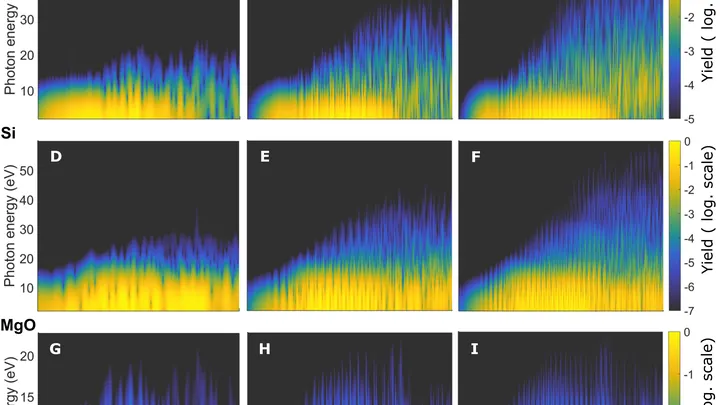
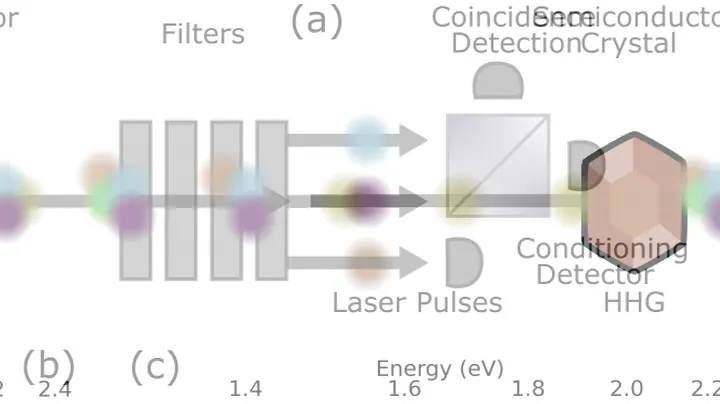
A powerful laser strikes a semiconductor, and it responds with light at many frequencies, like a string sounding a chorus of overtones. Previously, this was used in spectroscopy to observe ultrafast processes. But now physicists have noticed: the overtones are not independent; they behave as if connected by invisible threads.
Lithium in a battery sometimes behaves like ivy on a building facade: instead of a uniform layer, it sprouts thin, sharp tendrils. These needles can pierce the separator inside the battery and cause a short circuit. So engineers are looking for ways to make lithium grow calmly.
One trick they've found is to put a thin silver film under the lithium.
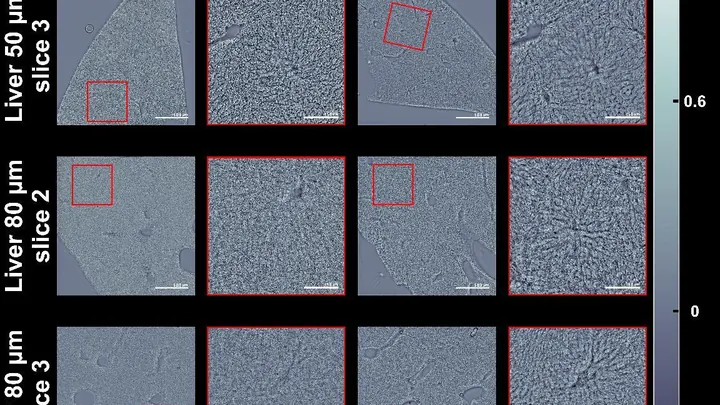
A thick slice of tissue under a microscope looks like fogged glass: light scatters and details are lost. Usually, to see cells, you stain them or cut them into very thin slices. But there's a simpler way — make the slice itself transparent, as if you've wiped the glass clean.
In the crystal lattice of iron selenide, iron and selenium atoms alternate like bricks in a wall. But sometimes extra iron atoms sneak into the voids between them, like uninvited guests squeezing into the gaps between bricks.
A graphene ribbon nine atoms wide is like a track where electrons race, as water rushes down a narrow trough. Gamma radiation is a stream of particles with enormous energy, capable of punching through metal and plastic.
Graphene is a carbon sheet just one atom thick, a fantastic conductor. But its surface is crinkly, like a wrinkled tablecloth that hasn't been ironed. Scientists built a 'sandwich': two of these sheets pressed together with a non-conductive spacer in between. They iron out each other's folds, like two halves of a sandwich making the surface perfectly even.
Imagine a superhighway where cars zoom along with barely a slowdown: that's what a layer of ultraclean semiconductor looks like, where electrons travel vast distances without a single collision. Scientists have built a transistor in which electrons run twice as fast as in any similar device before.
Light passing through a window pane refracts the same in all directions. But in thin layered crystals, it's a different story: light traveling along the layers sees the material differently than light traveling across them. It's as if a sheet of paper were transparent but transmitted light differently along and across its fibers.