Semiconducting nanostructures: quantum dots, wires, and wells. Single electronics, spintronics, 2d electron gases, quantum Hall effect, nanotubes, graphene, plasmonic nanostructures.
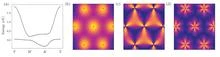
Using spectroscopy, like a probe feeling the electron clouds, physicists discovered: at one energy electrons sit on atoms, at another — in between. This means the internal structure of the material is more complex than a simple model, and such knowledge will help create quantum devices.
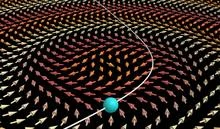
A hybrid quantum system has been proposed, combining long-lived spin memory, a fast superconducting processor, and a topologically protected mediator — a magnetic skyrmion. Its oscillations bridge the atomic world of defects with macroscopic circuits, overcoming the scale chasm. Calculations promise
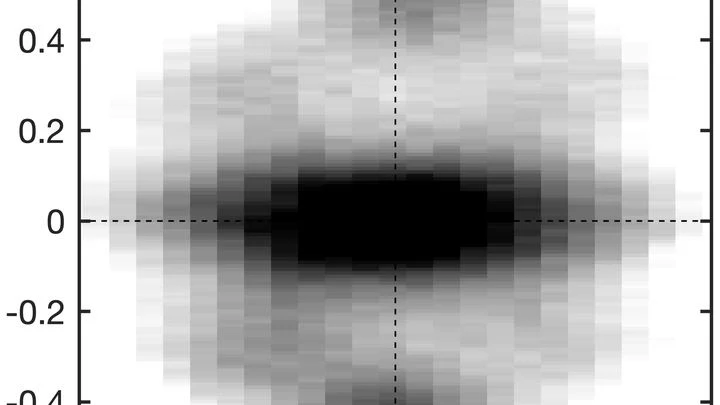
Usually, nonclassical states of motion require clever tricks. But new research reveals that the intrinsic nonlinearity of an optical trap itself sculpts quantum 'ghosts' from mechanical vibrations — states with a negative Wigner function. No probabilistic schemes needed, even in unresolved sidebands
Some materials conduct electricity only along their edges. Laser irradiation causes these edge paths to twist into a quantum Möbius strip—a noise-resistant foundation for future quantum computers.
Physicists have created an 'anti-qubit' — a quantum bit that evolves backward, like a film in reverse. Paired with an ordinary qubit, it becomes a gold standard sensor that even picks up the hidden direction of weak fields.
Scientists have theoretically shown that in materials with a specific pattern of electron spins, an effect similar to gravitational lensing arises. Electrons are deflected and focused without a magnetic field. This opens the possibility of studying cosmic phenomena in miniature and creating new type
The idea that light between mirrors behaves like a pair of tuning forks fails for flat systems. A new theory accounts for any shape and accurately predicts how light will bounce around inside. This paves the way for sensitive sensors and more powerful lasers.
Inside a mirror trap, light binds two magnetic nanoscale strings into a single quantum object. The pressure of light synchronizes their vibrations, creating entanglement that doesn't break even at a surprisingly high temperature — a few thousandths of a degree above absolute zero. This is an order o
Superconductors typically lose their properties in a strong magnetic field due to the Pauli limit. However, for layered PdTe₂, this limit depends on thickness. Reducing the sample from 50 to 19 nm boosted the critical field tenfold. The reason: quantum confinement forces electrons to react different
Physicists have found a way to entangle two microscopic defects in diamond simply by heating them. Usually heat destroys everything, but here it establishes quantum order instead. The secret is to make the environment behave like a crowd with uneven rules, which synchronizes the defects. This method
Using NV centers—glowing defects in diamond—scientists directly captured the mutual influence of spins. Reducing measurement noise paves the way for ultrasensitive quantum sensors.
Scientists have created a detector that catches axions—candidates for dark matter. The device, made of layered material in a magnetic field, turns axions into light particles. Resonance, like that of a musical instrument, amplifies the faint signal, and tilting instead of moving parts lets you tune
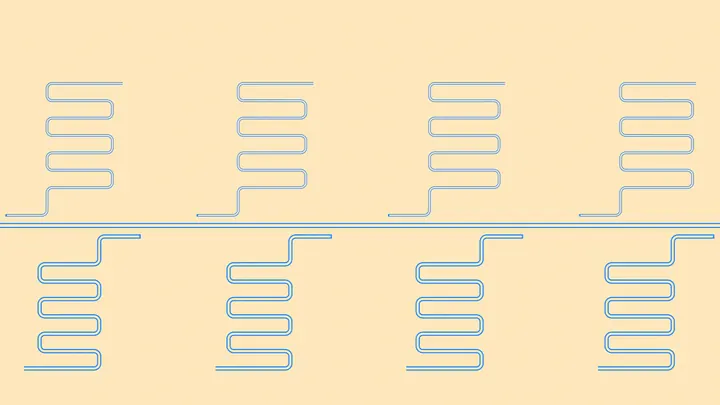
A device was built where a single electron on a helium film and a superconducting resonator exchange energy faster than quantum properties decay. This allows reading the electron’s state without destroying it—a crucial step toward quantum computers.
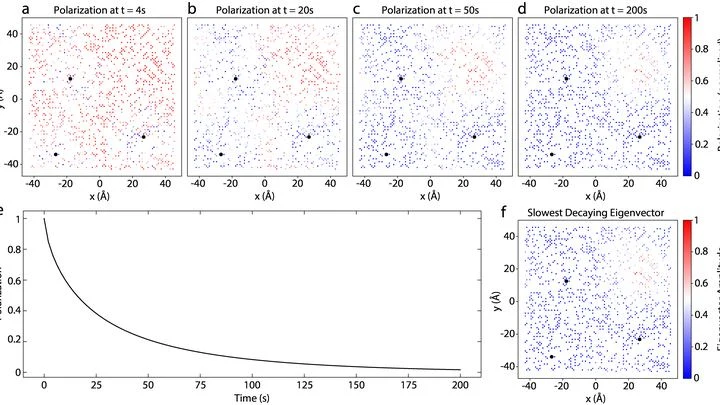
In a foil-like layer of boron nitride, an electron and a carbon atom's nucleus became partners in a quantum dance. Their bond held at room temperature—previously only possible in ultra-cold setups. This breakthrough promises compact quantum devices and ultra-sensitive sensors.
Ordinary detectors can't sense microwave photons—their energy is vanishingly small. A new superconducting device triggers an avalanche: one photon spawns dozens more, amplifying the signal and separating it from noise. This method paves the way for quantum networks and studying the echo of the Big B
Scientists grow smooth layers of frozen neon and check them with microwave sensors. A brief warm-up to 12 K makes the film uniform, allowing electrons to levitate over it as low-error qubits. This simple method paves the way for reliable quantum processors.
A quantum particle can seep through an energy barrier even if it lacks the strength to jump over it. If you place a detector right on the barrier, the very act of detecting the particle nudges it, taking away or adding energy. Thus, a microscopic engine emerges, running solely on observation—without
Ordinary particles don't change when swapped. But there are special 'knotty' ones that remember the path. For twenty years, scientists hunted for a variety called Majorana zero modes, crucial for quantum computing. In a new experiment on a microdevice, they performed a swap for the first time, confi
A magnetic material has been discovered where electron spins arrange into ripples due to relativistic effects. This brings spintronics — spin-based electronics — closer to reality.
The experiment showed that a single electron in a diamond can act as both a motor and a battery when charged with a quantum rhythm. After a few cycles, it produced almost double the work compared to its classical heat-based counterpart. This achievement brings us closer to an era of nanomachines ope
Scientists found that crystal imperfections help store quantum information longer. Experiments on diamond showed: chaos creates isolated pockets where fragile states live hundreds of times longer. This opens the way to reliable quantum storage media.
What it's about: studying the shape of the Fermi sea — a state where particles, following the Pauli principle, fill energy levels like a fluid. What's new: for the first time, the Euler characteristic — a measure of through-holes in this structure — has been experimentally obtained. Why it matters:
Scientists have shown that supersolidity—a symbiosis of solid order and liquid flow—can arise from ripples at the boundary between a liquid and a substrate. No need to chemically alter the medium; just the right container size is enough. This opens the door to materials with a solid shell and a flui
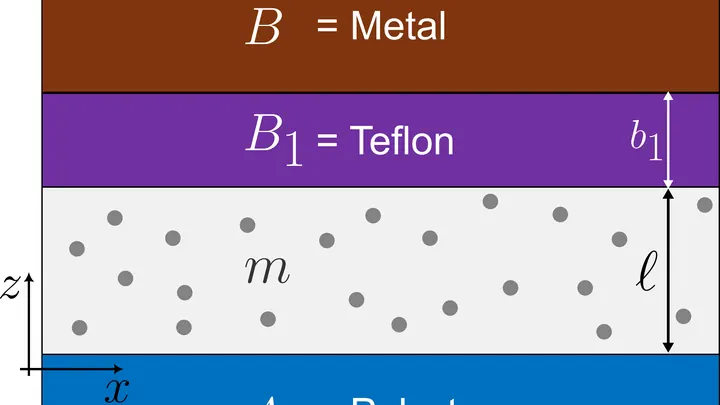
The Casimir effect makes surfaces stick together like quantum glue. But scientists have turned it into a force that holds a plate in the air without support. By placing an object over Teflon and adding a magnetic fluid, they learned to control the quantum field. This discovery eliminates friction an
Normally, rotation in a vacuum requires an asymmetric shape or a special material. But new research shows that a magnetic field and special magnets can induce rotation without any asymmetry. This paves the way for contactless nanomotors.
Superconductivity arises when the electron 'sheet' in a metal is so soft that it ripples and nudges electrons along. All metals fall into three classes based on the stiffness of this sheet. For the first time, this new approach explains why gold and copper don't superconduct, and it promises a targe
Two sheets of graphene, pressed together through an ultra-thin spacer thinner than a human hair, work like a pair of mutual ironing boards: each layer smoothes out the other's bumps. Under these ideal conditions, electrons become incredibly light, and quantum marvels—like the fractional quantum Hall
Gold and silver don't superconduct—until you make them thousands of times thinner than a human hair. Quantum effects in a two-dimensional layer change electron behavior: calculations show that at a thickness of about half a nanometer, resistance vanishes. This could enable electronics that don't hea
Adding bosons, nature's social particles, glues electrons into tighter pairs, so superconductivity survives at higher temperatures. The effect holds widely and could be tested with ultracold atoms and layered materials.
The quantum battery works like a sponge for light: it soaks up energy and doesn't release it without a forced squeeze. The idea is borrowed from bacteria, whose light traps transfer sunlight with almost no loss. Atoms arranged in a ring and placed inside a mirrored cavity create a one-way energy flo
Normally, electrons and photons cannot spontaneously organize. But if a thin layer of electrons is subjected to a pulsing magnetic field, they start to 'dance' in resonance with light inside a special cavity. A new phase emerges where particles and radiation merge into one, paving the way for lossle
Klein's paradox about the birth of particles from emptiness gets a simple explanation: a tightly stretched rubber band snaps, creating whirls — a particle and an antiparticle. This image makes it clear that pair creation is the medium's reaction to extreme stress.
The boundaries between magnetized regions can be moved like a wave through a row of dominoes. These mobile walls are perfect candidates for quantum bits: they carry information while dodging interference and could lead to compact devices that don't need ultra-low temperatures.
Physicists have developed a method to make thorium nuclei emit light signals with record stability. The key element is a crystalline cavity that amplifies light, greatly simplifying the excitation of nuclei with a laser. For the first time, a roadmap for creating all-solid-state nuclear clocks on a
Gravitons — the quanta of gravity — split into two streams in curved spacetime depending on their spin. The effect, discovered by Michael Berry, causes particles with right- and left-handed spin to move in opposite directions, and for gravitons it is twice as strong as for light due to their double
A microscopic system, resembling a particle counter, was made to oscillate in sync with an external signal. This synchronization proved remarkably reliable: rhythm slips become exponentially rare. It's a pathway to ultra-precise quantum clocks and sensors.
A diamond plate with magnetic particles on DNA strands analyzes liquid by the trembling of particles. Their movement changes with thickness and composition: in syrup—slow, in alcohol—fast. The diamond reads the magnetic echo and creates a precise portrait of the liquid—no reagents, no waiting.
Physicists have discovered that coordinated noise creates a stable pattern of particles moving strictly in one direction. It resembles a stadium wave frozen in one direction. The finding overturns the idea that interference always ruins quantum effects: noise can be the architect of order.