The magnetic field is a vector field that manifests through force on moving charges and magnetized bodies. In classical electrodynamics its measure is the magnetic induction B. The sources of the field are electric currents and changing electric fields (Maxwell's equations). The field lines are always closed: no magnetic monopoles have been found in nature. Materials react differently to the field: paramagnets (aluminum) slightly enhance it, diamagnets (water) repel it, and ferromagnets (iron) create a huge intrinsic field due to parallel alignment of electron spins. Earth's magnetic field (~50 µT) deflects the solar wind to the poles, generating auroras; without it the atmosphere would be swept into space.
History
William Gilbert published the first scientific treatise on magnets in 1600, proposing that Earth is a large magnet. Hans Christian Ørsted discovered the magnetic effect of an electric current in 1820. André-Marie Ampère promptly built a mathematical theory. Michael Faraday introduced the concept of lines of force. James Clerk Maxwell in the 1860s created a complete classical theory of the electromagnetic field, predicting light as a wave. Hendrik Lorentz later derived the force acting on a charge in a field. Quantum magnetism arose from the works of Pauli (spin-statistics theorem), Heisenberg (exchange interaction), and Dirac (equation with magnetic moment). Today, magnetic field research extends from cosmology to quantum computers.
How it works
The magnetic field is generated by conduction currents and displacement currents: the Ampère–Maxwell equation ∇ × H = j + ∂D/∂t. The Biot–Savart law gives the field of a current element. The Lorentz force F = q(E + v × B) explains the motion of charged particles in the field. In matter, microscopic magnetic moments (orbital and spin) align, creating magnetization M. Ferromagnetic ordering is described by the Heisenberg exchange integral; domains are separated by Bloch walls. The magnetic field can do work, for example, rotate a current-carrying loop — the principle of electric motors. In a plasma, the field is frozen into the matter, leading to the dynamo effect in the liquid cores of Earth and the Sun. The quantum Aharonov–Bohm effect demonstrates that field potentials are more fundamental than field strengths. Relativistic particles in a magnetic field emit synchrotron radiation, visible in radio galaxies and supernova remnants.
In practice
Magnetic fields spin the rotors of electric motors, focus the beam in old TV sets, confine incandescent plasma in reactors, and shield Earth from the harmful solar wind.
Fun fact
A neutron star's magnetic field is hundreds of millions of times stronger than Earth's — such a field would evaporate a person at the atomic level faster than a nerve impulse reaches the brain.
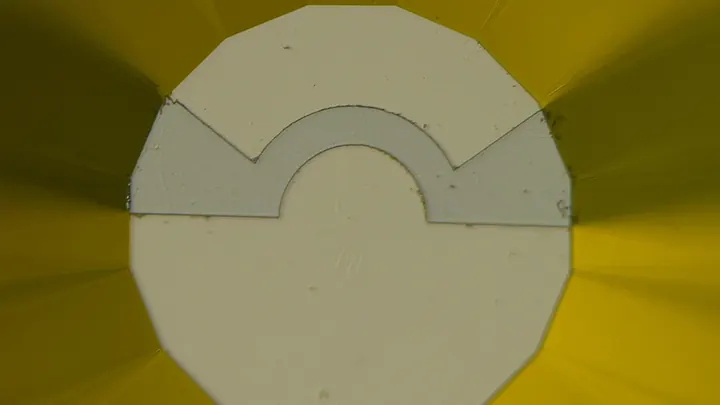
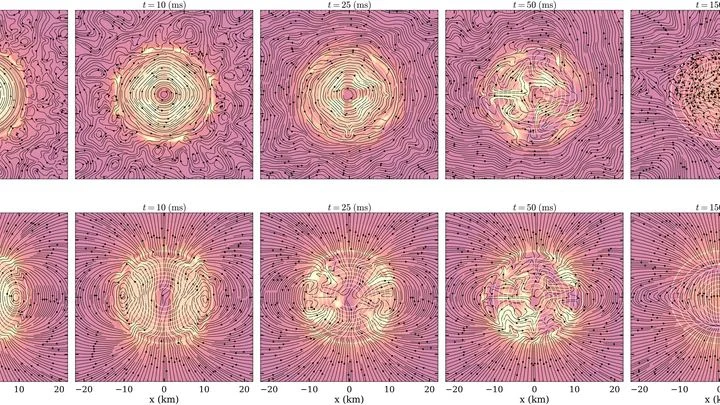
A vortex in a magnetic disk usually behaves like a large spinning top: to keep it from toppling, you need a spacious platform and a strong self-field that returns it to the center. But what if you shrink the platform to the size of a virus? Then the usual support disappears, and the vortex should fall apart.
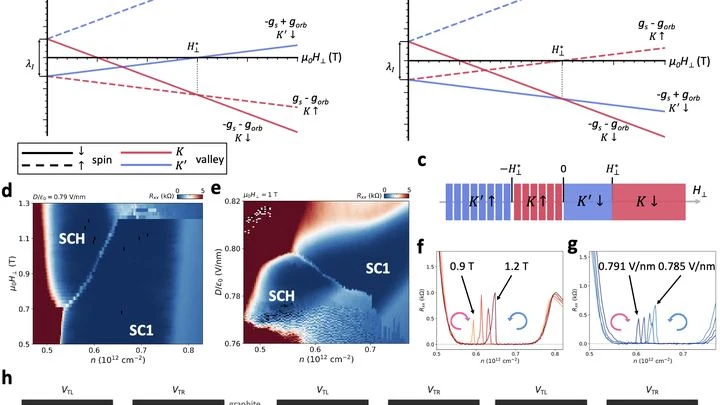
A microwave oven heats food, but in the lab, microwaves have done something different: they turned a superconductor into a permanent magnet. A 300-nanometer-thick film of yttrium barium copper oxide, cooled to 80 kelvin, responded to 5-gigahertz radiation.
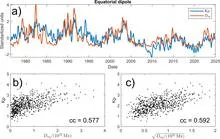
The Sun breathes, and that breath has a magnetic rhythm. Every 27 days, the visible surface of the star makes a full rotation, and with it, its magnetic field, like an invisible ribbon wrapped around the star.
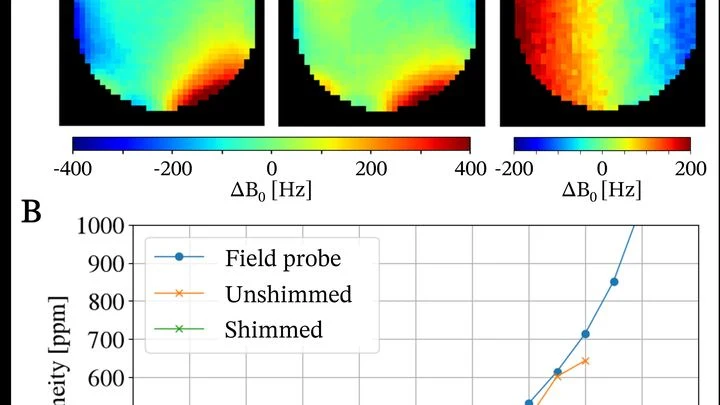
An MRI scanner is a big magnet that aligns hydrogen atoms in the body and then picks up their response signal. Such machines usually take up an entire room and cost as much as a nice house. Engineers from several labs decided to build a scanner that fits in a suitcase and released all the plans as open source.
A sculptor shapes mountains from magnetic fields and heat, but the stone resists. A neutron star, the ultra-dense remnant of a supernova explosion, in a binary system pulls matter from its companion star. This infalling matter heats the star's crust unevenly, while the magnetic field tugs from within.
A magnetic field usually acts like a strict traffic cop: for heat to turn into electricity, it must stand across the road. If the field lies along the heat flow, the effect disappears, or so it was believed for decades.
Scientists took an ultra-thin film of a magnetic oxide — a material where electron spins are aligned in a plane, like compass needles on a table.
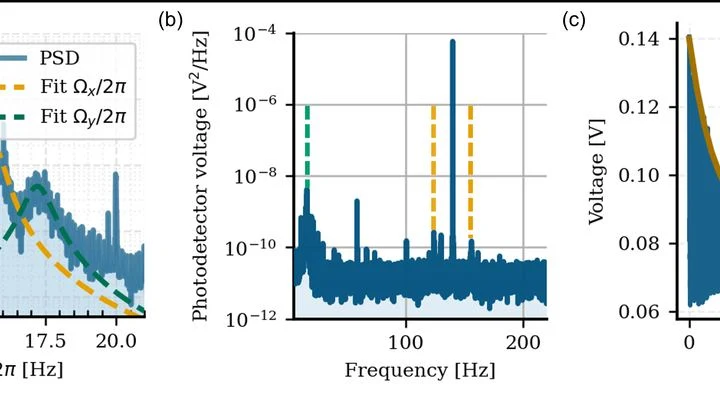
A magnetic top that doesn't fall. A tiny sphere of yttrium iron garnet hovers in midair, held by invisible forces. This isn't a magic trick but a Paul trap — an alternating magnetic field that rapidly changes direction and keeps the sphere from falling, like a juggler tossing balls.
The sphere trembles but doesn't fall.
A vortex in a magnetic material is like a whirlpool, but instead of water, the directions of magnetization twist. An electron flying through such a vortex feels not just a magnetic field, but a curvature of space: its path bends as if it were rolling down a funnel with a narrow neck.
A superconductor pushes out a magnetic field like a sponge squeezing out water. This Meissner effect has been known for nearly a century, but it's usually calculated in a flat world — without gravity. In the strong field of a black hole or at enormous speeds, the picture changes.
A piece of metal smaller than a millimeter, when cooled to minus 256 degrees Celsius, behaves like a kaleidoscope: in one corner, magnetic arrows align in neat rows, while in a neighboring corner, they twist into a screw. This was observed by directing a narrow X-ray beam at the sample and slowly sweeping it across the surface, like a flashlight along a dark wall.
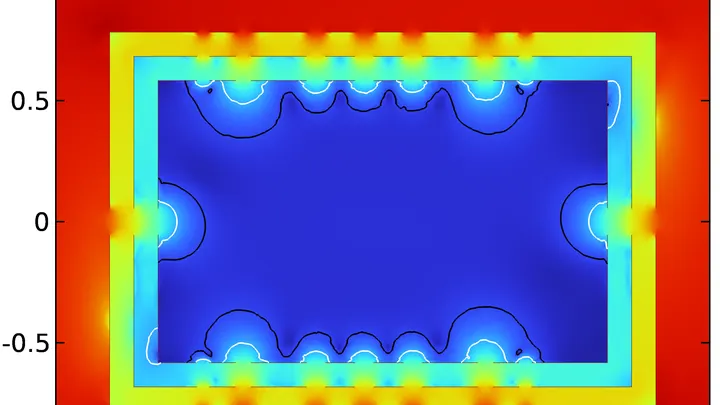
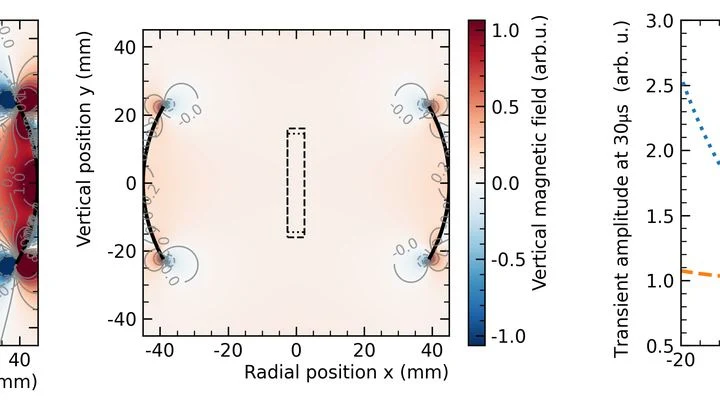
The magnetic field in this setup must be as smooth as glass: the slightest ripple would blur the signal. The engineers built two coils that cancel each other's field externally and packed them in three layers of ferromagnetic plates.
A magnet weighing just a few grains of sand hovers in midair with no support. It doesn't touch the walls, doesn't rub against bearings — it just hangs in a magnetic trap like a speck of dust in a sunbeam. Researchers have turned this tiny object into an ultra-sensitive compass: the device detects changes in the magnetic field of 23 femtotesla.
An X-ray flash tears through matter in billionths of a second. To remember it, physicists make atoms briefly absorb the light and then release it back. But pulling out a photon on command is like grabbing the right book from a shelf when the shelves move on their own.
The usual approach is to move several absorbers with extreme precision, like a well-coordinated orchestra.
A black hole is not a vacuum cleaner. By itself, it doesn't pull everything in more strongly than an ordinary star of the same mass. But if there's a magnetic field nearby and charged particles flying around, an interesting game begins.
A magnetic mirror is a tube open at both ends. The magnetic field inside is arranged so that hot plasma doesn't leak out: at the ends, the field lines bunch up like a cork in a bottle. Plasma particles flying toward the exit are repelled by these "corks" and bounce back. But some still escape: that's the classic "loss cone" argument.
A thin sandwich made of two different materials. You run an electric current through it, and the top slice magnetizes in one direction, the bottom in the opposite. This isn't a magic trick; it's the layer Edelstein effect, just described by physicists.
Radio waves, high-frequency electromagnetic oscillations, are powerless against the Earth's bulk: they attenuate, being almost completely absorbed within a couple of meters of depth. But a low-frequency magnetic field, governed by the equations of electrodynamics, behaves differently.
A Tesla coil crackles, and a beam of light begins to rotate around it. The medium it passes through is still stable, but the field grows, and the rotation intensifies. This is not a trick but the behavior of special materials that couple electricity and magnetism. For such coupling, there is a fundamental limit — the Tellegen limit.
An inflatable balloon with magnetic field lines drawn on it with a marker is a simple model of how a weak magnetic field behaves in an expanding universe. While the balloon is small, the lines lie obediently on the rubber and don't hinder its stretching. That's roughly how a field fills ready-made space without arguing with its geometry.
A lead sphere hangs above another lead sphere. According to the usual laws of gravitation, they attract each other exactly along the vertical — along the line connecting their centers.
Superconductors usually don't get along with magnets: a strong field destroys the state in which current flows without resistance. But in thin layers of carbon, things are different.
In the vast clouds of rarefied gas that fill the space between stars, something is always churning. Supernova explosions, colliding streams — all of it shakes the plasma. And in this rippling, as it turns out, hides the mechanism that gives birth to magnetic fields.
Plasma is a gas in which electrons are stripped from atoms.
The solar wind rushes from the Sun to Earth, but the magnetosphere bends the flow and sculpts it into plasma tails. The same motif plays out at the heart of galaxies: jets from accretion disks around black holes are twisted by the invisible hand of a magnetic field.
When physicists drive electrons through an ultrapure gallium arsenide channel at helium temperatures, they expect to see a well-behaved, almost ideal fluid.
Space is threaded with magnetic fields. They exist around galaxies, stars, and even in nearly empty voids — the vast empty spaces between galaxy clusters. It's usually thought that fields are amplified from weak 'seed' fields by turbulence, much like a dynamo. But the origin of the seed fields themselves has remained a puzzle.
A thin magnetic film is like a row of toy soldiers with tiny magnetic arrows. In the flat world, thermal jostling quickly disrupts this formation — even the slightest heating destroys the order. This is the Mermin–Wagner prohibition: in two dimensions, continuous symmetry cannot survive at finite temperature.
Deep underground, iron glows white-hot, and the pressure is so intense that an ordinary instrument would be crushed flat. To peer into this world, physicists built a special microscope based on tiny diamond defects (so-called NV centers).
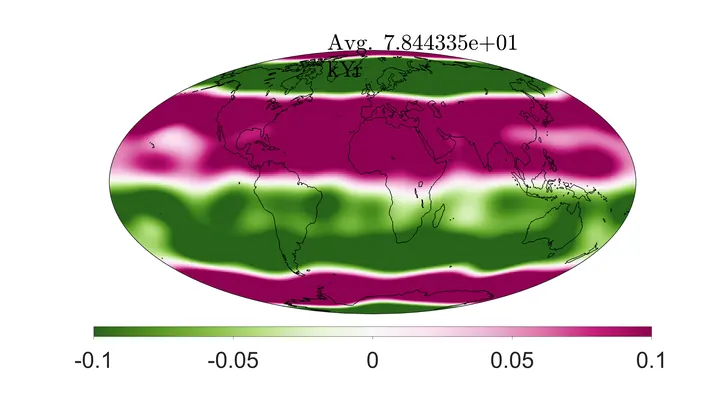
Earth's magnetic field is like an invisible shield that protects us from cosmic radiation. But if you look closely at its long-term averaged pattern, you'll notice that this shield isn't perfectly smooth: it has its own "seams" and "patches." New research using computer simulations of the geodynamo shows that…
Light from a distant blazar, an active galactic nucleus whose jet points our way, travels for billions of years. Along the way, it triggers cascades of charged particles that the intergalactic magnetic field deflects sideways. This creates a blurred gamma-ray glow around the blazar: a secondary halo.
Right after the Big Bang, space was a hot plasma — a mix of charged particles and light. In such a medium, electric currents couldn't flow on their own: a 'potential difference' was needed to push electrons relative to photons.
In a giant ring of magnets outside Chicago, muons whirled like figure skaters on an ice rink. But instead of music, there's a magnetic field, and instead of spinning, there's a barely perceptible wobble of the spin. Physicists call this wobble the anomalous magnetic moment.
In a small Petri dish sits a droplet of liquid the size of a pinhead. An ordinary scanner wouldn't even notice it: the signal is too weak. But bring a tiny magnetic field sensor close to the droplet, and the picture changes.
A sunspot cools, and above it a dark filament, a prominence, hangs for weeks. Inside it, like a compressed spring, hides the magnetic field. It can be laid out in neat arches, or it can be twisted into a tight rope.
Red giants are swollen, aging stars. Deep inside, an ocean of plasma churns: heat forces its way from the core to the surface, generating waves like a mighty surf. The star's magnetic field acts like an invisible seabed – it steers these waves, changing their height and speed.
A magnet the size of a grain of rice floats in a vacuum without touching the walls. It is held by the magnetic field of a superconducting trap — a ring cooled to a state where current flows without resistance.
A giant drum has just taken a hit. Its membrane is still trembling, but besides the main boom, a fine ripple spreads across it — someone ran a finger over the taut skin. In much the same way, in the first moments after the Big Bang, spacetime vibrated not only with the "roar" of expansion but also with the tension of suddenly emerging magnetic fields.
Many black holes are surrounded by magnetic fields. As it spins, the black hole drags curved spacetime along with it, like a machine's flywheel, and sets the cosmic factory in motion.
A neutron star is a sphere the size of a city but with the mass of an entire Sun. Its magnetic field can tear atoms apart from thousands of kilometers away. Yet until now, it was a mystery how this field is arranged inside: whether it is twisted into tight ropes or more like neat lines radiating from the poles.
A streetlamp flickers as someone walks past. That's roughly how our nearest star, Proxima Centauri, behaves: it flares in response to the motion of its planets.
Astronomers observed the star with a highly sensitive instrument, the ESPRESSO spectrograph. It captures light and splits it into colors, much like a prism.
An ordinary magnet always carries two poles — north and south. Split it in half, and each piece immediately grows its own pair. But deep in particle theory lives a strange notion: the monopole — a particle carrying just one magnetic charge, a lone pole without a partner.