Magnetoresistance is the change in a material's electrical resistance when an external magnetic field is applied. In ordinary metals, this effect is small and positive (resistance increases slightly), but in certain materials and structures, it can be dramatic — resistance can drop by orders of magnitude or even vanish. This phenomenon is not just a laboratory curiosity; it is the physical basis for modern magnetic sensors, hard disk read heads, and magnetic random-access memory (MRAM).
History
The effect was discovered by William Thomson (Lord Kelvin) in 1856, who observed that the resistance of iron and nickel changed when magnetized. The modern understanding and technological exploitation, especially giant magnetoresistance, emerged in the late 1980s with the work of Albert Fert and Peter Grünberg, who shared the 2007 Nobel Prize in Physics.
How it works
The effect arises because a magnetic field influences the paths of conduction electrons. In a simple picture, electrons moving through a material are scattered by atoms and impurities; a magnetic field curves their trajectories, increasing the chance of collisions and thus resistance (ordinary magnetoresistance). In more exotic cases, such as giant magnetoresistance (GMR) in layered magnetic/non-magnetic structures, the resistance depends on the relative alignment of magnetic layers: when aligned, electrons with matching spin pass through easily; when anti-aligned, they scatter more strongly. The effect can also reveal hidden magnetic order, as in the studies of magnetic ordering in crystals and superconductors mentioned in the titles.
In practice
Used in read heads of hard disk drives, magnetic field sensors in automotive and industrial applications, and in non-volatile magnetic random-access memory (MRAM).
Fun fact
The 2007 Nobel Prize in Physics was awarded for the discovery of giant magnetoresistance, which enabled a thousandfold increase in hard disk storage density.
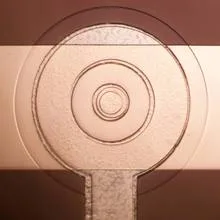
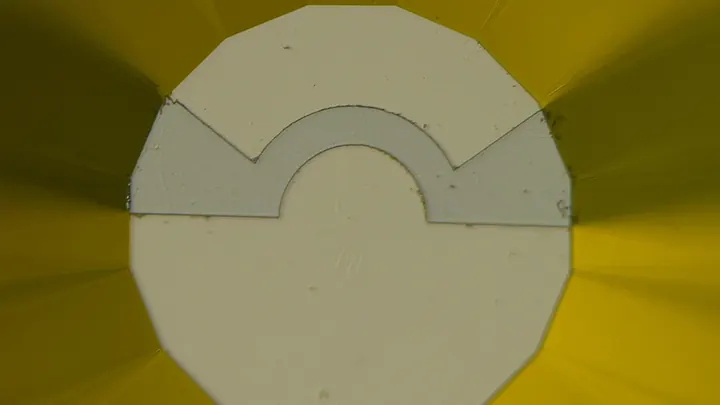
A ring-shaped channel of gallium arsenide is like a round pool with no rim: electrons flow in through the inner bank and out through the outer one. In an ultraclean material, they collide with each other more often than with lattice defects, and they begin to behave like a fluid.
Light knocks electrons out of a crystal, and they fly toward the detector like arrows toward a target. From their trajectories, physicists reconstruct how electrons behaved inside the material: with what energy and in which direction they moved. But switch on a magnetic field, and the trajectories bend. The arrows start to curve, the target turns into a warped mirror, and the picture blurs.
In a binary star system, a white dwarf acts like a vacuum cleaner, pulling gas from its companion star. If the dwarf has a magnetic field, the gas does not fall anywhere but flows toward the poles, like iron filings to a magnet. There it accumulates into a pile. But what keeps this pile from spreading out?
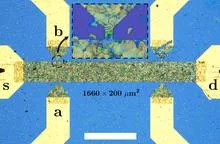
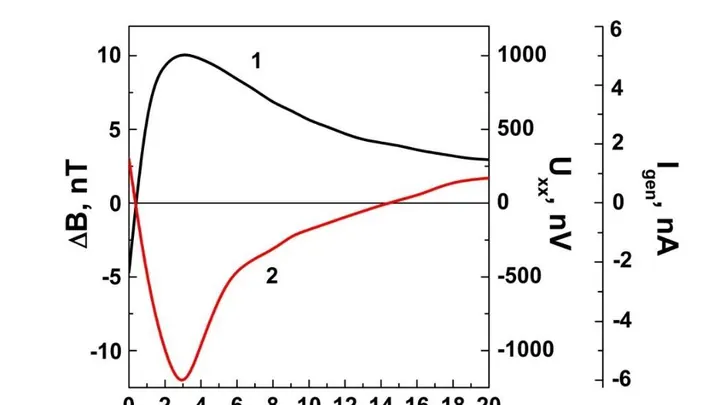
On the lab bench lies a piece of graphite grown from gas, like a deposit on the wall of a reactor. Usually, such material is not suitable for converting heat into electricity: inside it, electrons and holes run in opposite directions and cancel each other out.
Two dancers on one stage: one pulls the partner in one direction, the other in the opposite. In the crystal Cu2(OH)3Br, known as botallackite, copper atoms form chains where the spins (magnetic moments) of neighboring ions align either parallel, as in a ferromagnet, or antiparallel, as in an antiferromagnet.
An orchestra without a conductor can sound harmonious if the musicians feel the common rhythm. In the world of solids, phonons play that role: quanta of crystal lattice vibrations. When atoms in a substrate start moving in circles, they can transfer their rotation to a magnetic layer on top and flip its magnetization.
Two caravans travel toward each other along a narrow road. One is wide and slow, carrying a load of density. The other, a string of light carts carrying current, slips between the first. Thus, in a magnetron discharge, two structures rotating in opposite directions coexist: the density spoke and the current filaments.
Current in an ordinary metal flows like a crowd of people down a straight street: each electron is on its own, and if you turn on a magnetic field, the whole crowd shifts slightly sideways. This shift is called the Hall effect.
The magnetic framework of the EuMnSb2 crystal resembles scaffolding: manganese atoms form rigid vertical pillars, while europium atoms act as movable crossbars. Until now, there was no consensus on the angle at which these crossbars rest and how they rotate when a magnetic field presses on the scaffold.
Inside an MRI magnet, current flows through a closed superconducting loop, like water circling in a bucket after you give it a spin, it just keeps going on its own. To change that current, you heat the loop with a small heater: it stops being superconducting, becomes an ordinary resistor, and then an external source can 'top up' or 'draw off' current.
A magnetic field usually acts like a strict traffic cop: for heat to turn into electricity, it must stand across the road. If the field lies along the heat flow, the effect disappears, or so it was believed for decades.
Scientists took an ultra-thin film of a magnetic oxide — a material where electron spins are aligned in a plane, like compass needles on a table.
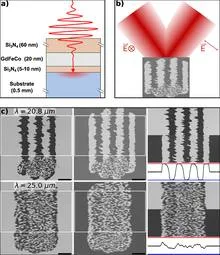
Electricians working with high voltage are like divers: they need to see what's happening deep underwater without going down themselves. What's needed is a sensor that stays away from the dangerous current and relays information to the surface. Usually, light is used: a beam passes through a transparent crystal, and the electric field slightly rotates it.
Two sheets of graphene — the thinnest layers of carbon, just one atom thick — are stacked like bread in a sandwich. Between them lies a magnetized layer of CrSBr. When current flows through this sandwich, the resistance depends on which way the magnetic moments in the middle layer point.
A magnetic mirror is a tube open at both ends. The magnetic field inside is arranged so that hot plasma doesn't leak out: at the ends, the field lines bunch up like a cork in a bottle. Plasma particles flying toward the exit are repelled by these "corks" and bounce back. But some still escape: that's the classic "loss cone" argument.
Ion current through a membrane is like a queue at a turnstile. Sometimes the turnstile is free — ions pass through quickly. Sometimes it gets stuck — the flow drops. A weak magnetic field, it turns out, doesn't push ions from behind; it simply changes the number of open turnstiles.
Deep underground, iron glows white-hot, and the pressure is so intense that an ordinary instrument would be crushed flat. To peer into this world, physicists built a special microscope based on tiny diamond defects (so-called NV centers).
A dead star with a magnetic field billions of times stronger than Earth's is a magnetar. Its crust cracks, sending a powerful X-ray burst into space. But some of that light doesn't reach us in its usual form. In an ultra-strong field, photons can turn into gravitational waves — the trembling of space itself.
Red giants are swollen, aging stars. Deep inside, an ocean of plasma churns: heat forces its way from the core to the surface, generating waves like a mighty surf. The star's magnetic field acts like an invisible seabed – it steers these waves, changing their height and speed.
A regular fridge magnet attracts iron because all its tiny magnetic arrows point in the same direction. But there are materials where the arrows arrange themselves more cunningly: neighboring rows point in opposite directions, so from the outside it looks like there's no magnetism at all. Such materials are called altermagnets.
A fridge magnet stays put because the tiny atomic arrows inside it all point in the same direction. But when those arrows start to argue (some pulling left, others right, and some spinning like tops) you get magnetic frustration. That disorder gives rise to whimsical patterns: stripes, spirals, vortices.
A compass needle turns slowly, but inside some materials, tiny magnetic moments can flip over timescales that are hard to imagine. A team of physicists has calculated how to make them change direction in a quadrillionth of a second — faster than a lightbulb blinks.
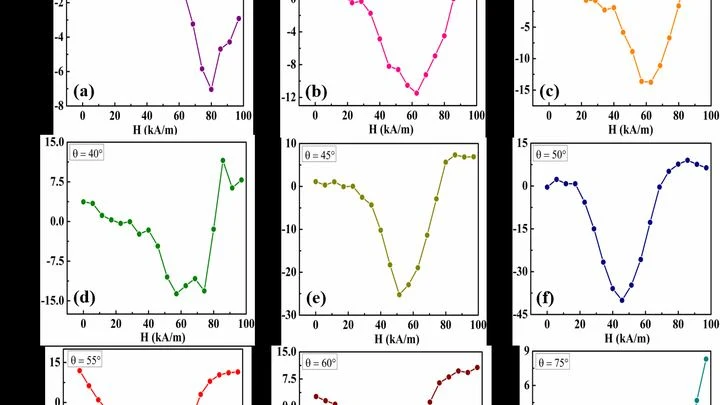
A piece of zinc oxide film lies on a table. A magnet is brought near, and slowly rotated around the film. The film, thinner than a human hair, begins to change its dimensions: now contracting, now stretching. This property is called magnetostriction — the ability of a material to deform under a magnetic field.
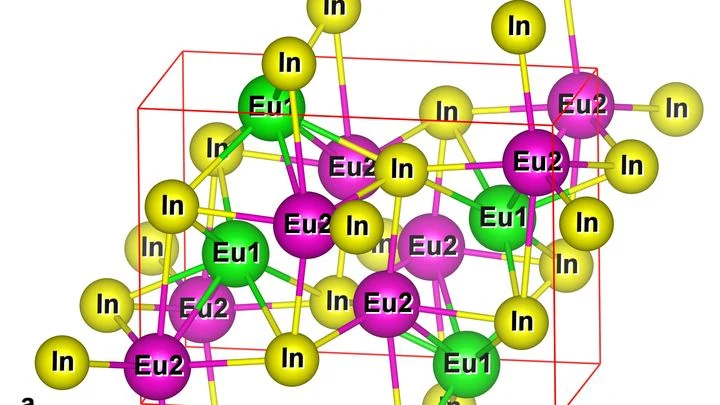
A piece of europium-indium alloy, when cooled in a magnetic field, behaves like water that does not freeze all at once but first in one corner of the glass, then in another.
The magnetic refrigerator of the future won't hum with a compressor. Instead, it will cool your groceries by exploiting a special material that heats up in a magnetic field and cools down when the field is removed. This cycle resembles the compression and expansion of gas in a conventional fridge, but here a magnet does the work of a piston.
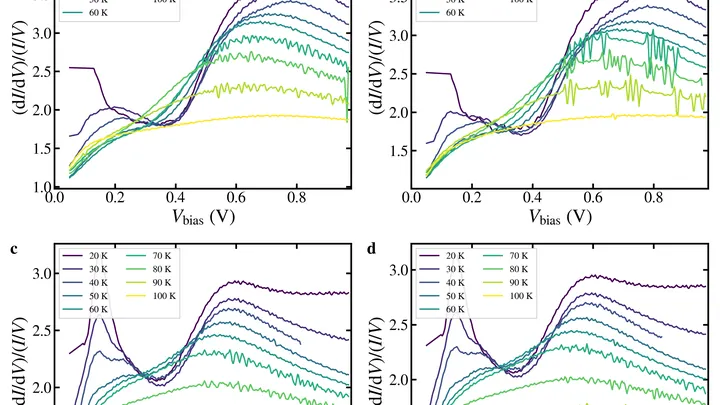
In a crystal made of europium, zinc, and phosphorus, electric current behaves like a car on a bumpy road. Electrons don't run freely but drag magnetic clouds, polarons, behind them.
A crystal does not grow as a single whole but like a city of neighborhoods — grains. In each neighborhood, atoms are arranged in their own way, and the boundaries between them are like streets.
When cooled strongly, a uranium-telluride crystal stops resisting current. Before that happens, at a slightly higher temperature, its resistance can still be measured — and it tells about the shape of the invisible paths along which electrons run.
A magnet, like a compass needle, likes to point in a certain direction. But what if the material is layered, like a stack of pancakes? Scientists took just such a magnet made from a compound of chromium, germanium, and tellurium and set out to find out how stubbornly it resists having its magnetization turned.
Magnetic moments in a crystal are like compass needles fixed at lattice sites. In the normal state, they line up in neat order, but if an electromagnetic wave strikes the crystal, the needles start to sway, like wheat stalks in the wind. These oscillations are called magnons, and they carry energy without the atoms themselves moving.
In a piece of manganese oxide just a few atomic layers thick, electrons behave like a crowd on an escalator: each moves by its own rules, but together they create a common flow. Physicists shone soft X-rays on such a film and knocked electrons out.
If you hold an iron nail near a magnet, it will be attracted. Inside the magnet, tiny atomic magnetic arrows point in the same direction, like soldiers in formation. But in some crystals, the formation is different: neighboring arrows point in opposite directions. This order is called altermagnetism, and it is hard to see directly.
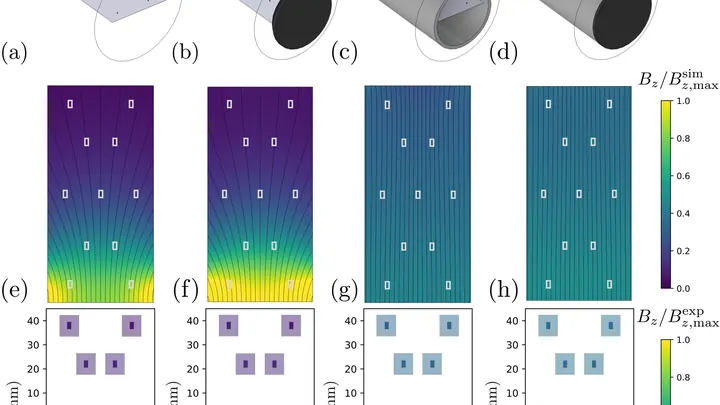
A magnetic field is like a shadow cast by an object: it changes with the shape of the source. But if you put a lens in the path of light, you can alter the shadow. Here, the authors devised a 'lens' for magnetic fields — an assembly of ordinary materials with different magnetic permeabilities (their ability to let the field through).
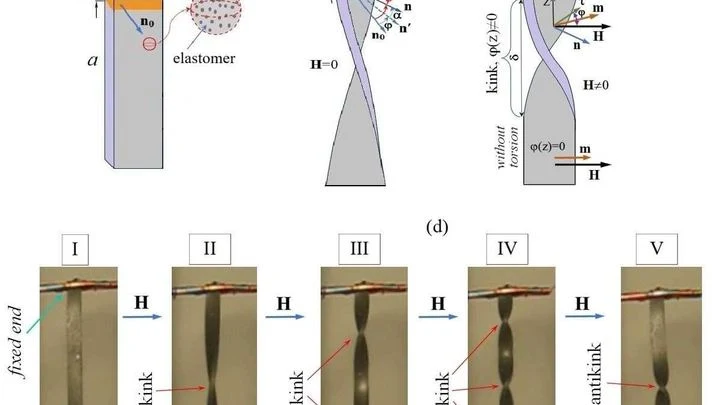
An ordinary rubber strip filled with fine iron filings doesn't just bend in a magnetic field: it ties itself into a stable knot. This effect was predicted and reproduced in experiments by physicists working with magnetoactive elastomers: a silicone base with carbonyl iron particles.
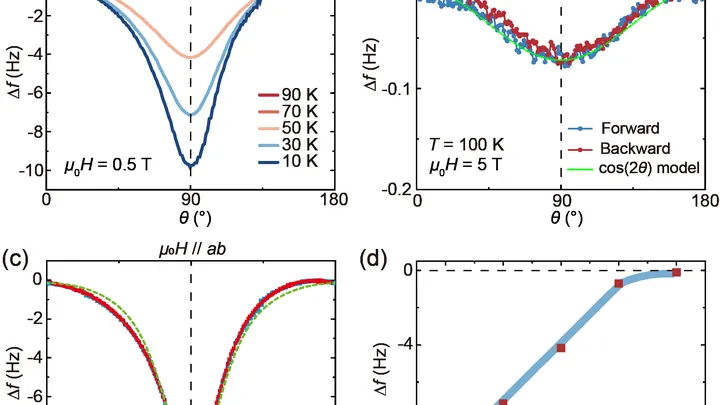
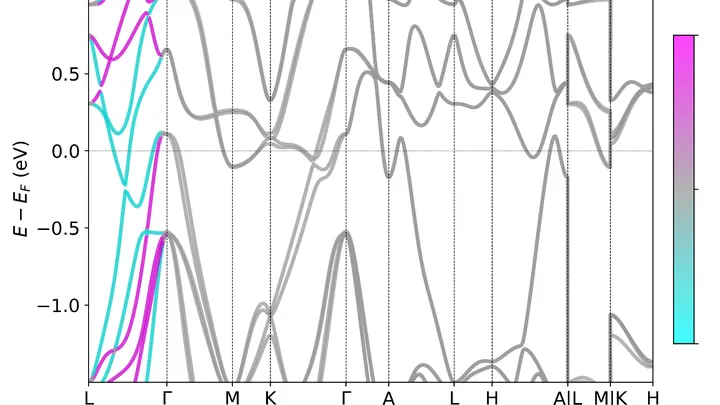
Electrons in a CrSb crystal behave like a school of fish: inside the material, they dart along their "corridors," and at the boundary with vacuum, they arrange themselves into intricate patterns. These patterns are the Fermi surface — a map of all allowed electron velocities. You can't reach out and touch it, but you can "feel" it with a magnetic field.
A magnet that stacks up like a pile of pancakes: that's how the material CrSBr is structured. At low temperatures, each layer is magnetized, but neighboring layers point in opposite directions, and their magnetic fields cancel each other out. This order is called antiferromagnetic, and it's fragile: just a slight warming demagnetizes the layers.
The crystal Ca2RuO4 resembles a stack of thin sheets. Inside each sheet, the electron spins are arranged in strict order, like rows of soldiers on a parade ground. The bonds between the sheets are weak, and their sign can be flipped by slightly pulling the crystal apart.
A magnet doesn't like its field penetrating a superconductor. An ordinary piece of lead, cooled to cryogenic temperatures, pushes out magnetic field lines, and levitates above a magnet. This is the Meissner–Ochsenfeld effect, discovered in 1933.
Diamonds sometimes have a defect: instead of two adjacent carbon atoms, there is one nitrogen atom and an empty spot. This defect acts like a tiny antenna that responds to magnetic fields. Scientists aimed a laser and microwaves at such a diamond, and the defect started spitting out electrons.
A regular switch clicks, and current either flows or it doesn't. Now imagine a material that switches itself between 'conducts without loss' and 'resists' under the influence of a magnet. That's exactly the sandwich physicists built: a thin lead film on top of a superconductor made of bismuth, strontium, calcium, copper, and oxygen.
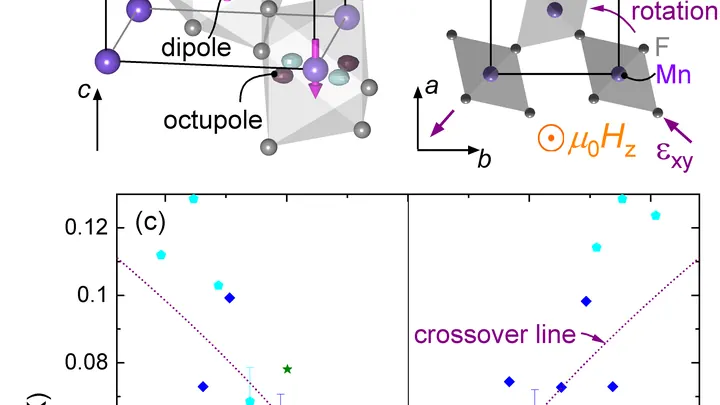
In a manganese fluoride crystal, atoms are lined up like soldiers in formation. But within this formation lies a hidden pattern: the magnetic moments of the atoms point in opposite directions, and the pattern itself changes when the crystal is rotated.