A Vortex Inside a Crystal
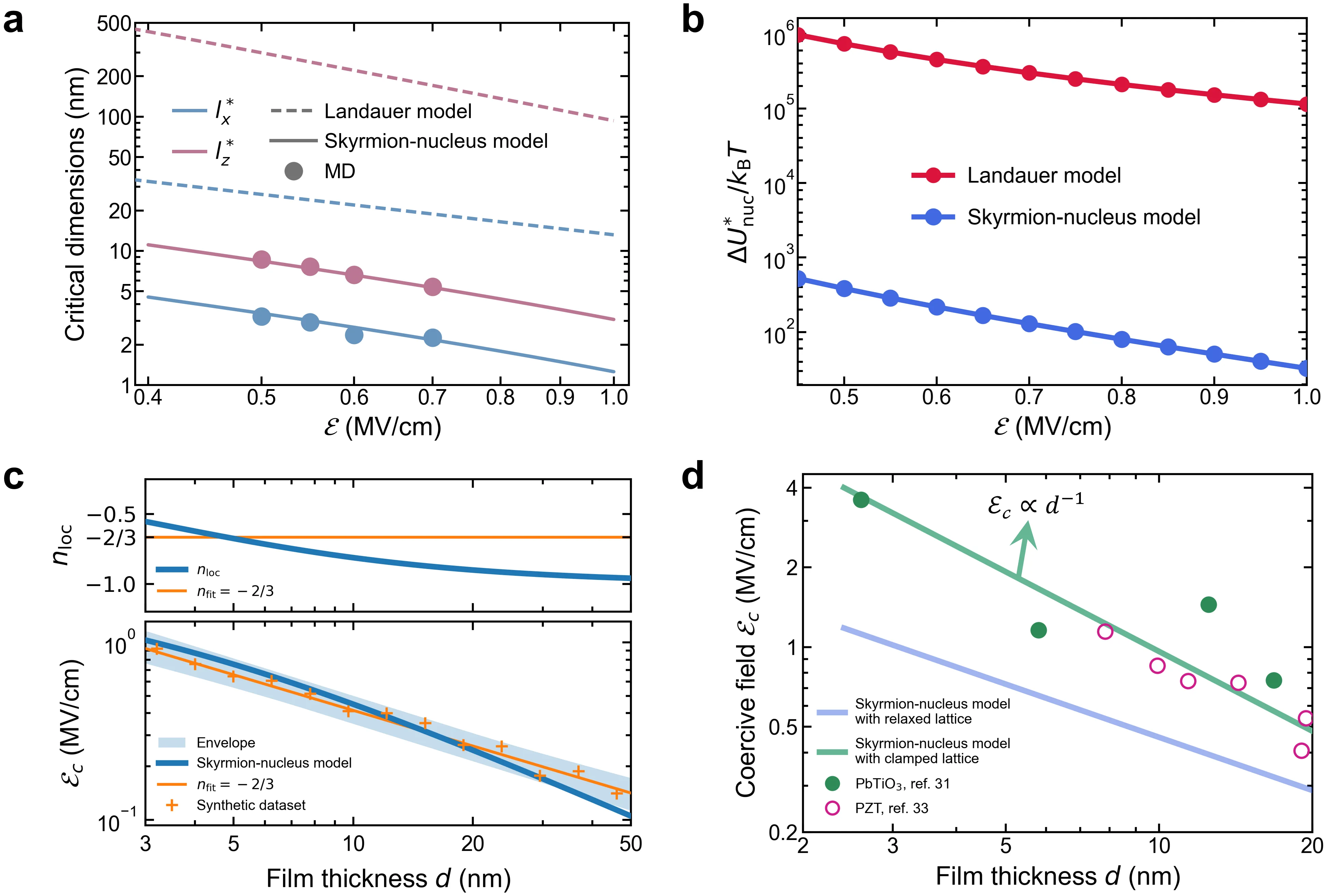
A crystal of lead titanate is like a formation of soldiers, each atom-soldier holding a dipole arrow pointing the same way. To turn the whole formation through 180 degrees, the old calculations said you would need so much energy that the crystal would simply melt. Yet in reality such crystals switch easily. How does that happen? A vortex is born inside.
Instead of all the arrows turning at once, the vortex twists them gradually, layer by layer. Each next arrow is rotated just a little, so the electric charges on the surface almost completely cancel out. People used to think switching was impossible without defects, but the vortex works even in a perfect crystal. Computer modeling showed that this vortex is as stable as a knot in a rope, and it is precisely what lets the material switch at a small voltage. Such crystals are used in non-volatile memory, and now it is clear how to improve them for future devices.
The skyrmion core in a 20 nm PbTiO3 film is only 3.2 nm across, comparable to a few unit cells, yet its topological charge protects the texture from falling apart.
In Greg Egan's novel Schild's Ladder, topological defects in the vacuum govern the laws of physics; here a topological defect in polarization governs how a material switches, echoing the idea of hidden topological states as organizers of dynamics.