Ferroelectric materials are crystals that possess a spontaneous electricpolarization that can be reversed by applying an external electric field. This property is analogous to ferromagnetism, but for electric dipoles instead of magnetic spins. Ferroelectrics are key components in capacitors, memory devices, and sensors, and they exhibit a hysteresis loop in their polarization versus electric field response.
History
The first ferroelectric material, Rochelle salt, was discovered in 1920 by Joseph Valasek. The theory of ferroelectricity was developed in the 1940s and 1950s, with significant contributions from Vitaly Ginzburg and others.
How it works
In a ferroelectric crystal, the atoms are arranged in a way that creates a permanent electric dipole moment. This dipole arises from a slight displacement of positive and negative ions relative to each other. When an external electric field is applied, the dipoles can be switched to align with the field, and this switching is non-volatile, meaning the polarizationstate remains even after the field is removed.
In practice
Ferroelectrics are used in non-volatile memory (FeRAM), piezoelectric actuators, and infrared sensors. They are also being explored for use in energy harvesting and neuromorphic computing.
Fun fact
Ferroelectric materials are also pyroelectric and piezoelectric, meaning they generate electricity when heated or mechanically stressed, making them versatile in transducers.
Picture an orchestra in which violins and trumpets play different parts but together create a powerful sound. In a crystal of the layered magnet Fe5GeTe2 doped with nickel, tiny regions of a different phase, Fe6GeTe2 nanoprecipitates, take on the role of those instruments. It is they, not the nickel itself, that keep the material magnetic at 478 kelvin, that is, at 205 degrees Celsius.
In a perfect crystal of lead titanate, the atoms line up like soldiers on parade: all electric dipoles point the same way. To flip that formation by 180 degrees, old calculations demanded energy comparable to heating the crystal to millions of degrees.
On the lab bench lies a piece of graphite grown from gas, like a deposit on the wall of a reactor. Usually, such material is not suitable for converting heat into electricity: inside it, electrons and holes run in opposite directions and cancel each other out.
An orchestra without a conductor can sound harmonious if the musicians feel the common rhythm. In the world of solids, phonons play that role: quanta of crystal lattice vibrations. When atoms in a substrate start moving in circles, they can transfer their rotation to a magnetic layer on top and flip its magnetization.
A microwave oven heats food, but in the lab, microwaves have done something different: they turned a superconductor into a permanent magnet. A 300-nanometer-thick film of yttrium barium copper oxide, cooled to 80 kelvin, responded to 5-gigahertz radiation.
In a thin layer of liquid crystal, molecules usually lie like matches in a box — aligned in one direction but randomly oriented: some point up, others down. To make all the matches point the same way, you need a special molecular architecture. Scientists have found a chemical trick that does this almost automatically.
A magnetic field usually acts like a strict traffic cop: for heat to turn into electricity, it must stand across the road. If the field lies along the heat flow, the effect disappears, or so it was believed for decades.
Scientists took an ultra-thin film of a magnetic oxide — a material where electron spins are aligned in a plane, like compass needles on a table.
Hot water after a shower, warm air from ventilation, the heated walls of an engine — all this is heat below 100°C. Usually, it dissipates without doing any useful work. Now it can be captured and turned into electricity.
Inside the new device is a wire made of a nickel-titanium alloy. This material remembers its shape: when heated, it contracts; when cooled, it returns to its original shape.
In a pot of water, microscopic spheres, colloidal particles, are floating. Each sphere is coated with long polymer chains that look like a brush and carries an electric charge. If you get the temperature and solution composition right, the spheres start arranging themselves into ordered patterns — crystals.
A light switch clicks, and the light comes on. But imagine a switch that, with the same press, can either turn on the lamp or leave the room dark. It also remembers what it did last time, and sometimes it seems to flip a coin to decide whether to light up.
This kind of behavior was found in a crystal of black phosphorus — a semiconductor just a few atomic layers thick.
A highway where opposing flows are separated not just onto different sides, but onto two independent roads: each with its own entrance and exit. Something similar happens to electrons in a new type of topological insulator described by the authors of the study.
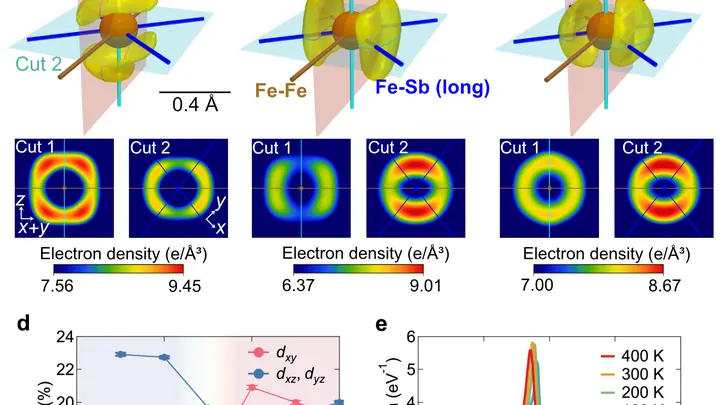
A house with cork walls suddenly gets covered in copper sheets, but only when frost sets in. That's roughly how FeSb₂ behaves when made into a film just a few atomic layers thick. Under normal conditions, it's a narrow-gap insulator: electrons sit tightly in place like spectators in an overcrowded hall.
A sheet of paper with magnetic properties: that's roughly what the new material 1T-CrS₂ is like. Its layers are held together by weak forces, like the pages of a notebook, but each layer is a true magnet.
In extreme cold — minus 268 degrees — a crystalline perovskite film starts transmitting light differently depending on its polarization. The beam seems to split in two: one part travels slightly faster, the other slightly slower.
A thin sandwich made of two different materials. You run an electric current through it, and the top slice magnetizes in one direction, the bottom in the opposite. This isn't a magic trick; it's the layer Edelstein effect, just described by physicists.
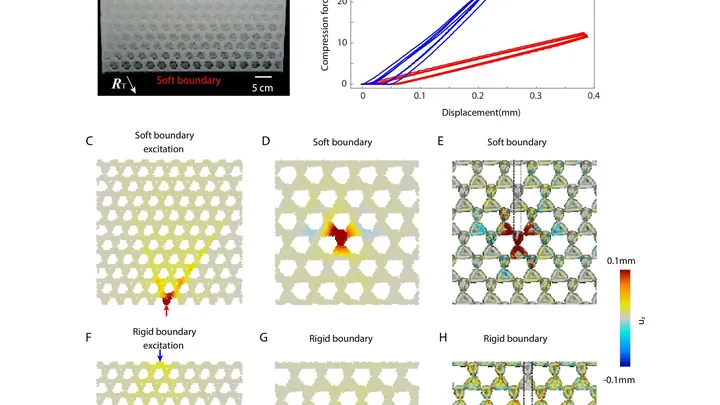
Bending a sheet of paper is easy. But compressing it by pushing from the edge is a different story: the paper will crumple but barely transmit the force further. That's how ordinary elasticity works — deformation depends on where and how you press. The new three-dimensional lattice pushes this contrast to the limit.
A parquet floor where every other plank is turned the opposite way looks symmetric. But if you run your hand over it, in one direction your fingers glide along the grain, and in the other they catch. That's roughly how the new type of magnetism studied in the crystal AgCrP2S6 works.
In the world of two-dimensional materials, states sometimes emerge that are as extraordinary as they are fragile. One of them — the fractional anomalous Hall crystal (FAHC)—is like a quantum centaur: half ordered lattice, half topological liquid.
Traditional electronics operates on charge, but spintronics and the nascent orbitronics dream of incorporating the particles' own rotation. At the heart of this lies the Edelstein effect: a current flowing in materials with Rashba spin-orbit coupling generates spin polarization.
The solar wind rushes from the Sun to Earth, but the magnetosphere bends the flow and sculpts it into plasma tails. The same motif plays out at the heart of galaxies: jets from accretion disks around black holes are twisted by the invisible hand of a magnetic field.
Two-dimensional worlds never cease to amaze: here even crystal melting is not a symmetry breaking but a vortex drama discovered by Kosterlitz and Thouless. At the heart of this theater are topological сингулярности, whose energy and энтропия bargain for order. This language is common to сверхтекучести и сверхпроводимости.
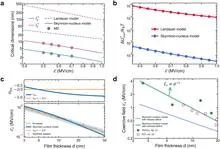
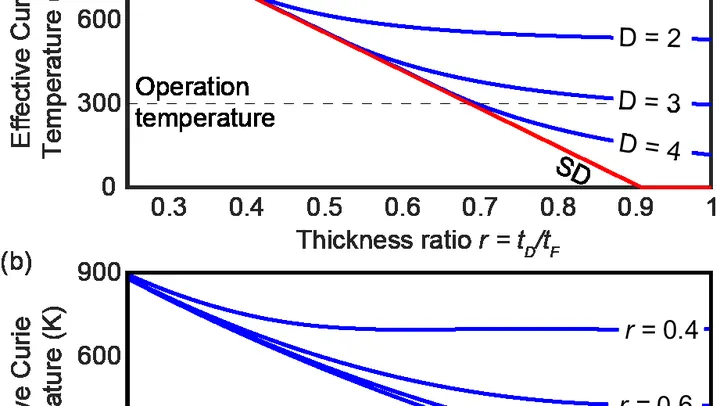
The thinner the ferroelectric film, the stronger the depolarizing field — a dictate of classical physics. Imagine a pencil balancing on a fingertip: the shorter it is, the harder to keep it upright. Nanoscale polarization likewise strives to vanish.
A sugar cube squeezed between your fingers will almost certainly crumble rather than compress evenly. A similar challenge faces quantum computer builders. They need to slightly stretch or compress miniature silicon plates — qubits are later placed on them.
Imagine a carousel with two types of seats: some spin clockwise, others counterclockwise. If you push all of them at once, the carousel jerks but stays in place. That's how a Weyl semimetal crystal works: electrons are born in pairs—'left' and 'right'—and their contributions to current cancel each other, like two identical motors running in opposite directions.
A rubber band that gets thicker the harder you pull it. In electricity, this behavior is called negative capacitance: the more charge accumulates on the plates, the lower the voltage. A regular capacitor works the opposite way — voltage rises with charge.
Two teams pull a rope with equal force in opposite directions — the rope doesn't move, and the net force is zero. That's how many antiferromagnets behave: the magnetic moments of atoms are aligned oppositely and cancel each other out.
Each electron is a tiny magnet. In a single-atom-thick layer of iron chloride, they all align in the same direction, like dancers in a perfectly synchronized routine. Nature usually avoids such order (that's high entropy), but quantum forces compel them to comply.
Heat a nail in a fire, and it will lengthen — everyone knows that. But heat only the tip and leave the other end cold, and the nail doesn't just get longer: it bends, because hot metal expands more than cold metal. It's this very bending, but at the atomic level, that physicists have turned into electricity.
A superconductor is like a perfect electron dance: electrons move in pairs without losing energy, like dancers who never miss a beat. But add a few magnetic impurities, and strangers crash into the dance, disrupting the synchronized motion. The temperature at which this dance begins drops.
Tile a floor with identical triangles, and you get a boring repeating pattern. But what if you want the pattern to never repeat, yet use just one tile? For a long time, mathematicians were sure it couldn't be done: you'd need at least two different shapes. The famous Penrose mosaic is a case in point: rhombi with acute and obtuse angles arrange into an infinitely varied but strictly ordered pattern.
The dance floor is full of couples waltzing. Usually, partners move in opposite directions: one steps forward, the other backward, to keep the overall rhythm.
A comb rubbed through your hair picks up scraps of paper. Physicists decided to apply this simple trick at the microscopic level — to control magnetic vortices called skyrmions. A skyrmion is like a tiny tornado in a sea of magnetization: at its center, compass arrows point up, while at the edges they twist downward.
A magnetic vortex, or skyrmion, is like a tiny whirlpool in the sea of spins — the atoms' intrinsic magnetic moments. Like a whirlpool in a river, it twists the magnetization around itself, and this pattern is remarkably robust: hard to destroy with a random jolt.
A crystal is like a city: if the streets are crooked, traffic jams. In a crystal, the streets are atomic rows, and the traffic is the flow of electrons. Any tiny imperfection, impurity, or atomic displacement makes electrons scatter. Scientists from several labs have learned to grow crystals so that the "streets" are almost perfectly straight.
The method is called horizontal vapor transport.
In a tiny magnet, information is encoded not in which way the arrow points, but in how the directions of its atoms alternate. In antiferromagnets, these arrows cancel each other out, so the material appears non-magnetic from the outside. The data is there, but you can't read it the usual way: the state is like a note written in invisible ink.
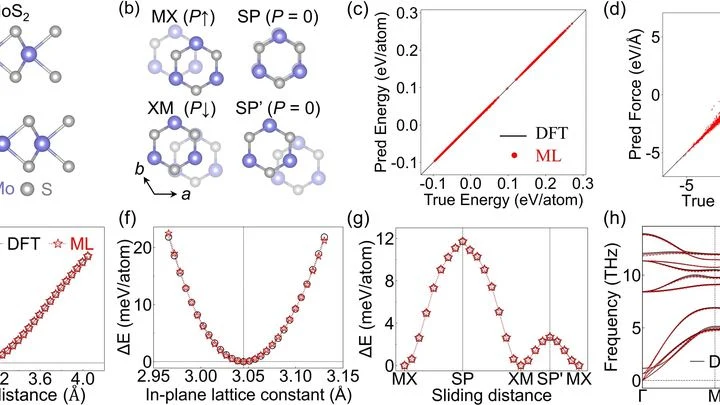
Two sheets of paper stacked together start to creep ever so slightly over each other when heated. That's roughly how layers of molybdenum disulfide, a material one atom thick, behave. At room temperature, they spontaneously slide at a speed of about one meter per second.
Honeycombs are built from identical cells, but tweak the shape of just one, and the whole structure gains new properties. Researchers did something similar to create a magnet without a single metal atom. They took flat carbon molecules shaped like triangles, triangulenes, and arranged them in a hexagonal lattice, just as bees build honeycombs.
Shine light on an FePS3 crystal, and it responds with its own glow, like a neon sign, but much fainter and in the infrared range. This glow is not random: it depends on how the crystal is oriented. The scientists took samples from a thick chunk down to a single-atom layer and observed four emission bands — at 1.24 electronvolts, 1.79, 2.3, and 2.56.
In ordinary flash memory, a bit is stored in a single layer, and its signal hits a ceiling: the thinner the film, the less charge it can hold. Engineers have spent years trying to squeeze a bit more out of the material, but the gains were pennies. The authors of the new work took a different route: they stacked two floors of memory on top of each other and made them work as a pair.