quantity

electric charge

A fundamental property of matter that causes it to experience a force in an electromagnetic field.
6 related articles · 6 formulas

Description

Electric charge is a fundamental property of matter that determines how it interacts with electromagnetic fields. It comes in two types, conventionally called positive and negative, with like charges repelling and opposite charges attracting. Charge is quantized — it always appears in integer multiples of the elementary charge e — and it is strictly conserved: in any closed system, the total charge never changes. This property underlies everything from the structure of atoms to the behavior of lightning and the chemistry of life.

History

The concept of charge was formalized by Benjamin Franklin in the 18th century, who introduced the terms positive and negative. The modern understanding of charge as a quantized, conserved quantity emerged with experiments by Robert Millikan (1909) and the development of quantum electrodynamics in the mid-20th century.

How it works

Charge creates and responds to electric and magnetic fields. A charged particle produces an electric field that exerts forces on other charges, and when it moves, it also generates a magnetic field. The strength of these interactions is set by the fine-structure constant, about 1/137. In quantum electrodynamics, charge is the coupling constant that determines how often a particle emits or absorbs a photon, the carrier of the electromagnetic force.

In practice

Electric charge is the basis of all electrical technology: from power generation and electronics to medical imaging like MRI and particle accelerators used in cancer therapy.

Fun fact

The electric charge of a single electron is exactly equal in magnitude to that of a proton, but opposite in sign — a balance that, if off by even a tiny fraction, would make atoms unstable and matter as we know it impossible.

Concept graph →

Formulas

$$\Delta Q = \nu \frac{e \Delta \Phi}{\Phi_0}$$
Charge quantization in superconductors relates flux change to accumulated charge.
What is in the formula
\Delta QvariableAccumulated charge change in the superconductor — electric charge coulomb
\Delta \PhivariableChange in magnetic flux through the superconducting loop — magnetic flux weber
\nuvariableFilling factor (integer or fractional) of the quantum Hall state — dimensionless
econstantMagnitude of the electric charge of a single electron or proton — elementary charge = 1.602176634e-19 coulomb
\Phi_0constantSuperconducting flux quantum, h/(2e), the fundamental unit of magnetic flux in a superconductor — magnetic flux quantum = 2.067833848e-15 weber
$$\Xi = \frac{k_e Q^2}{G M^2}$$
Compares electrostatic to gravitational force strength.
What is in the formula
QvariableElectric charge of the body — electric charge coulomb
MvariableMass of the body — mass kilogram
k_econstantElectrostatic force constant in Coulomb's law — coulomb constant = 8.9875517923e9 newton metre squared per coulomb squared
GconstantNewtonian constant of gravitation — gravitational constant = 6.67430e-11 cubic metre per kilogram per second squared
$$r_{\pm} = \frac{GM}{c^2} \left(1 \pm \sqrt{1 - \frac{k_e Q^2}{G M^2}}\right)$$
Locations of event horizons in charged black holes.
What is in the formula
r_±variableInner and outer event horizon radii — horizon radius metre
QvariableElectric charge of the black hole — electric charge coulomb
MvariableMass of the black hole — mass kilogram
GconstantNewtonian constant of gravitation — gravitational constant = 6.67430e-11 cubic metre per kilogram per second squared
cconstantSpeed of light in vacuum — speed of light = 299792458 metre per second
k_econstantElectrostatic force constant in Coulomb's law — coulomb constant = 8.9875517923e9 newton metre squared per coulomb squared
$$p_{\max} = \frac{e B L}{c}$$
Maximum momentum a charged particle can gain in a magnetic field of scale L.
What is in the formula
p_maxvariablemaximum momentum — momentum kilogram metre per second
evariableelectric charge — electric charge coulomb
Bvariablemagnetic field strength — magnetic field tesla
Lvariablecharacteristic length scale — length metre
cconstantspeed of light in vacuum — speed of light = 299792458 metre per second
$$\omega_p = \sqrt{\frac{n e^2}{m \epsilon_0}}$$
Natural frequency of charge density oscillations.
What is in the formula
\omega_pvariableplasma angular frequency — angular frequency radian per second
nvariableelectron number density — number density per cubic metre
evariableelementary charge — electric charge coulomb
mvariableelectron mass — mass kilogram
\epsilon_0constantpermittivity of free space — vacuum permittivity = 8.8541878128e-12 farad per metre
\sqrt{}operatortakes the square root — square root
$$\sigma_H = \frac{\nu e^2}{h}$$
Hall conductivity quantized in units of e²/h.
What is in the formula
σ_HvariableHall conductivity — electrical conductivity siemens
νvariableFilling factor (integer or fractional) — filling factor
evariableElementary charge — electric charge coulomb
hvariablePlanck constant — planck constant joule second

Related articles · 6

The Impostor Drop: How Evaporation Charges and Drives Microdroplets
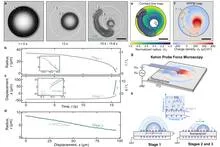
A water droplet on a fluoropolymer film initially behaves as expected: it sits and evaporates. But once it shrinks to a quarter of its initial size, it suddenly takes off and, within fractions of a second, covers a distance several times its own radius. Then it crawls slowly but persistently, leaving behind an invisible trail of electric charges. That trail is what drives the motion.
General Relativity2026-08-021 minarXiv:2608.01152express
The Hidden Twin of a Black Hole's Spin
The Kerr-NUT black hole is not just a cosmic vacuum cleaner. It's a solution to Einstein's equations where the hole has mass, rotation, and a strange NUT parameter. This parameter behaves like a magnetic charge for gravity: seemingly invisible, yet it alters the properties of surrounding space.
HEP Theory2026-07-242 minarXiv:2607.22938express
How Mass and Charge Swap Roles in a Multidimensional World
A carousel doesn't just spin you around in a circle — with each revolution, it also slightly screws itself into the ground. This corkscrew-like motion is the essence of the NUT charge, a special property of spacetime that physicists have been studying since the mid-20th century.
Strongly Correlated2026-03-252 minarXiv:2603.24453express
How an Electron Loses Itself in a One-Dimensional World
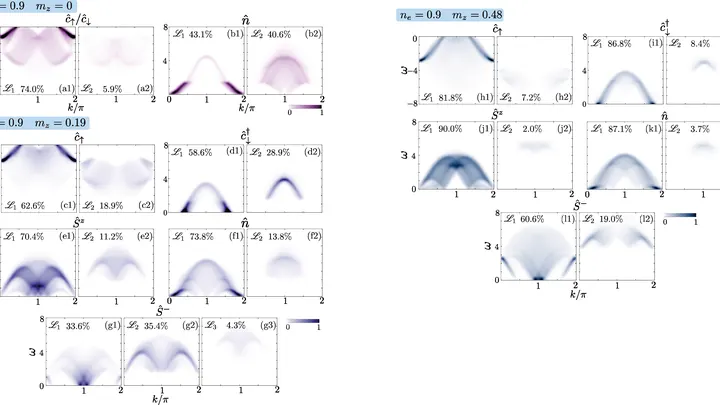
An electron in an ordinary wire is like a courier carrying both a package and the recipient's signature at once: its charge and spin are always together. But if the wire is made just one atom thick, the courier gets cramped. In such a one-dimensional tube, electrons cannot overtake each other, and their collective behavior changes beyond recognition.
Fluid Dynamics2026-01-262 minarXiv:2601.18465express
The Hidden Force on Leaves
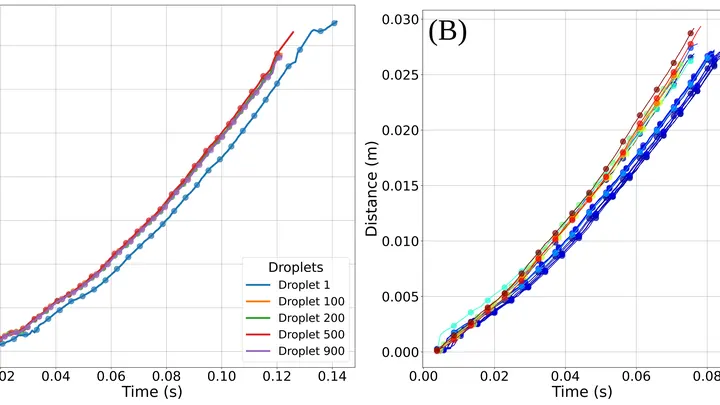
A water droplet races across a taro leaf like a bead on a freshly waxed floor. But it doesn't just glide: it picks up electricity. Thirty years ago, scientists explained why lotus leaves stay dry: their surface is covered with microscopic bumps that trap air. Now it turns out that water on leaves has another, hidden power.
General Relativity2026-01-221 minarXiv:2601.16325express
Gravity and Charge: Physics' Blind Spot
Since the days of Galileo, it was believed that in a vacuum all bodies fall identically. Einstein elevated this to a principle: gravity travels at the speed of light and is the curvature of spacetime.