A skyrmion core resolves the Landauer paradox
Context
Ferroelectric switching underpins nonvolatile memory and logic devices, yet the fundamental question of how an ideal single-domain crystal reverses its polarization has remained open for nearly 70 years. Classical Landauer nucleation theory predicted a barrier above $10^8$ kBT, which would make switching impossible, and the observed coercive fields were explained only by defects or interfaces. The work stands somewhat apart: neighboring studies in the archive deal with quasiparticles, squeezed states and quantum-like models, but there is no direct connection to topological nucleation in ferroelectrics.
Methods
The authors carried out large-scale molecular dynamics simulations of defect-free PbTiO3 using a machine-learned force field trained on first-principles calculations. The critical nucleus was identified with the revised persistent embryo method (rPEM): a small nucleus of opposite polarization was inserted into the single-domain crystal, stabilized by a bias potential, and then the potential was gradually removed until the saddle point was reached. The shape of the nucleus was not prescribed in advance, which made it possible to discover an unexpected topological texture.
Results
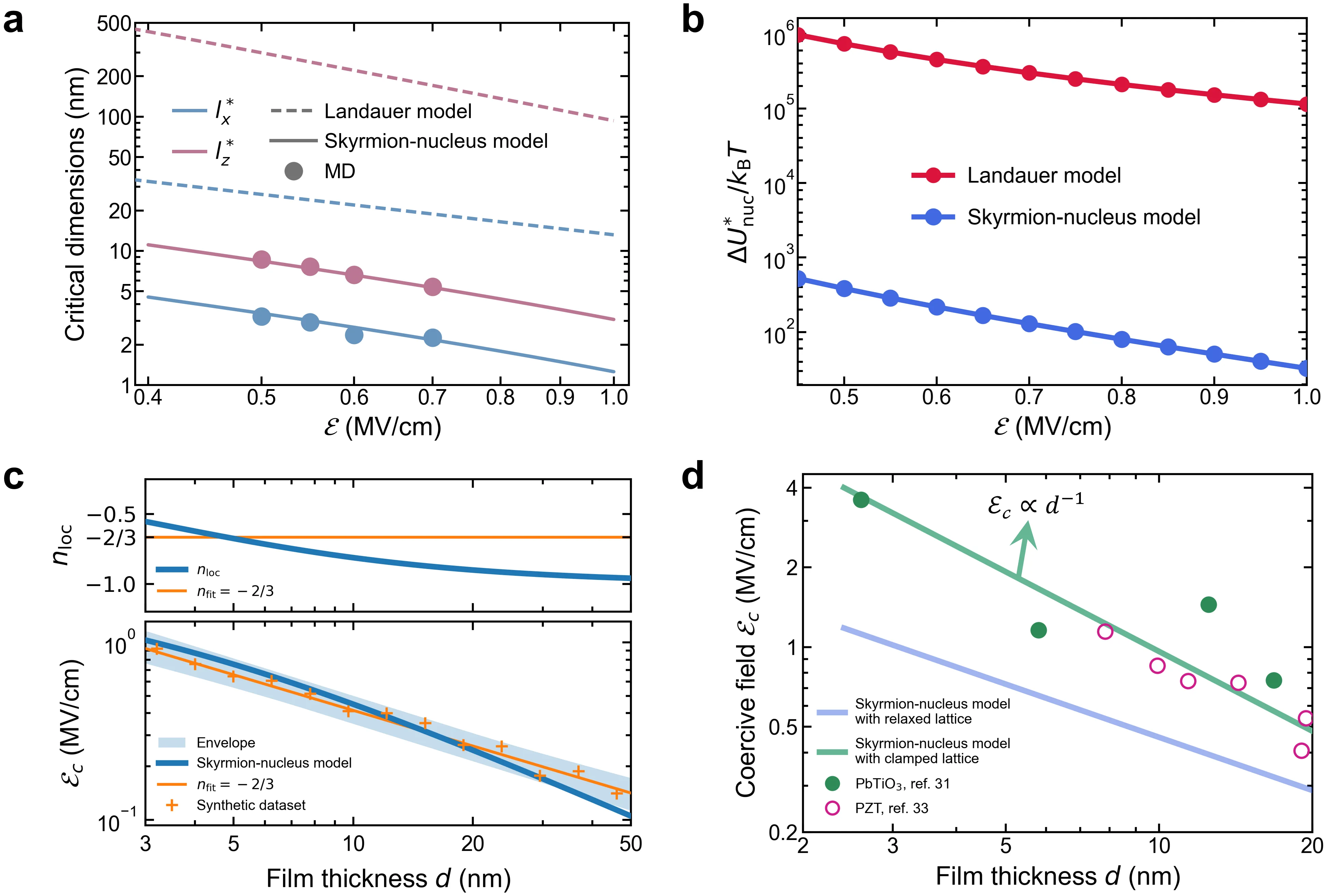
At 300 K and a field of 0.55 MV/cm, the critical nucleus turned out to be a polar skyrmion with a lateral size of 3.2 nm and a vertical size of 8.0 nm, a topological charge Q = -1 and Neel-type walls. The continuous rotation of the polarization reduces the effective bound-charge density by nearly two orders of magnitude (to 0.047 Ps/a), and enhanced dielectric screening further suppresses the depolarization energy to 0.42 kBT, against 2.9×$10^5$ kBT in the Landauer model. An analytical skyrmion-core model predicts a coercive field of 0.3 MV/cm for a 20 nm PbTiO3 film, in agreement with experiment. The Janovec-Kay-Dunn law with its -2/3 exponent turns out to be only an effective approximation over a finite thickness window: the local exponent varies continuously from -1 in thick films to -0.55 in ultrathin ones.
Implications
The work shows for the first time that a standard Landau-type phase transition can proceed kinetically through a topological transition state rather than through a uniform reversal of polarization. Unlike neighboring studies, which examine equilibrium or metastable topological textures in superlattices, here the skyrmion emerges as the saddle point of a nonequilibrium process and governs the switching kinetics. This changes our understanding of the intrinsic switchability of ferroelectrics and links the macroscopic coercive field to a microscopic parameter, Ps/Kloc, that can be computed from first principles.
Future development
The idea of hidden topological transition states could be extended to other symmetry-breaking phase transformations, for example in magnetic or ferroelastic materials. The proposed descriptor Ps/Kloc opens a path to the predictive design of ferroelectrics with a tailored thickness dependence of the coercive field, which matters for device miniaturization.
Impact
The results will influence ferroelectric physics, oxide materials science and the development of nonvolatile memory, where control of switching at the nanoscale is critical.
Next steps
The next step will be an experimental test of the skyrmion core's existence using high-resolution transmission electron microscopy or time-resolved X-ray diffraction.
Key open problems
The work connects the long-standing problem of the kinetic unswitchability of ideal ferroelectrics with modern topological-defect physics. Open questions remain about the role of temperature, defects and interfaces in stabilizing or suppressing the skyrmion mechanism in real materials.
The skyrmion core in a 20 nm PbTiO3 film is only 3.2 nm across, comparable to a few unit cells, yet its topological charge protects the texture from falling apart.
In Greg Egan's novel Schild's Ladder, topological defects in the vacuum govern the laws of physics; here a topological defect in polarization governs how a material switches, echoing the idea of hidden topological states as organizers of dynamics.
Key numbers
- Bound-charge density in the skyrmion core: 0.047 Ps/a (versus 2 Ps/a in the Landauer model)
- Depolarization energy: 0.42 kBT (versus 2.9×10⁵ kBT)
- Coercive field for 20 nm PbTiO3: 0.3 MV/cm
- Size of the critical skyrmion: 3.2 nm × 8.0 nm
- Topological charge: Q = -1