Skyrmion core resolves the Landau paradox
In a perfect crystal of lead titanate, the atoms line up like soldiers on parade: all electric dipoles point the same way. To flip that formation by 180 degrees, old calculations demanded energy comparable to heating the crystal to millions of degrees. Such a barrier made polarization switching impossible, and for nearly 70 years physicists explained the observed behavior through defects and boundaries. But a simulation with not a single defect showed that a vortex is born inside the crystal, bypassing the prohibition.
This vortex is called a polar skyrmion. Unlike a uniform reversal, where all dipoles turn simultaneously and create a huge electric charge on the surface, the skyrmion twists the polarization smoothly, like a whirlpool in a river. Each successive atomic layer is rotated slightly relative to the previous one, so the bound charges compensate each other almost completely. The uncompensated charge density drops from 2 units to 0.047, and the depolarization energy (the penalty for charge separation) decreases by hundreds of thousands of times.
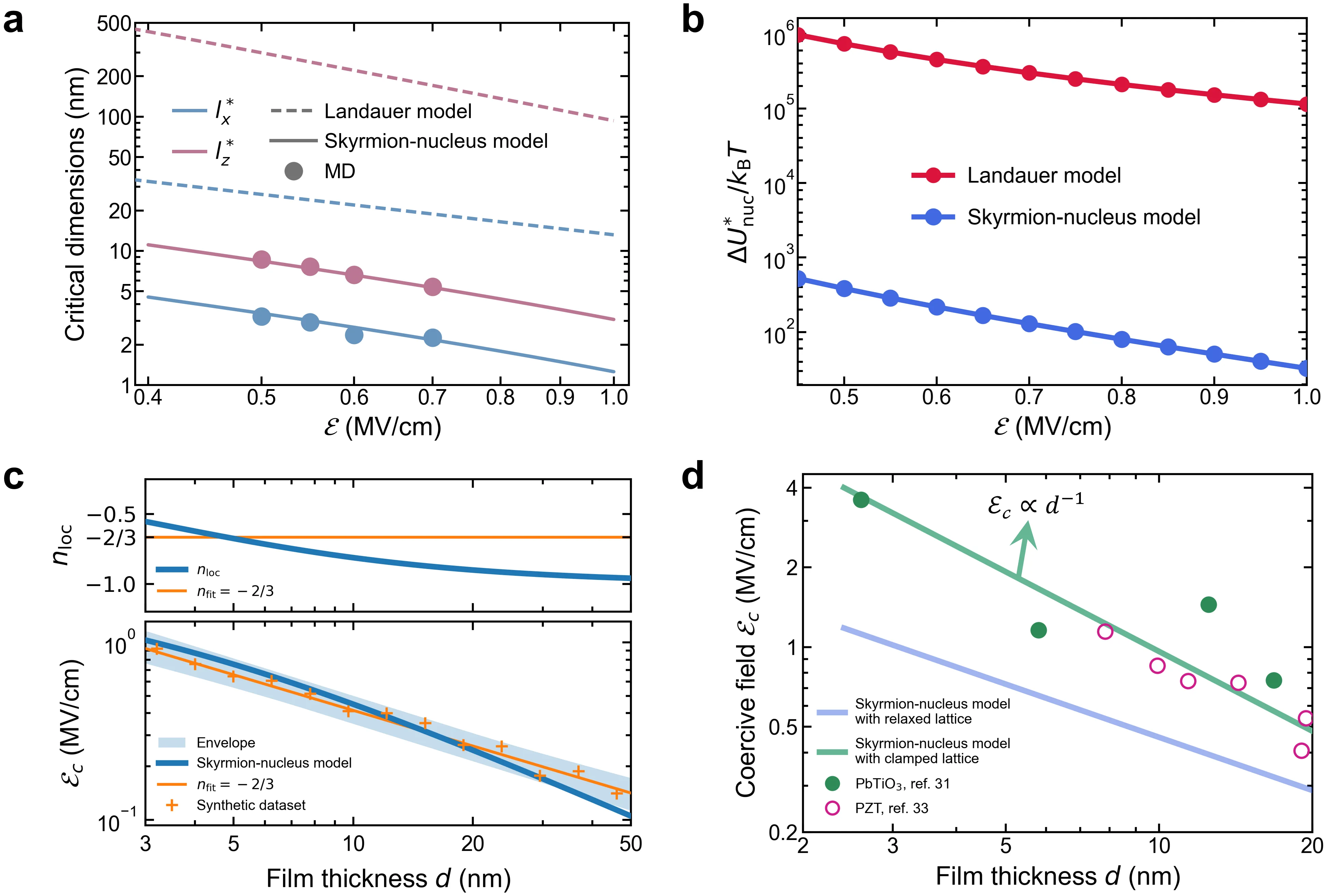
The authors used molecular dynamics with a machine-learned potential that reproduces quantum calculations but allows tracking millions of atoms. Instead of manually defining the nucleus shape, they placed a small nucleus of opposite polarization into the crystal and stabilized it with an external field. Then the field was gradually removed, and the nucleus evolved on its own to the saddle point—the critical state after which irreversible growth begins. It turned out that this state is not a flat wall but a three-dimensional vortex with topological charge Q = -1.
Topological charge means the vortex cannot be smoothed out by continuous deformation without tearing the texture. It is protected, like a knot in a rope. This protection explains why the skyrmion nucleus is stable and why switching proceeds through it rather than through the energetically more costly uniform rotation. An analytical model built on this discovery predicts a coercive field (the minimum field for switching) of 0.3 MV/cm for a film 20 nanometers thick, which matches experiment.
Previously it was thought that an ideal ferroelectric could not switch, and thus its behavior was determined by defects. Now it is clear that the material itself can bypass the barrier by creating a hidden topological state. The Janovec–Kay–Dunn law, which linked the coercive field to film thickness as a power of -2/3, turned out to be only an approximation. In thin films the exponent varies from -1 to -0.55, and the entire dependence is governed by a single parameter: the ratio of spontaneous polarization to the local lattice stiffness.
This discovery changes more than our understanding of ferroelectrics. If a phase transition can proceed not through a uniform change but through a topological vortex, then similar hidden states may govern other transformations: in magnets, ferroelastics, superconductors. The whirlpool in the river that we saw in the crystal may exist in every material that changes symmetry.
The skyrmion core in a 20 nm PbTiO3 film is only 3.2 nm across, comparable to a few unit cells, yet its topological charge protects the texture from falling apart.
In Greg Egan's novel Schild's Ladder, topological defects in the vacuum govern the laws of physics; here a topological defect in polarization governs how a material switches, echoing the idea of hidden topological states as organizers of dynamics.