Atomic Mosaic: A Bit in a Square Less Than a Nanometer Wide
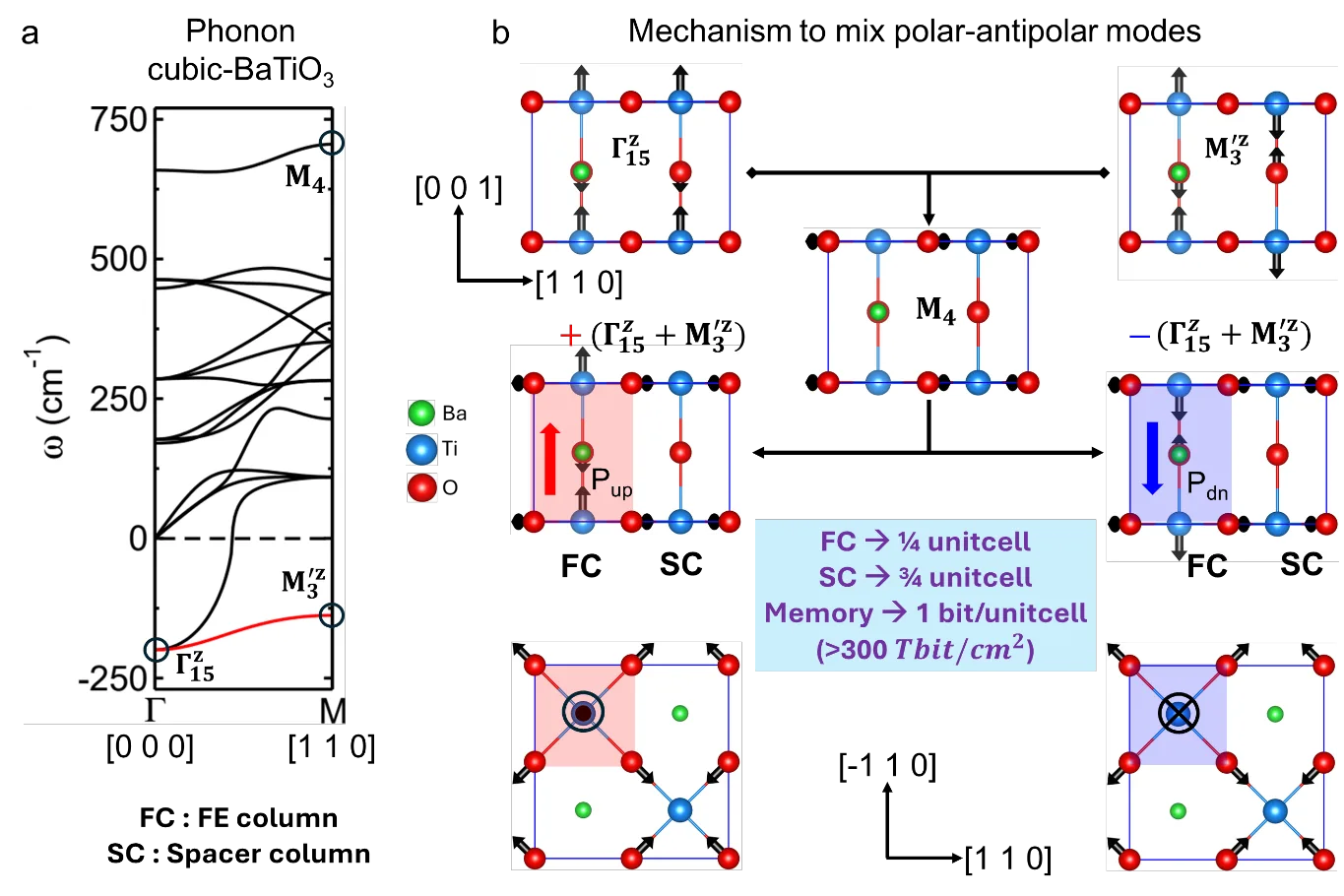
An atomic mosaic where every piece switches on its own has long been out of reach. In an ordinary memory material, a ferroelectric, neighboring pieces are coupled. Flip one and the others follow, so the pieces have to be made large, several nanometers across.
Scientists have found a way to break that coupling. They stacked an ultrathin sandwich: a layer of barium titanate one atom thick, then a layer of barium zirconate, and so on. Zirconium atoms are larger than titanium atoms, so the oxygen cages around them tilt. As a result, lattice vibrations change in such a way that neighboring cells stop feeling each other.
Such a tiny piece means enormous storage density: 320 terabits per square centimeter. A postage stamp could hold several million books. Switching takes very little energy, so the memory will be efficient. What remains is to grow such layers in the lab and test how they perform in a real device.
A density of 320 Tbit/cm² means that an area the size of a postage stamp could store the contents of several million books.
The idea of storing information in individual atomic cells echoes the concept of "atomic memory" in Arthur C. Clarke's novel The City and the Stars, where knowledge was stored in crystalline structures.