Sub-nanometer ferroelectric domains from a flat polar band
Context
Ferroelectric memory stores a bit in the direction of a domain's spontaneous polarization. The smaller the domain, the higher the storage density. But in ordinary ferroelectrics the polar phonon band is dispersive, and condensing the soft mode requires domains of finite size (a few nanometers and larger). A flat band removes this constraint: it stabilizes ultra-narrow domains with nearly zero domain-wall energy. Until now, only a one-dimensional flat polar band was known, in hafnium oxide, giving linear domains half a cell wide. A two-dimensional flat band remained elusive, even though it is exactly what is needed for square domains and maximum density. The work stands apart: the archive around it holds studies of superlattices, ferroelectrics and superconductivity, but there are no direct neighbors on two-dimensional flat polar bands.
Methods
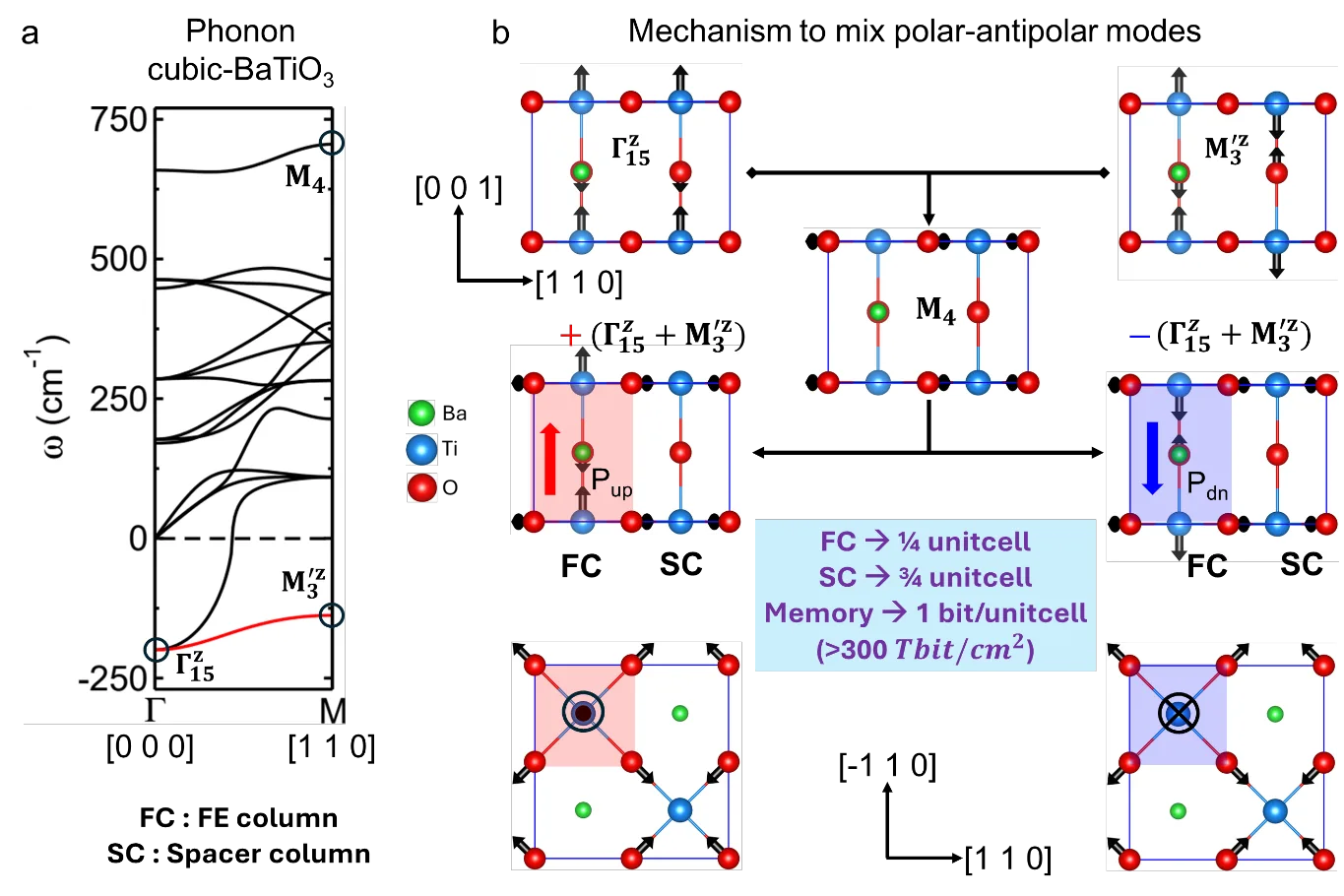
The authors mixed polar and antipolar modes in a (BaTiO3)1/(BaXO3)1 superlattice (X = Zr, Sn) with columnar ordering. Symmetry analysis showed that the mixing of the Γ15z and M3'z modes is mediated by the antipolar M4 mode. In bulk BaTiO3 this mode is stiff and does not condense, but in the superlattice the difference in atomic radii of Ti and Zr/Sn shifts the oxygen octahedra so that the M4 mode arises naturally. Density functional theory (DFT) calculations with the PBEsol functional and lattice dynamics (DFPT) showed that in the superlattice the polar band becomes flat across the entire Brillouin plane.
Results
In the ferroelectric P4mm phase of the BT1/BZ1 and BT1/BS1 superlattices, the polar phonon band is flat along the Γ–X–M–Γ directions. This means the dipoles are localized in the xy plane and barely interact. Switching a single dipole in a 4×4×1 supercell gives a stable configuration with a domain-wall energy of just 2.2 (1.5) mJ/m². The polarization in the switched cell holds at −19.8 (−18.5) µC/cm², close to the bulk value. The switching barrier for a single dipole, estimated by the NEB method, is 0.135 (0.083) eV per unit cell and matches the Landau barrier. The domain density reaches ~320 (~303) Tbit/cm² if one bit is counted per domain. This is a record among known ferroelectrics.
Implications
The work differs from its archive neighbors in that it realizes, for the first time, a two-dimensional flat polar band in a ferroelectric. Neighboring studies examine superlattices, ferroelectric films and superconductivity, but do not achieve sub-nanometer square domains. Here a domain occupies a quarter of a unit cell, and the domain-wall energy is nearly zero. This changes the picture of the minimum size of a ferroelectric domain and opens a path to memory whose density is limited only by the atomic scale.
Future development
Two-dimensional flat polar bands can be sought in other superlattices and interfaces. Three-dimensional flat bands may be possible if dispersion can be suppressed in all directions. Experimental realization of columnar BT1/BX1 superlattices on MgO substrates looks achievable, which would allow the predictions to be tested and real switching characteristics to be measured.
Impact
The results will influence the development of ultra-dense nonvolatile memory, neuromorphic computing, and devices that require atomic-precision control of polarization.
Next steps
The next step is to synthesize columnar BT1/BZ1 and BT1/BS1 superlattices and confirm the ultra-dense domains experimentally. It is also important to study switching dynamics at room temperature and the influence of defects.
Key open problems
The work is directly tied to the problem of the minimum size of a ferroelectric domain. Until now it was thought that dispersion of the polar mode imposes a fundamental lower bound. A flat band removes this constraint, but a question remains: how stable are such domains at finite temperature, and how do they interact with defects and electrodes?
A density of 320 Tbit/cm² means that an area the size of a postage stamp could store the contents of several million books.
The idea of storing information in individual atomic cells echoes the concept of "atomic memory" in Arthur C. Clarke's novel The City and the Stars, where knowledge was stored in crystalline structures.
Key numbers
- domain density: ~320 Tbit/cm²
- domain area: 0.31 nm²
- domain-wall energy: 2.2 mJ/m²
- switching barrier: 0.135 eV/cell
- local polarization in the column: 101.2 µC/cm²