Atomic Mosaic: How to Switch Tiles a Quarter of a Unit Cell Wide
A mosaic of atoms where each tile switches on its own long remained a beautiful but impractical idea. In an ordinary ferroelectric, a material that stores a bit through the direction of its electric polarization, neighboring tiles are coupled. To flip one, you have to drag others along, and the pattern comes out coarse: domains several nanometers wide, not one atom.
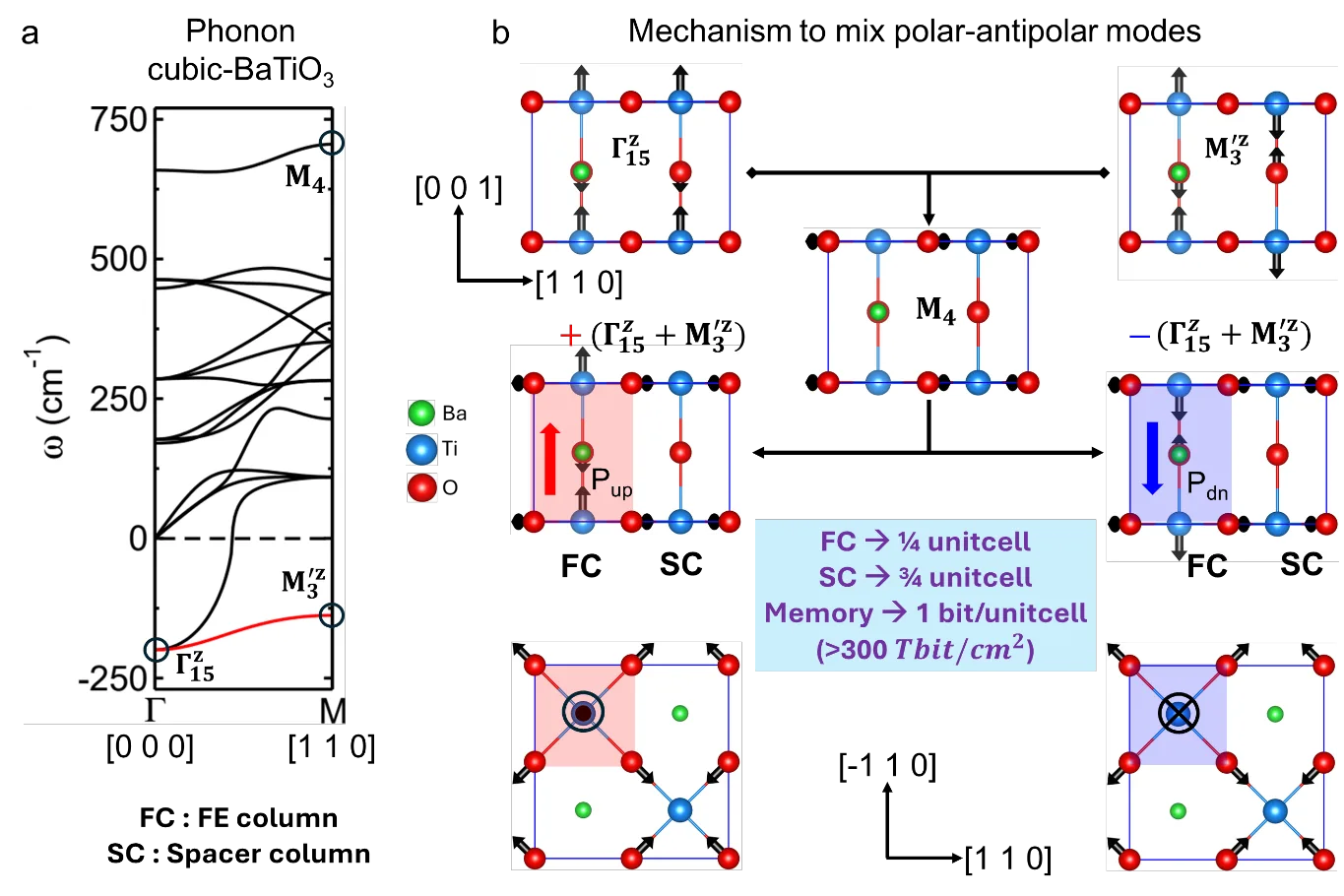
It turned out that the coupling between tiles can be almost completely severed. To do this, layers of barium titanate one unit cell thick are alternated with layers of barium zirconate or stannate. Zirconium or tin atoms are larger than titanium, so the oxygen cages around them tilt slightly. A special pattern of crystal-lattice vibrations arises, one that damps the interaction between neighboring cells.
Supercomputer calculations showed that in such a mosaic one tile can be flipped without touching the rest. The domain occupies a quarter of a unit cell, and its boundary energy is only 2.2 millijoules per square meter. For comparison: in ordinary ferroelectrics this energy is hundreds of times larger.
The practical payoff is immediately visible. The recording density reaches 320 terabits per square centimeter. On the area of a postage stamp you could fit the contents of several million books. At the same time, switching a single tile requires only 0.135 electronvolts, which promises low energy consumption.
The atomic mosaic has ceased to be a metaphor. Now it is an engineering task: grow such ultrathin layers on a magnesium oxide substrate and test how the tiles switch in a real device. If experiment confirms the calculation, memory with atomic precision will move from science fiction to mass production.
A density of 320 Tbit/cm² means that on an area the size of a postage stamp you could store the contents of several million books.
The idea of storing information in individual atomic cells echoes the concept of 'atomic memory' from Arthur C. Clarke's novel The City and the Stars, where knowledge was stored in crystalline structures.