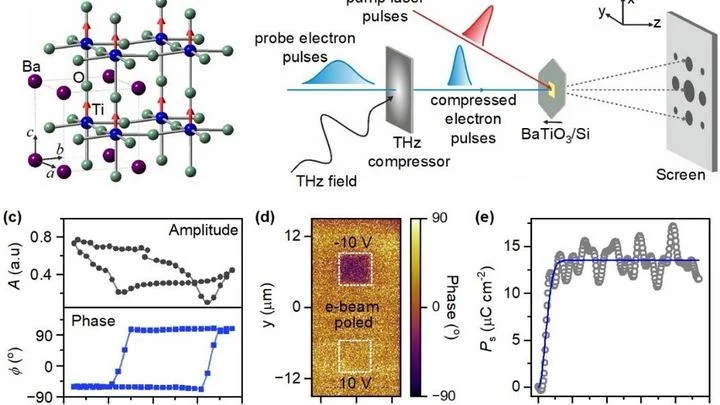
Barium titanate (BaTiO₃) is a crystalline oxide that belongs to a class of materials called ferroelectrics. In its ferroelectric phase, it possesses a spontaneous electric polarization that can be reversed by an applied electric field. It is also piezoelectric, meaning mechanical stress generates an electric voltage, and vice versa. Because of these properties, barium titanate is a model material for studying the photogalvanic effect — the generation of a steady electric current in a crystal when illuminated by light, without any external voltage. This effect arises from the asymmetric crystal structure, which allows light to drive charge carriers in a preferred direction.
History
Barium titanate was discovered during World War II, independently in the United States, the Soviet Union, and Japan, around 1943–1944. Its ferroelectric properties were identified shortly after, making it the first ferroelectric ceramic and a cornerstone of modern electronics.
How it works
The photogalvanic effect in barium titanate relies on its non-centrosymmetric crystal structure. When light is absorbed, it excites electrons from the valence band to the conduction band. In a symmetric material, these excited electrons move randomly, producing no net current. But in barium titanate, the lack of inversion symmetry means that the probability of an electron moving in one direction is higher than in the opposite direction. This asymmetry, combined with the material's ferroelectric polarization, creates a net drift of charge carriers, resulting in a measurable photocurrent. The direction and magnitude of this current depend on the light's polarization and the crystal's orientation.
In practice
Barium titanate is widely used in multilayer ceramic capacitors, piezoelectric sensors and actuators, and nonlinear optical devices. In research, it serves as a testbed for understanding photovoltaic effects in ferroelectrics, which could lead to more efficient solar cells.
Fun fact
Barium titanate's piezoelectric coefficient is so strong that a thin film of it can generate enough voltage to power micro-electromechanical systems (MEMS) just from mechanical vibrations.
A transparent film of bismuth tungstate sits on a substrate and does not conduct electricity. Three minutes in a cloud of nitrogen plasma, and it turns black, with resistance dropping by a factor of a billion.
Light born when a fast electron enters a material is usually assumed to be the same in all directions. But in crystals where optical properties depend on direction, that's not the case. Run your hand over velvet: one way it's smooth and shiny, the other — dark and rough. Similarly, a crystal responds differently to light depending on how it's oriented.
You can make light turn on command, like water in a hose — if you know where to squeeze. That's what electro-optic circuits do: they change the direction of a beam inside a chip using an electric field. The classic material for such tricks is lithium niobate, a crystal that responds to voltage like a string to a pluck.
A translator who has memorized all the lines in advance responds instantly — no need to listen to the whole conversation again. That's how the new model works: instead of running atoms through a computer for hours, it immediately outputs the crystal's free energy at any temperature and pressure.
Electricians working with high voltage are like divers: they need to see what's happening deep underwater without going down themselves. What's needed is a sensor that stays away from the dangerous current and relays information to the surface. Usually, light is used: a beam passes through a transparent crystal, and the electric field slightly rotates it.
In a pot of water, microscopic spheres, colloidal particles, are floating. Each sphere is coated with long polymer chains that look like a brush and carries an electric charge. If you get the temperature and solution composition right, the spheres start arranging themselves into ordered patterns — crystals.
A stack of playing cards lies still. You can slide the top card with your finger: that's crude intervention. Or you can blow so that the whole stack momentarily changes shape, but the cards don't scatter. That's roughly how light, in a new experiment, rearranges a crystal of tin selenide (SnSe).
Usually, to change the structure of a solid, you heat it or pass a current through it.
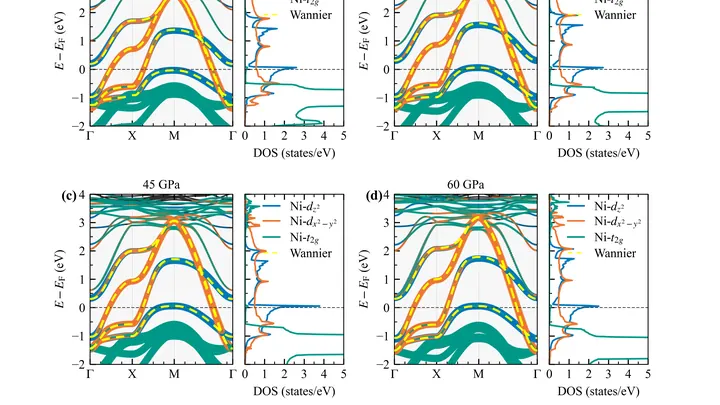
Under pressure, the layered crystal La₃Ni₂O₇ behaves like an orchestra where the conductor adjusts the volume of different instrument sections. Compression increases electron hopping between layers — which, one might think, should boost superconductivity. But at the same time, some electrons become too mobile.
A layered cake where each tier conducts electricity differently: that's the structure of the crystal La3Ni2O7, a compound of nickel, lanthanum, and oxygen. Current flows differently along the layers than across them.
In extreme cold — minus 268 degrees — a crystalline perovskite film starts transmitting light differently depending on its polarization. The beam seems to split in two: one part travels slightly faster, the other slightly slower.
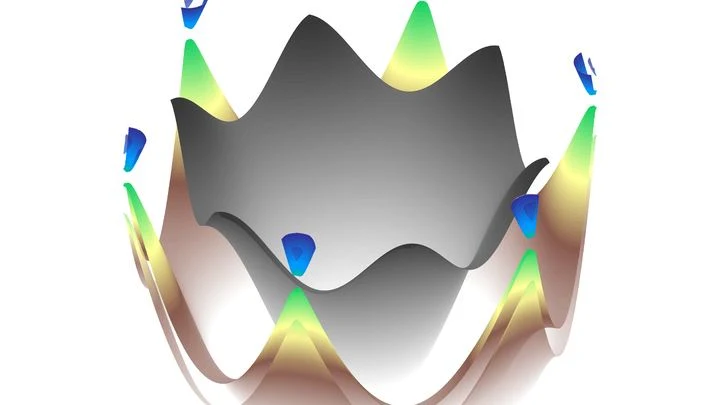
In a crystal, electrons are not distributed randomly. Their waves obey the lattice symmetry, like ripples on water taking the shape of a hoop thrown into it. The new work shows that at high-symmetry points, this ripple must have nodes — places where electron density is strictly zero.
The solar wind rushes from the Sun to Earth, but the magnetosphere bends the flow and sculpts it into plasma tails. The same motif plays out at the heart of galaxies: jets from accretion disks around black holes are twisted by the invisible hand of a magnetic field.
The thinner the ferroelectric film, the stronger the depolarizing field — a dictate of classical physics. Imagine a pencil balancing on a fingertip: the shorter it is, the harder to keep it upright. Nanoscale polarization likewise strives to vanish.
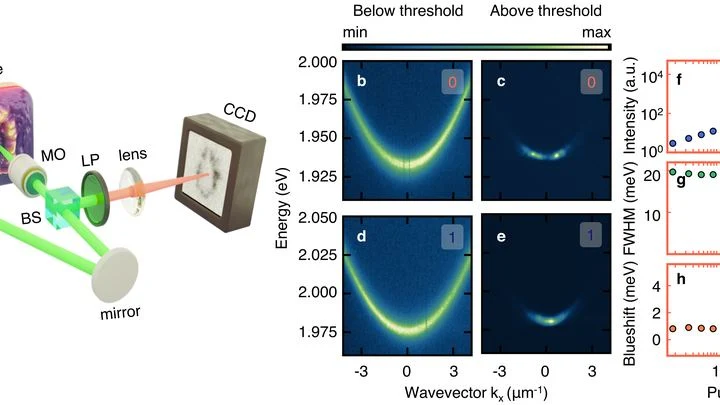
Generative neural networks that create images typically rely on digital randomness. But a team of researchers built a system where randomness is born not in code, but in a tiny optical cavity filled with an organic dye.
A potter uses a sharp stylus to trace a pattern on a still-damp clay tile. One wrong move, and the line blurs, the tile cracks. Physicists work with films of the high-temperature superconductor YBCO (a compound of yttrium, barium, copper, and oxygen) in much the same way.
Imagine a carousel with two types of seats: some spin clockwise, others counterclockwise. If you push all of them at once, the carousel jerks but stays in place. That's how a Weyl semimetal crystal works: electrons are born in pairs—'left' and 'right'—and their contributions to current cancel each other, like two identical motors running in opposite directions.
The dance floor is full of couples waltzing. Usually, partners move in opposite directions: one steps forward, the other backward, to keep the overall rhythm.
Quantum vacuum resembles a sea, constantly rippling with tiny splashes. An electron in an atom moves in this sea, and its path slightly changes due to the waves. Previously, such corrections were accurately calculated only for hydrogen-like ions with a single electron. But in highly charged ions with several electrons, the picture becomes more complex.
Barium titanate is an electro-optic material that can control the speed of light with an electric voltage. This property has long attracted developers of optical chips, but creating a perfectly flat epitaxial film on silicon remained an unsolved challenge.
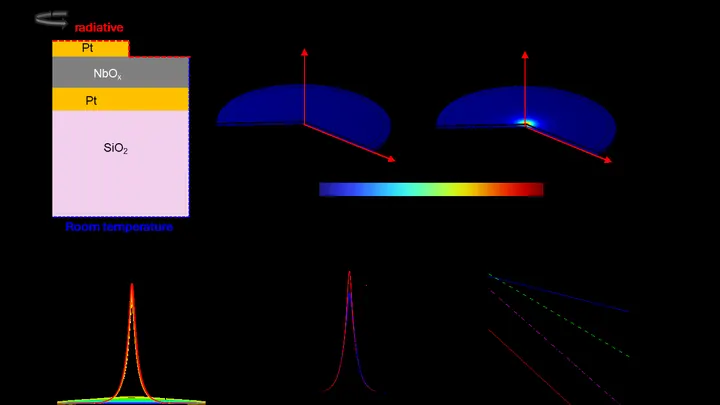
An ordinary kitchen knife made of niobium would suddenly start conducting electricity with zero loss at −258 °C. That's how superconductivity works, and you can "switch it on" right at the metal's surface by blasting it with a laser in a nitrogen atmosphere.
A memristor is a resistor with a memory: after the current is turned off, it retains its resistance. Inside, a thin film of metal oxide is sandwiched between two metal electrodes. When a strong current is first passed through the device, conductive filaments of oxygen vacancies form in the oxide, and the resistance drops sharply.
A lithium battery is like a sandwich: two slices of bread are the electrodes, and the filling between them is the electrolyte, through which lithium ions shuffle back and forth. In conventional batteries, the filling is liquid, like a sauce, and it can leak or catch fire.
Ruthenium oxide has long been regarded as a textbook altermagnet — a material where magnetic moments of neighboring atoms point in opposite directions but do not fully cancel due to the crystal's special symmetry. New measurements show that inside the crystal, there is no magnetism at all. All the magnetic action is confined to the surface.
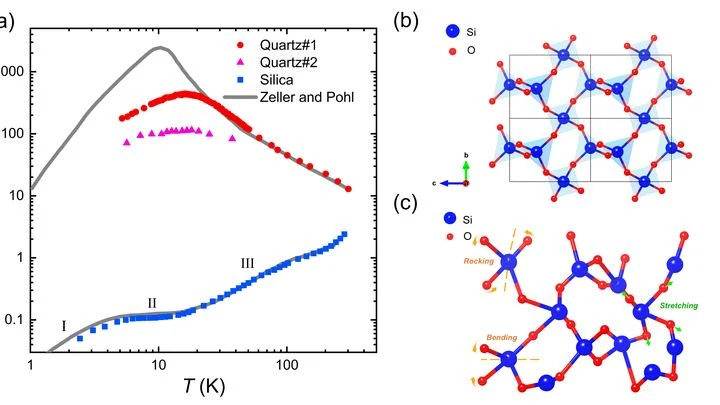
If you push heat through a piece of quartz, it usually goes straight, like water through a pipe. But switch on a magnetic field, and the flow veers slightly sideways, as if the pipe suddenly grew a side branch.
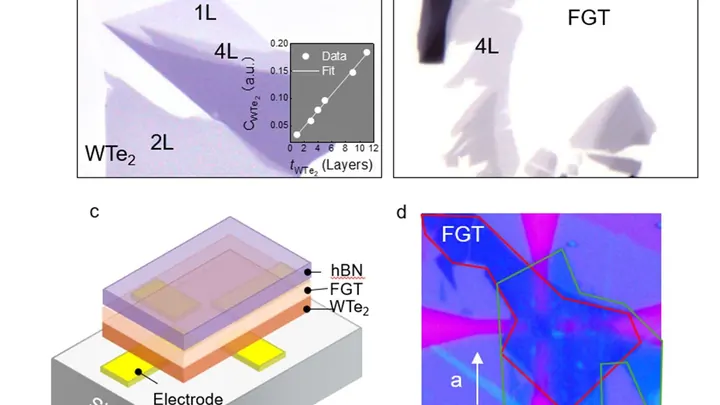
Usually, current in a metal acts like boiling water on ice: it heats the material and destroys magnetic order. But in a layered structure of tungsten ditelluride and the ferromagnet Fe3GeTe2, current behaves differently.
A barium titanate crystal is like a crowd where everyone holds a pointer. Normally, the pointers face in random directions, but when you apply an electric field, they all snap to point the same way. This ordered state is called ferroelectric: it stores information the way a compass needle stores direction.
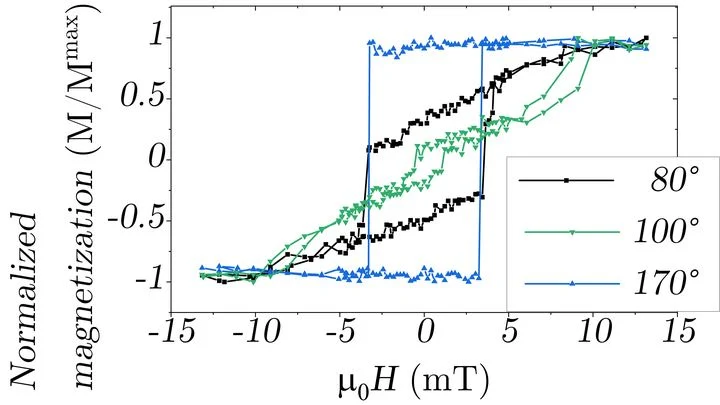
The Fe₃Sn₂ crystal looks like a patterned lattice where iron atoms sit at the corners of hexagons. Under normal conditions, their magnetic arrows are aligned neatly, like soldiers in a row. But squeeze the crystal, and the alignment breaks.
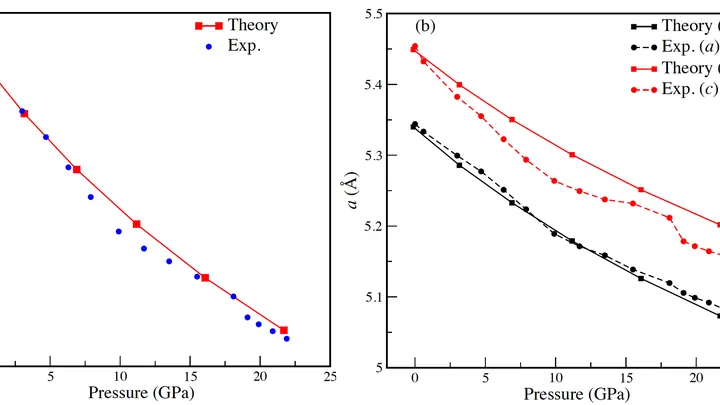
Under a pressure of about 20 gigapascals (imagine twenty elephants standing on your thumbnail), the lattice slightly rearranges.
Inside a barium titanate crystal, there's a built-in electric field, like a permanent magnet, but for charges. When a flash of light hits it, electrons are knocked loose and start darting around, colliding with atoms. But the crystal isn't the same in all directions: it has an axis along which the field is strongest.
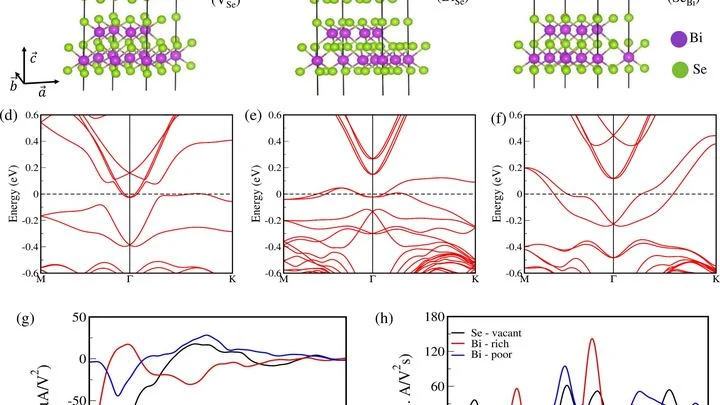
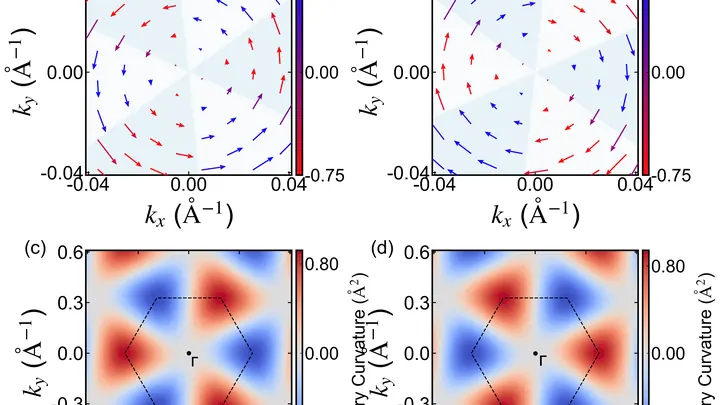
The crystal bismuth selenide (Bi₂Se₃) is symmetric by itself, like a neatly stacked sandwich: flip it over, and nothing changes. But twist one layer slightly relative to the other, and the symmetry breaks. The material begins to 'feel' which side the light comes from and responds with an electric current.
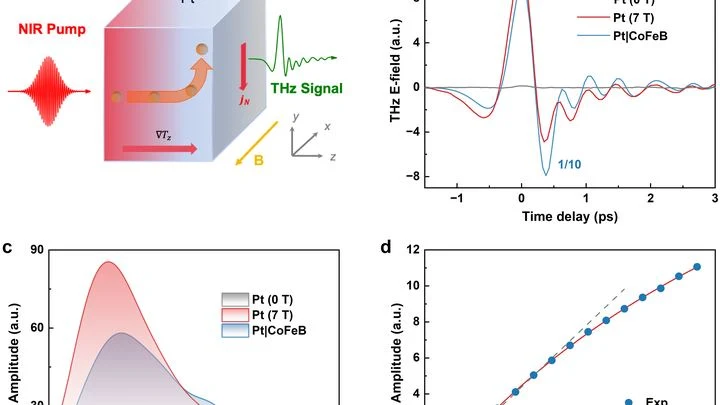
Usually, to generate terahertz waves (light between microwaves and infrared), researchers build a sandwich of different metals. One layer acts as the source, another as the receiver of charges. In such designs, platinum was assigned the role of a simple conductor. But it turns out it can work alone.
A solar cell is like a heart: if you force it to beat out of rhythm, it tires quickly. Usually, cells are tested by applying reverse voltage, but in real life, a shadow from a leaf or a bird forces neighboring cells to pass foreign current through themselves.
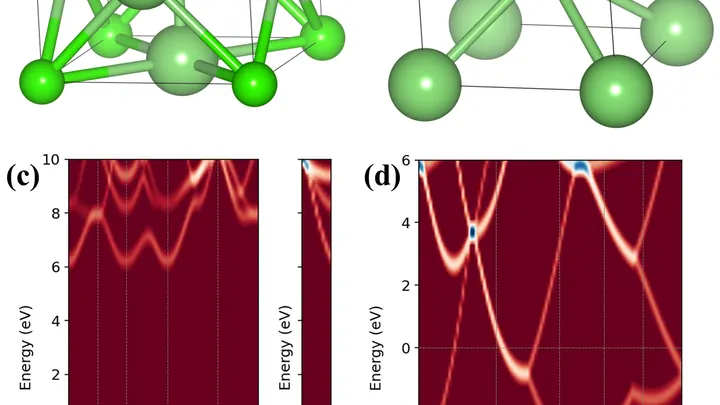
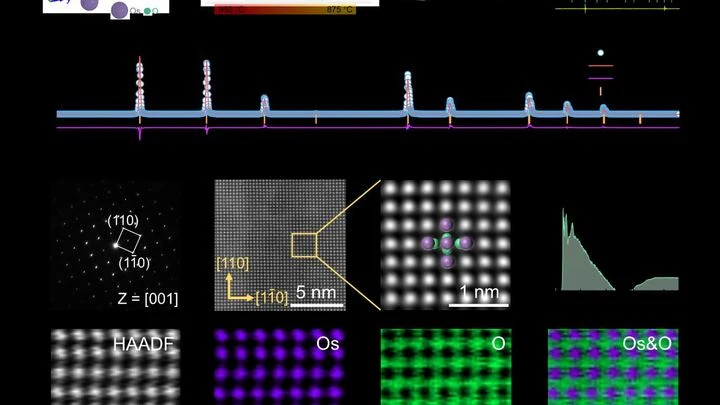
A crystal of osmium dioxide, OsO₂, is like a stubborn teenager: under ordinary conditions it behaves like a typical metal, but press hard enough and its character changes.
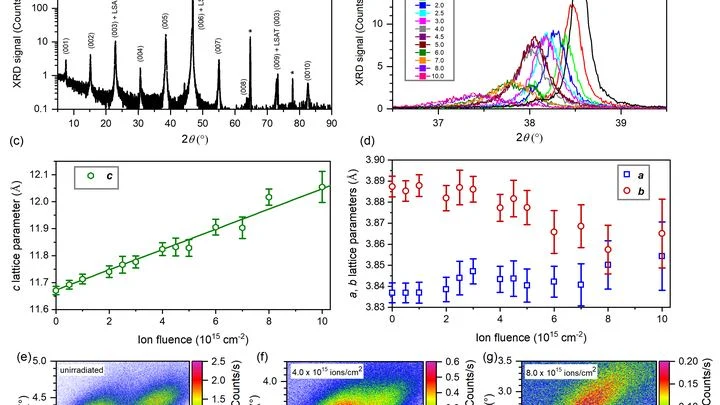
A beam of charged particles, like a fine pen, draws an invisible pattern on a metal film. Where it touches, the material changes its internal atomic order: from a close-packed arrangement, like a pyramid of oranges in a crate, the atoms rearrange into a looser one, like cubes stacked in a box.
Light can get stuck inside tiny structures, like sound in a perfectly tuned bell: the energy does not escape, even though there are no walls around. Such states are called 'bound states in the continuum'—light is trapped but not confined in a box. Until now, they were produced in ordinary crystals, where left and right directions are indistinguishable.
Silver niobium oxide, AgNbO₃, is a layered pie of silver, niobium, and oxygen atoms. At room temperature, it behaves like an ordinary dielectric, but when cooled, the atoms start to shift, and the crystal gains electric polarization, like a compass needle, but instead of pointing north, it points in the direction of the internal…
A laser flash hits a one-atom-thick layer of silver sitting on bilayer graphene, and within quadrillionths of a second, a gap opens in graphene's electronic structure where none existed before. It's as if an ordinary wire momentarily became a semiconductor: electrons stop flowing freely, and a band gap appears.
A crystalline film thinner than a human hair lies on a rigid substrate like a carpet nailed to the floor. The substrate prevents the film from freely changing shape when heated: it expands and contracts stiffly, losing sensitivity. In the new work, the film was separated from the substrate by dissolving an intermediate layer in water.
The crystal Ba4Ru3O10 was long considered a simple antiferromagnet: when cooled to 100 K, the spins of ruthenium atoms align in opposite directions, like rows of arrows pointing at each other. But new measurements show that at the same temperature, something more happens — a hidden charge density wave is born inside the material.
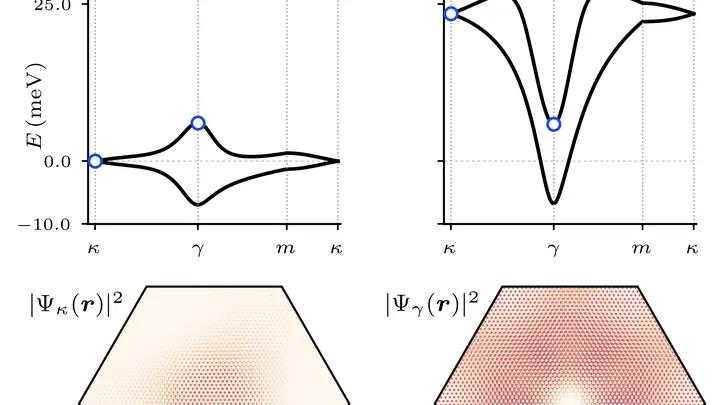
Twisted layers of atoms in a material form a pattern of tiny regions, domains, each of which can be electrified in one of two directions, like a compass needle pointing north or south. Previously, such materials were studied only as a whole, measuring thousands of domains at once, and their collective behavior was like a choir where individual voices are not heard.
Heat one end of a conductor and keep the other cold, and electrons start flowing from hot to cold. Usually, this creates a voltage along the conductor, like water running down a tilted trough. But in some materials, electrons veer sideways, and the voltage appears across the conductor.