El errante helado Quirón rodeado de anillos y un disco exprés
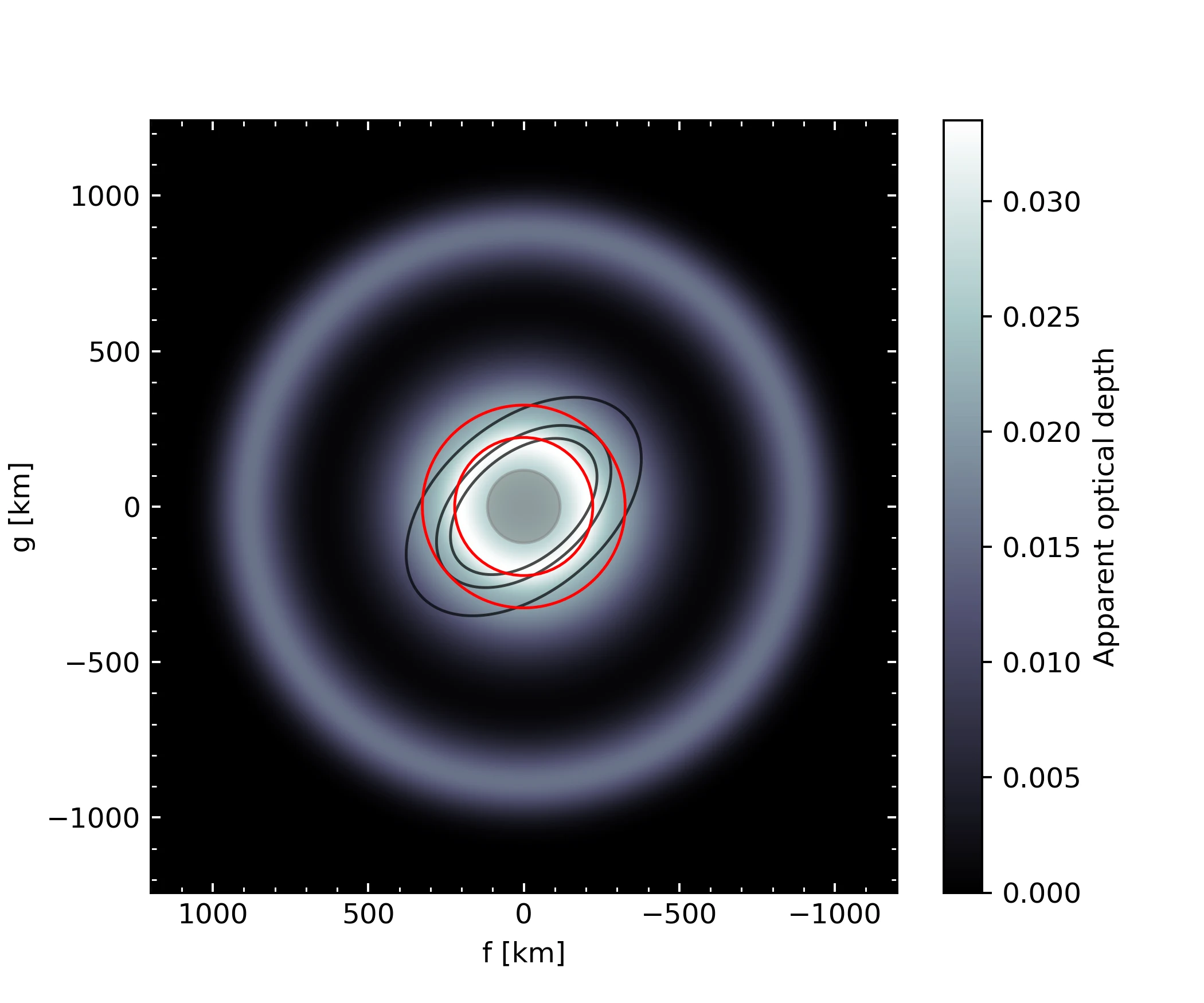
Solo al pasar frente a una estrella, Quirón reveló su secreto. Tres anillos helados rodearon el cuerpo de 200 kilómetros, un híbrido de cometa y asteroide. Antes solo se insinuaban mediante espectros de luz reflejada y variaciones de brillo. Pero ahora la estrella parpadeó tres veces y la danza circular helada se manifestó.
Las fuerzas gravitatorias ya no desgarran el polvo, permitiendo que se agrupe. Por qué vemos otro anillo en lugar de un satélite, se desconoce. Cerca hay un disco de polvo y un diminuto objeto en la periferia: probablemente, un embrión de luna.
La comparación de imágenes durante 30 años mostró que los anillos cambian. Hoy vemos cómo alrededor del errante helado se teje un nuevo sistema planetario, hecho de nieve y rocas.
Resumen original
tal como lo escribieron los autores, en inglés arXiv:2510.12388
The centaur (2060) Chiron has long been a candidate for hosting material in orbit, based on occultation and photometric and spectroscopic data. Here, we present a multichord stellar occultation observed on 2023 September 10 UT that reveals new and complex structures surrounding Chiron. High-cadence light curves show multiple secondary events that are best explained (when compared with a multishell interpretation) with a system of three confined rings located at average radii of 273, 325, and 438 km, the outermost of which lies beyond Chiron's Roche limit. The rings appear coplanar, with a mean pole orientation of {\lambda} = 151{\deg} +/- 4{\deg} and \b{eta} = 20{\deg} +/- 6{\deg}. A broader, disklike structure extends from about 200 to 800 km, and a newly detected faint feature is observed at ~1380 km. Chiron thus appears as the fourth small solar system body known for hosting a ring system. Comparisons with previous occultation events that have occurred since 1994 show that these features are not permanent. With these observations, we may witness for the first time the ongoing formation and evolution of a ring system.
Los anillos de Quirón no se pueden ver con telescopio: solo los delatan los rápidos parpadeos de las estrellas durante la ocultación.