Un collar cósmico con un enigma de carbono exprés
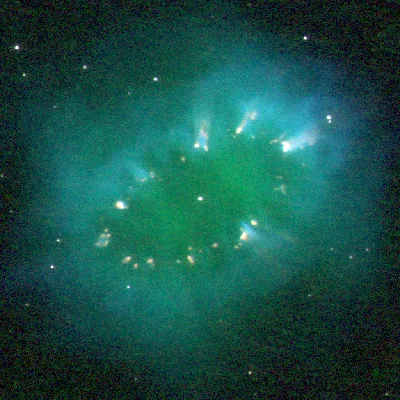
En lo profundo del espacio hay una nube de gas que parece un collar con cuentas brillantes. Es la nebulosa del Collar: los restos de una estrella que una vez se hinchó y engulló a su vecina. En el centro quedó un par: una pequeña estrella caliente y su compañera hinchada, rica en carbono.
Los científicos apuntaron el telescopio espacial Hubble hacia la nebulosa y observaron cuánto carbono hay en su parte interior. Resultó que hay poco carbono, como si alguien lo hubiera raspado con una cuchara. Pero la estrella compañera, justo al lado, está literalmente repleta de carbono. ¿Cómo pudo pasar esto?
Probablemente, la primera estrella, antes de morir, expulsó gas rico en carbono y la compañera lo atrajo hacia sí. Pero entonces, ¿por qué la parte interior de la nebulosa es pobre en carbono? Quizás ese gas voló más lejos, dejando el centro "vacío". O quizás solo vemos parte del panorama.
Este enigma recuerda a una novela de detectives: las pistas se contradicen, pero juntas cuentan la historia de cómo una estrella entregó su materia a otra. Y de cómo, de ese caos, nació un hermoso collar cósmico.
Resumen original
tal como lo escribieron los autores, en inglés arXiv:2601.19382
Context: The Necklace nebula is a bipolar, post-common-envelope planetary nebula, the central star of which has been shown to have a dwarf carbon star companion. Aims: We aim to understand the origins of the Necklace and its dwarf carbon central star. Methods: We study the carbon abundance of the nebula through far ultraviolet spectroscopy obtained with the Hubble Space Telescope. Furthermore, through simultaneous modelling of multiband light and velocity curves, we attempt to constrain the parameters of the central star system. Results: Puzzlingly, we find that the region of the inner nebula observed with the Hubble Space Telescope is seemingly not carbon-rich, at odds with the dwarf carbon star nature of the companion of the central star. The initial mass of the nebular progenitor was likely very close to the limit to become carbon-rich, perhaps experiencing a very late thermal pulse. The dwarf carbon star companion is found to be significantly inflated with respect to that expected for an isolated main sequence star of the same mass. Conclusions: The properties of the central binary are consistent with the progenitor having become carbon-rich and its companion having accreted a significant amount of that carbon-enriched material. However, it is unclear how this evolutionary hypothesis can be reconciled with the inner nebula potentially being carbon poor.
La nebulosa del Collar se encuentra a unos 15 000 años luz de la Tierra, en la constelación de la Flecha.
En la novela Solaris de Stanislaw Lem, el océano del planeta también se comporta de manera inesperada, como esta nebulosa que oculta sus secretos.