Nanotubos de carbono con calcio retienen hidrógeno exprés
El hidrógeno es un combustible ideal: al usarlo solo produce agua, y no dióxido de carbono. El problema es que el hidrógeno es el gas más ligero, y sus moléculas se filtran de cualquier recipiente. Actualmente, el hidrógeno en los automóviles se almacena en tanques pesados a alta presión, lo que anula las ventajas de peso.
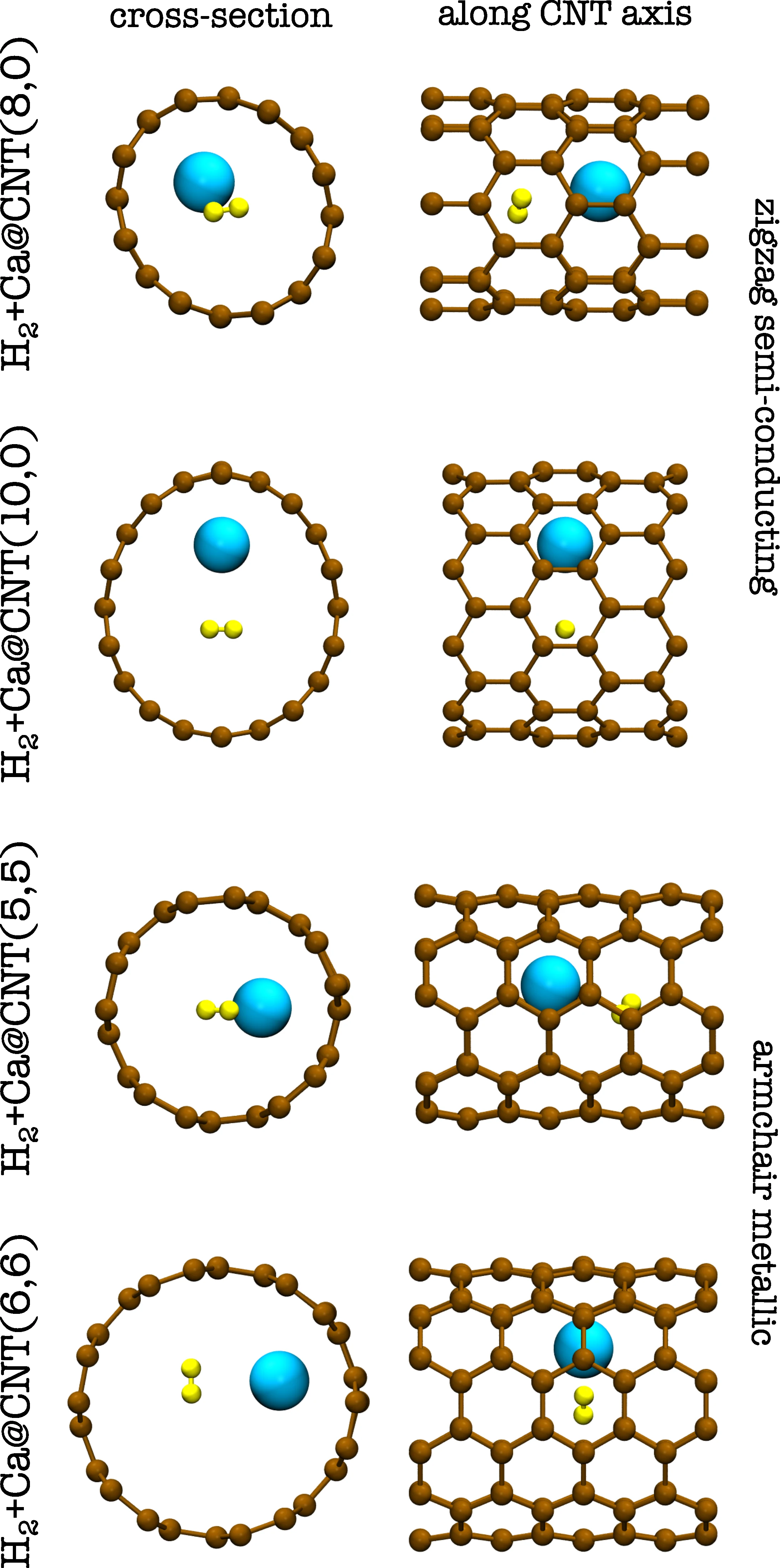
Los investigadores evitaron el problema sin usar alta presión. Tomaron nanotubos de carbono — cilindros huecos de un átomo de grosor, como una malla enrollada — y colocaron átomos de calcio en su interior. El calcio, el mismo metal del que están hechos nuestros huesos, resultó ser un 'velcro' ideal: el hidrógeno se pega a él lo suficiente para no escaparse, pero se desprende fácilmente cuando se necesita.
Este principio proporciona pautas precisas para los materiales. Si los ingenieros logran producir estas nanoestructuras, los automóviles de hidrógeno serán realmente ligeros y de largo alcance.
Resumen original
tal como lo escribieron los autores, en inglés arXiv:2604.07110
Hydrogen technology is set to be a key energy alternative for mitigating pollution and reducing CO$$_2$$ emissions. However, the current storage mechanism of hydrogen molecules in carbon fibre tanks detracts from the fuel economy of hydrogen in mobile applications, necessitating the development of alternative storage mechanisms. Adsorbing hydrogen in its molecular form (H$$_2$$) at typical operating conditions of proton exchange membranes can potentially meet storage requirements. However, H$$_2$$ is the smallest molecule with only two electrons and therefore it has very limited propensity to physisorb in a material within the binding energy window of $$-0.2$$ to $$-0.4$$ eV that is suitable for storage. Calcium atom decorators on graphene have previously shown promise for tunable H$$_2$$ binding, but the system is thermodynamically unstable toward the formation of calcium hydride. Moreover, the absolute adsorption of H$$_2$$ is challenging to predict accurately and is typically overestimated with van der Waals inclusive density functional approximations. In this work, we perform state-of-the-art fixed-node diffusion Monte Carlo alongside a selection of density functional approximations for two strategies of anchoring Ca: (i) Ca on boron doped graphene and (ii) Ca inside carbon nanotubes. We predict reliable Ca and H$$_2$$ binding energies, and establish that Ca is anchored inside carbon nanotubes and on boron doped graphene, while boosting the H$$_2$$ adsorption energy. Importantly, the H$$_2$$ adsorption energy is found to be improved by the anchoring strategies, with the energy inside a Ca decorated carbon nanotube reaching the viable storage window. The reference DMC binding energies provide much-needed benchmarks for developing data-driven methods and guiding experiment in the systematic design of hydrogen storage materials.
El hidrógeno es el elemento más abundante del universo, pero en la Tierra casi no se encuentra en estado puro; hay que extraerlo del agua o de hidrocarburos.