Quién contagia y quién enferma: la vida oculta de una epidemia exprés
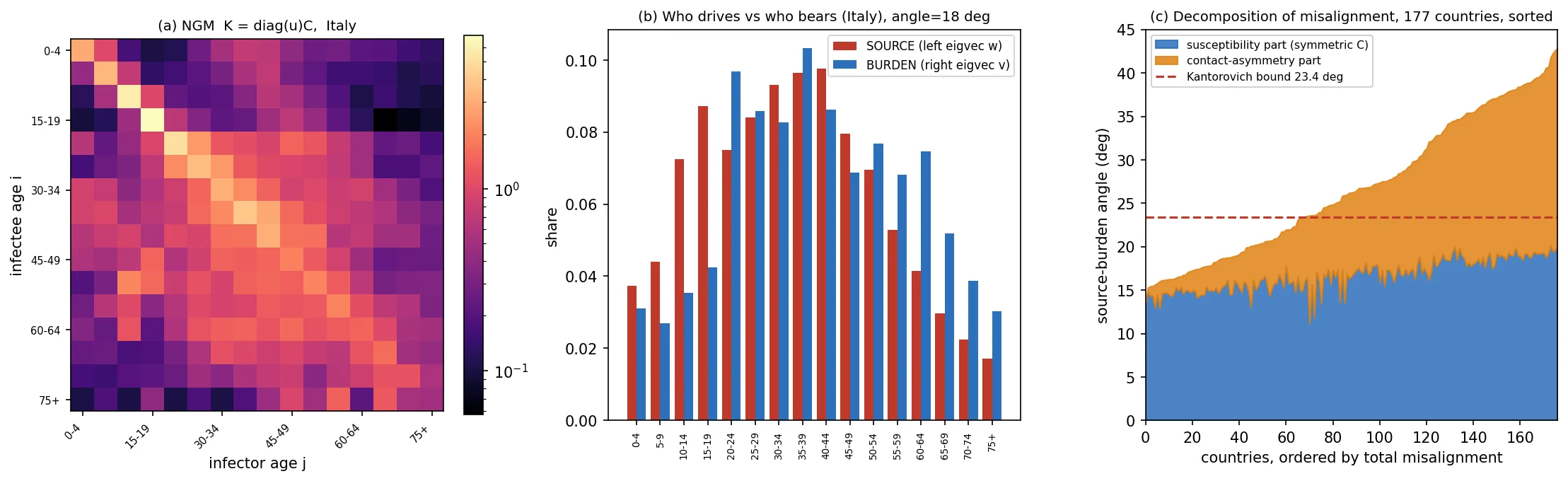
La orquesta toca sin director. Conocemos el volumen general: ese es el indicador básico de contagiosidad R0, el radio espectral de la epidemia. Pero la partitura en sí, la matriz de contactos entre personas de distintas edades, guarda la melodía: quién propaga la infección y quién recibe el golpe principal.
Los científicos analizaron datos de contactos de 177 países, recopilados en el trabajo de Prem et al., y observaron un panorama curioso. En un mundo ideal, las 'fuentes' y las 'víctimas' de la epidemia coinciden: quienes más contagian son también quienes más enferman. Pero en la realidad, estos grupos se separan. En promedio mundial, el ángulo entre ellos fue de 26°, y en algunos países superó los 40°. Es como bomberos que apagan el fuego sin sufrir daño mientras las llamas arrasan el barrio vecino.
Los autores demostraron un teorema: cuando los contactos son recíprocos (cuántas veces te encuentro, tantas me encuentras), esta brecha está limitada por la simple relación entre la susceptibilidad más alta y la más baja. Pero en la realidad los contactos no son recíprocos, y la brecha se hace aún mayor. Lo más preocupante es que una estrategia dirigida solo a reducir el R0 a veces falla: protege a quienes transmiten el contagio, no a quienes mueren por él. Como resultado, la mortalidad promedio por la infección puede incluso aumentar.
Resumen original
tal como lo escribieron los autores, en inglés arXiv:2607.03979
The basic reproduction number is the spectral radius of a matrix, $$R_0=\rho(K)$$. Taking that definition literally, we ask what $$K\mapsto\rho(K)$$ discards. A matrix carries three kinds of information: its dominant eigenvalue, its dominant eigenvectors, and its departure from normality. $$R_0$$ keeps only the first; the other two are where the epidemic's social structure lives. The right eigenvector is the burden distribution, the left the source distribution; they coincide when the system is normal and diverge under heterogeneity. Across the $$177$$ national contact matrices of Prem et al., the operator is \emph{never} normal, and once age-specific susceptibility is included, its source and burden eigenvectors are misaligned by a median of $$26^{\circ}$$, exceeding $$40^{\circ}$$ in some countries: the groups that drive transmission are systematically not those that bear it. We prove that under reciprocal contact this misalignment obeys a Kantorovich bound set by the susceptibility contrast $$q_{\max}/q_{\min}$$ alone, and zero when susceptibility is uniform, with the excess in real, non-reciprocal matrices contributed by contact asymmetry. Transient amplification, by contrast, stays small, so the operative social content is the misalignment, not transient blow-up. The omission also has teeth: because minimizing $$R_0$$ protects those who \emph{spread} infection, while minimizing deaths protects those who \emph{die} from it, the two target different age groups; the former sometimes raises average infection fatality even as it lowers the scalar. When contact is strongly structured and susceptibility is heterogeneous, we suggest reporting $$R_0$$ along with its eigenvectors rather than reporting it alone.
En algunos países, la diferencia entre quienes transmiten la infección y quienes la padecen supera los 40 grados, como si la aguja de una brújula señalara no al norte, sino al noreste.