Un termómetro térmico para el Sol exprés
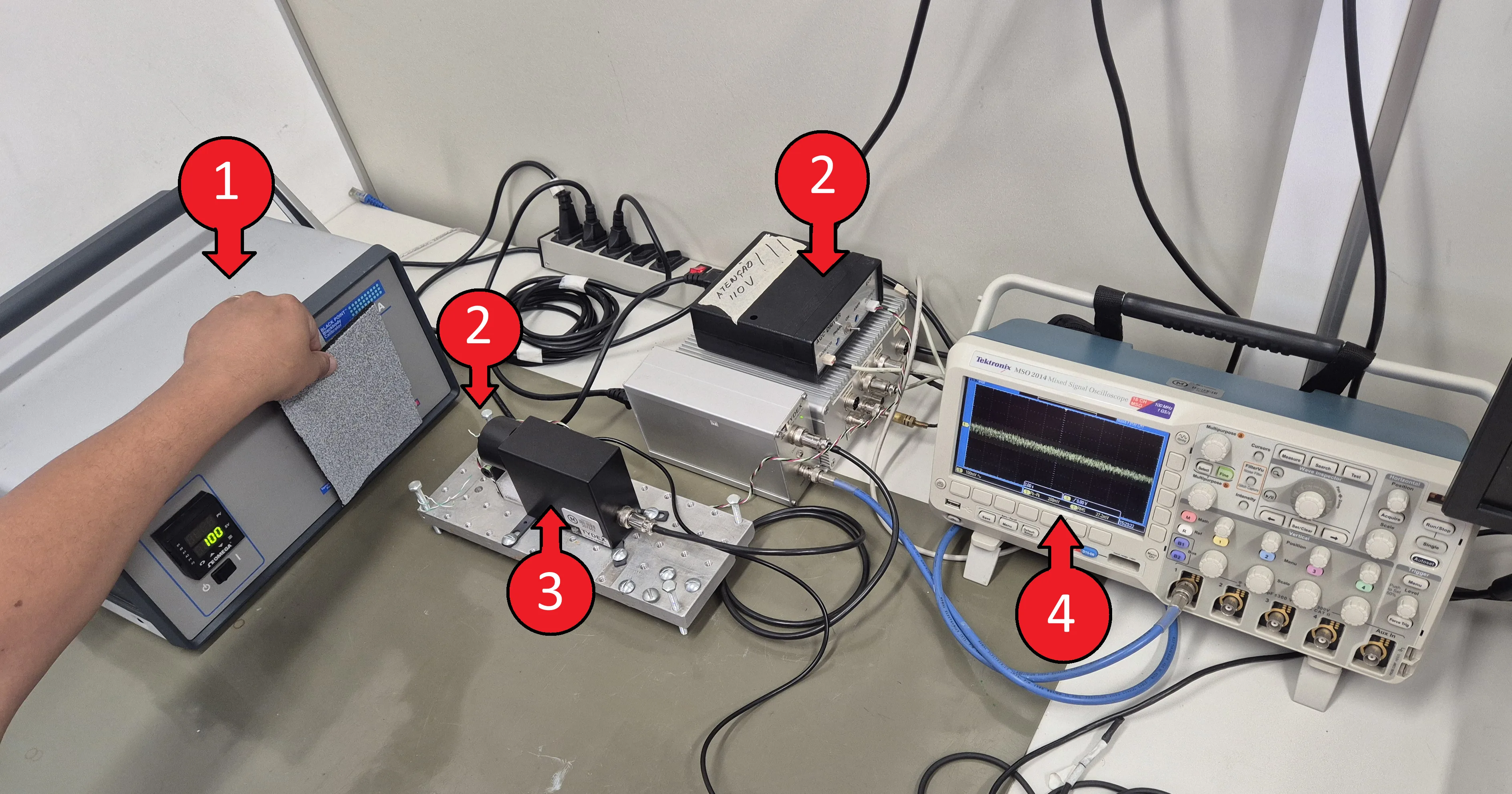
En la cocina, cuando la sartén se calienta al rojo, la mano siente el calor antes de tocar. El telescopio solar capta un calor invisible similar, pero que proviene de una estrella, no de una estufa. El instrumento llamado HATS detecta radiación en el rango de terahercios, que antes apenas se estudiaba por las dificultades técnicas. Su corazón es la celda de Golay, una diminuta cámara con gas que se expande con el calor y mueve un espejito.
Para extraer la señal débil del ruido, se coloca un disco giratorio con ranuras delante del receptor, que interrumpe el haz 20 veces por segundo. La señal se convierte en un parpadeo y se procesa matemáticamente. Los autores compararon dos enfoques: el ajuste de una sinusoide y la transformada rápida de Fourier con seis 'ventanas' diferentes, filtros que suavizan los bordes de la señal de distintas maneras. La ventana de Hamming funcionó mejor: el error fue de solo 15,48 y el coeficiente de calibración, de 10,32 milivoltios por cada grado Kelvin.
La precisión de la calibración no es importante solo para el Sol. El mismo principio de modulación y filtrado se puede aplicar en fábricas donde se necesita medir la temperatura del metal fundido sin contacto, o en instrumentos que vigilan el vapor de agua en la atmósfera. Y en medicina, los rayos de terahercios prometen una forma segura de mirar debajo de la piel sin rayos X. Así, un pequeño termómetro para una estrella ayuda a construir grandes herramientas para la Tierra.
Resumen original
tal como lo escribieron los autores, en inglés arXiv:2608.12137v1
The THz range has been under-explored for solar astronomy, mainly due to technological limitations. Only recently, a few new telescopes, such as the High Altitude Terahertz Solar (HATS) photometer, have been monitoring the solar activity in this range of the spectrum. This paper presents the experimental characterization and voltage-to-temperature calibration of the HATS acquisition system. HATS uses a Golay cell for capturing the incoming radiation, modulated by a 20 Hz fork chopper. The amplitude of the signal is then obtained at predetermined time intervals by applying a windowing function and an FFT to the signal. To characterize this acquisition system, a blackbody calibrator, with temperatures varying from 100 to 500 C (373.15 K to 648.15 K), was used as a THz source, and two signal recovery methodologies were compared: sinusoidal curve fitting and FFT combined with six windowing functions (rectangular, Hamming, Hann, Barlett, Blackman, and Flat Top). Our quantitative results demonstrate high linearity in the system's response over the input source's temperature range, with the Hamming window achieving the highest precision, yielding a Root Mean Square Error (RMSE) of 15.48 and a calibration temperature-to-voltage factor of 10.32 +- 0.13 mV/K. In contrast, the Bartlett window presented the highest error (RMSE 16.02). The choice of windowing function had only a minor effect on the calibration factors, which ranged from 10.32 to 10.43 mV/K, all within the experimental uncertainties. Beyond solar photometry, the signal modulation and windowing concepts established here are highly applicable to other fields requiring high-sensitivity thermal detection, such as industrial pyrometry for high-temperature manufacturing, environmental monitoring of atmospheric water vapor, and the development of medical imaging systems based on Terahertz radiation for non-invasive tissue analysis.
La celda de Golay fue inventada en 1947 para visores térmicos militares y todavía se utiliza en detectores de terahercios por su simplicidad y sensibilidad.
En la serie 'Star Trek', el tricorder médico escanea el cuerpo sin contacto: los sensores de terahercios, como el calibrado aquí, acercan esos dispositivos a la realidad.