Le halo sombre de la Voie lactée est aplati et tordu express
Le disque stellaire de la Voie lactée est comme un tourbillon lumineux, et la matière noire est un nuage invisible qui l'entoure. Pour la première fois, sa forme a été mesurée avec précision. Les astronomes ont suivi le mouvement de millions d'étoiles et ont construit une carte tridimensionnelle du halo sombre jusqu'à une distance de 160 000 années-lumière. Déjà Fritz Zwicky et Vera Rubin avaient prouvé l'existence de cette masse cachée, mais sa répartition restait une énigme.
Le tableau a stupéfié. Le halo n'est pas sphérique, mais allongé et aplati, comme un ballon de rugby dégonflé. Et son grand axe pointe presque verticalement par rapport au disque stellaire — comme si cette charpente invisible était inclinée à 90 degrés. Cette orientation coïncide avec le plan dans lequel orbitent les galaxies naines satellites.
Cet inclinaison s'explique simplement : il y a des milliards d'années, le disque de la Voie lactée a basculé sous la poussée gravitationnelle de petites galaxies. Les simulations informatiques le confirment. Cette découverte relie le modèle cosmologique standard au comportement réel des galaxies et, enfin, explique le mystérieux plan des satellites.
Résumé original
tel que rédigé par les auteurs, en anglais arXiv:2510.08684
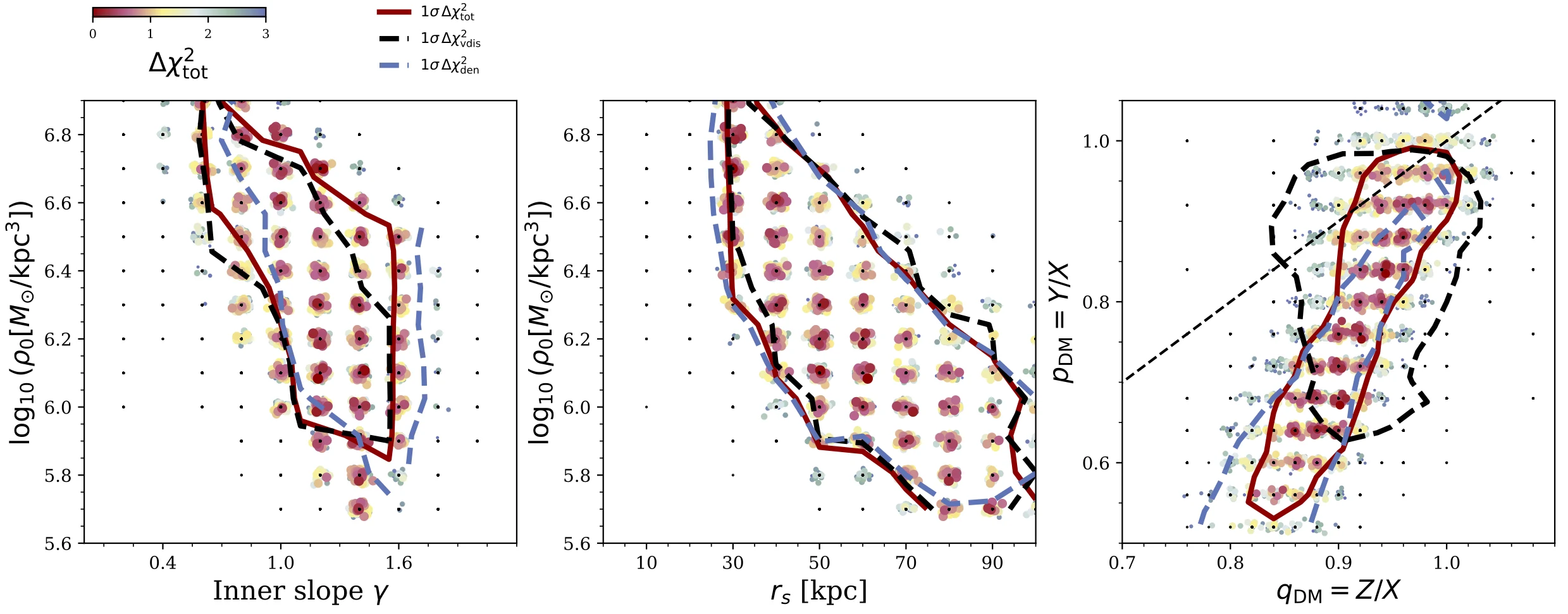
Unveiling the 3D shape of the Milky Way's dark-matter halo is critical to understanding its formation history. We created an innovative dynamical model with minimal assumptions on the internal dynamical structures and accommodates a highly flexible triaxial DM halo. By applying the method to 6D phase-space data of K-giant stars from LAMOST + Gaia, we robustly determine the 3D dark-matter distribution of the Milky Way out to approximately $$50$$ kpc. We discover a triaxial, nearly oblate dark-matter halo with $$q_{\rm DM} = Z/X= 0.92\pm0.08$$, $$p_{\rm DM} = Y/X= 0.8\pm0.2$$ averagely within 50 kpc, where $$Z$$ axis is defined perpendicular to the stellar disk. The axes ratio $$q_{\rm DM} > p_{\rm DM}$$ is strongly preferred; the long-intermediate axis plane of the dark-matter halo is unexpectedly vertical to the Galactic disk, yet aligned with the `plane of satellites'. This striking configuration suggests that the Galactic disk (and the inner halo) has flipped, likely torqued by minor mergers, from an original alignment with the outer dark-matter halo and satellite plane, as supported by Milky Way analogues from Auriga and TNG50. By allowing $$q_{\rm DM}(r)$$ and $$p_{\rm DM}(r)$$ vary with radii, we find tentative evidence that the dark-matter halo is twisted, that it agrees alignment with the disk in the inner regions and transitions to a vertical orientation at $$r\gtrsim 20$$ kpc, supporting the disk flip scenario prediction. Such disk reorientation is non-trivial yet its physical mechanism is straightforward to comprehend and naturally originates a vertical satellite plane. Our findings offer a unified framework that links dark-matter halo orientation, satellite alignment, and disk evolution, reinforcing the internal consistency of the Milky Way in $$\Lambda$$CDM model.
La matière noire est cinq fois plus abondante que la matière ordinaire. Sans sa gravité invisible, les galaxies se désintégreraient sous l'effet de la force centrifuge.