Shude Mao

8 articles · 30 co-authors · latest: 2026-08-11
10 citations · h-index 2 · 8 papersData: Semantic Scholar

We have retold 8 papers by this author. 2 of them with a full read. most often about: dwarf galaxy, dark matter, galaxy. 30 co-authors across our retellings.

Links in the knowledge graph
Galaxies2025-10-091 minarXiv:2510.08684express
The Milky Way's Dark Halo is Flattened and Twisted
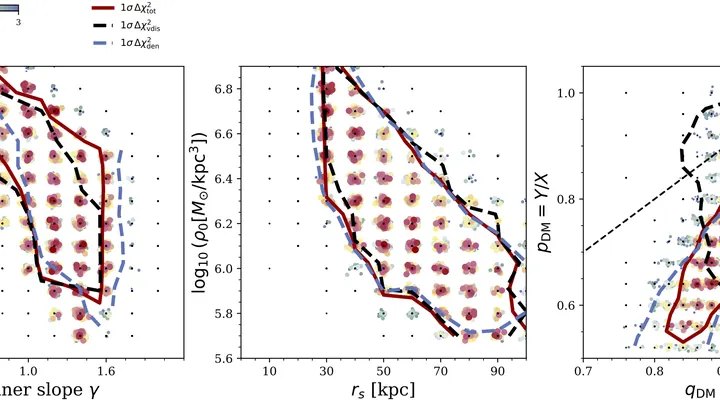
The Milky Way's stellar disk is like a glowing pinwheel, and тёмное вещество is an invisible cloud around it. For the first time, its shape has been precisely measured. Astronomers tracked the motions of millions of stars and built a 3D map of the тёмное гало out to 160,000 light-years.
Exoplanets2026-01-141 minarXiv:2601.09835express
Cosmic Billiards: How Planets Become Wanderers
Space works like a billiard table. Massive outer planets, like heavy balls, transfer their energy to light inner worlds. Such a gravitational kick can fling a small planet out of the stellar system. It turns into a free-floating wanderer — a rogue exoplanet without a star. Detecting these invisible bodies is hard: they neither emit nor reflect light.
Galaxies2026-01-161 minarXiv:2601.11054express
Artificial Intelligence Discovered 247 New Cosmic Lenses
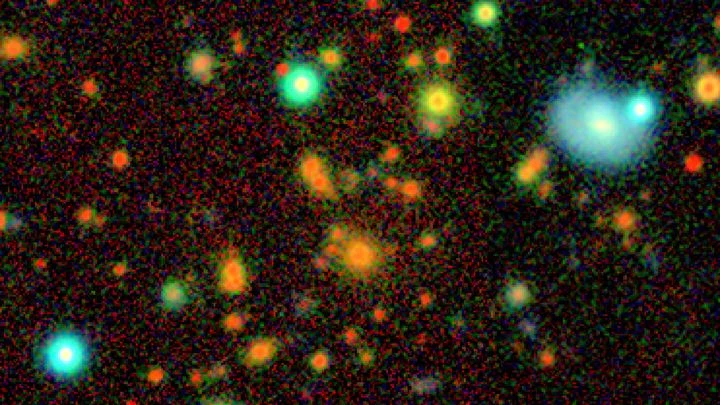
A galaxy cluster's gravity warps spacetime, acting like a colossal lens: it focuses and amplifies light from distant objects, as predicted by Einstein. Such lenses are rare, but they let us glimpse what lurks at the edges of the cosmos.
Exoplanets2026-01-161 minarXiv:2601.11469express
Invisible Lens Reveals a Planet 40 Times the Mass of Earth
One night, a star at the edge of the sky suddenly flickered and brightened for a few days. It wasn't a supernova, and no cloud passed by — an invisible planet drifted between the star and Earth. Its gravity bent the light of the distant star like a pair of glasses focusing a sunbeam.
Galaxies2026-06-232 minarXiv:2606.25022
Exoplanets2026-06-261 minarXiv:2606.27725express
A Lonely Wanderer in Einstein's Desert
A pebble drops into a night lake, and ripples spread across the water. You can't see the pebble itself, but the ripples give it away. Astronomers use a similar trick when hunting for dark bodies in space: these objects betray themselves by the way they warp the light of distant stars.
Galaxies2026-08-111 minarXiv:2608.10719express
A Wanderer That Feeds on the Go
A black hole with a mass of 35,000 Suns drifts through a galaxy's gas like a barge through fog. Its gravity rakes the material ahead of it, leaving a dense trail behind — a wake of gas. Some of that gas gets pulled into the black hole, and it grows.