La danse obscure : quand l'énergie et la matière échangent leurs rôles express
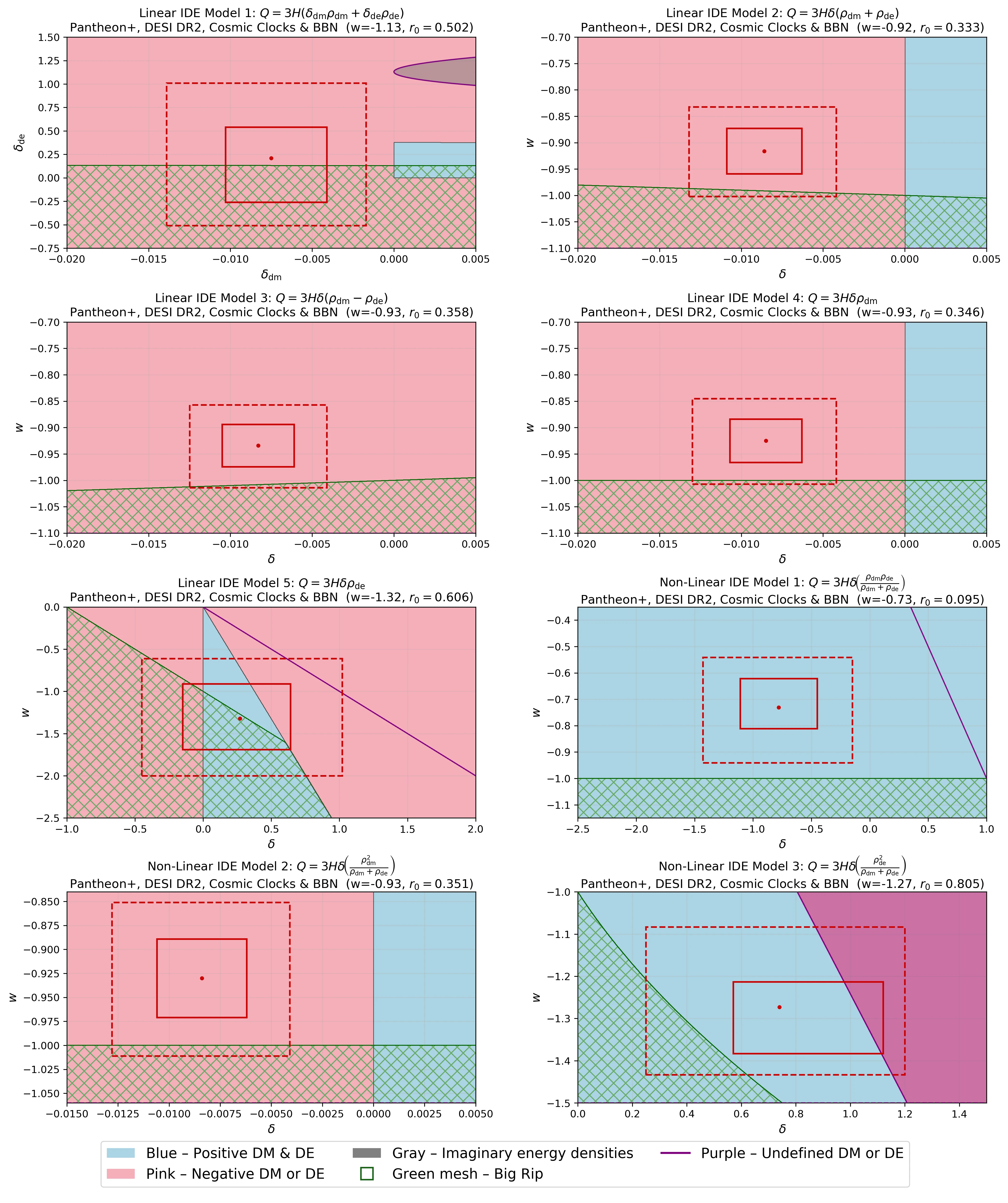
Dans la danse cosmique, l'énergie noire et la matière noire échangent de l'énergie. Longtemps, l'énergie noire a été considérée comme une force constante accélérant l'univers – une découverte qui a valu le prix Nobel à Adam Riess, Saul Perlmutter et Brian Schmidt. Mais de nouvelles données montrent que cette danse est changeante.
Les scientifiques ont testé huit modèles d'interaction. Il s'avère qu'actuellement, l'énergie noire cède de l'énergie à la matière noire, alors que par le passé, c'était l'inverse. Mais dans certaines versions, la densité de l'énergie noire devenait négative – comme si le danseur dépensait plus qu'il n'a.
Résumé original
tel que rédigé par les auteurs, en anglais arXiv:2601.03122v1
In this study, we present observational constraints on a class of phenomenological interacting dark energy (IDE) models that admit analytical solutions for the Hubble parameter $$H(z)$$. We consider a set of five linear and three non-linear IDE scenarios, encompassing both interactions proportional to the dark matter and/or dark energy densities, as well as non-linear combinations of the two. For all eight IDE models, we find a better fit than $$\Lambda$$CDM from a $$\Delta\chi^2$$ analysis for both combinations of datasets considered. When using the Akaike Information Criterion ($$\Delta$$AIC), we find a similarly improved fit in all cases, except for one dataset combination in $$Q=3H\delta\rho_{\rm de}$$. Our analysis also shows a preference for sign-switching interactions, with energy transfer from dark energy to dark matter at low redshift, reversing direction at higher redshift. These results should be interpreted with caution, as the latter direction of energy transfer is accompanied by negative dark energy densities in the past, which may be unphysical. Models that do not allow sign-changing behaviour instead show a preference for energy flow from dark matter to dark energy, and hence negative dark energy densities. The only exceptions are $$Q=3H\delta\rho_{\rm de}$$ and $$Q=3H\delta\left(\tfrac{\rho_{\rm de}^2}{\rho_{\rm dm}+\rho_{\rm de}}\right)$$, which exhibit energy flow in the opposite direction. Furthermore, for all interactions considered, we find a phantom-divide crossing in the effective dark energy equation of state $$w^{\rm eff}_{\rm de}$$, with the dark energy density decreasing ($$w^{\rm eff}_{\rm de}>-1$$) at present and at low redshift, while increasing ($$w^{\rm eff}_{\rm de}<-1$$) in the past at high redshift. These results highlight the promising, but problematic, nature of dark sector interactions, as well as the need to extend the analysis using early-time physics and datasets.
Dans certains modèles, la densité de l'énergie noire était négative dans le passé – le danseur semblait emprunter de l'énergie. Cela laisse les physiciens perplexes.