Spicules solaires : comment la couronne reçoit sa chaleur express
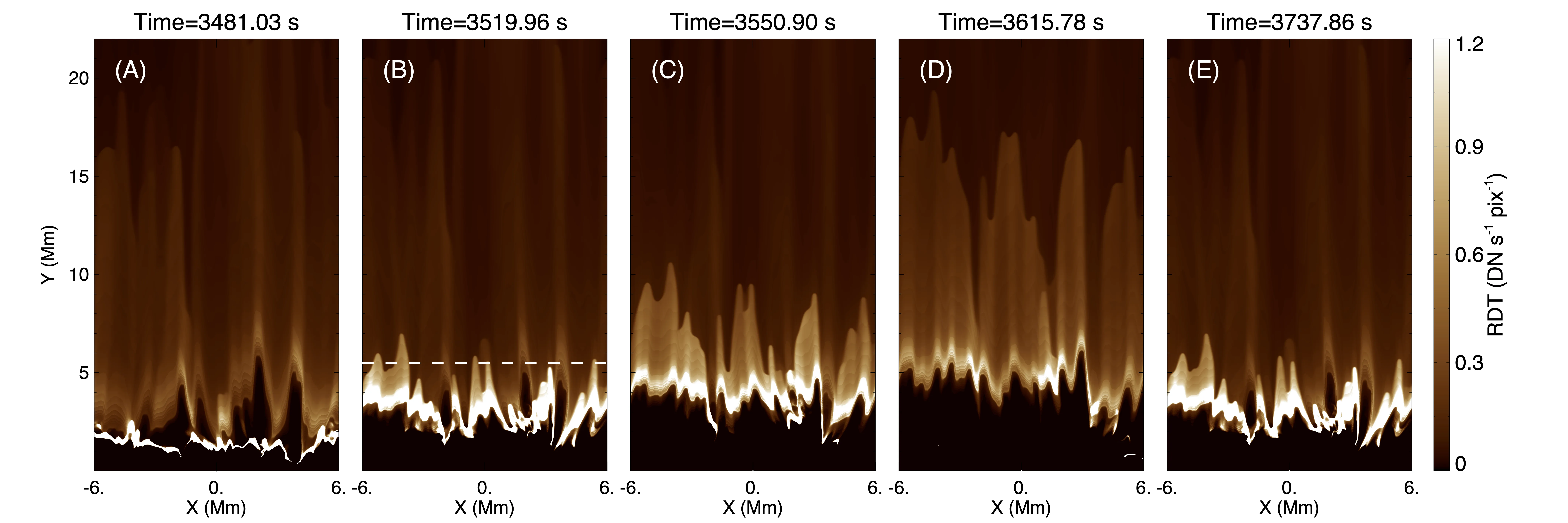
La surface du Soleil bout comme l'eau dans une casserole. Le gaz chaud monte, refroidit et redescend — c'est la convection. Autour, les champs magnétiques bouillonnent, se déchirent et se reconnectent. Dans cette agitation naissent les spicules — d'étroits jets de plasma qui s'élancent à des milliers de kilomètres vers le haut. Ils ne vivent que quelques minutes, mais ont le temps de transmettre leur énergie à l'atmosphère externe du Soleil.
Les spicules ne se contentent pas de s'élever — ils poussent devant eux des ondes et des fronts de choc. Ces ondes compriment le gaz et le chauffent. Ainsi, l'énergie de la surface parvient à la couronne — la couche externe ténue qui est des centaines de fois plus chaude que la surface elle-même. Sans les spicules, la couronne se refroidirait et le vent solaire dans les trous coronaux se tarirait.
Ainsi, jet après jet, comme une pompe, ils aspirent la chaleur vers la couronne. Les spicules ne sont pas seulement un beau spectacle au bord du disque solaire. Ils sont la clé du mystère qui a tourmenté les astrophysiciens pendant 80 ans : pourquoi la couronne est-elle plus chaude que la surface ?
Résumé original
tel que rédigé par les auteurs, en anglais arXiv:2602.19953
How the solar atmosphere is heated from a temperature of about $$5,000-6,000$$\,K in the lower atmosphere to about $$1-2$$\,MK in the corona has challenged the astrophysical community for about 80 years. The same puzzle exists for the stellar coronae heating as well. In this study, we present a series of findings on solar spicules and their subsequent impact on the corona within a coronal hole environment, characterized by locally open magnetic field lines, combining insights from MHD simulations with observations. We find that the convective and turbulent motions around the solar surface cause plenty of shocks and small-scale magnetic reconnection in the lower atmosphere. The combined effects of shock compression and reconnection outflows then drive the formation of groups of spicules with a quasi-period of about $$300$$\,s and width of $$\sim 200-500$$\,km. The spicule upflows provide an averaged mass flux above $$10^{-9}$$\,kg\,m$$^{-2}$$\,s$$^{-1}$$ in the lower corona to sustain the solar wind in coronal holes, and they continuously trigger further new local slow-mode waves and shocks. These waves supply an energy flux of $$10-100$$\,W\,m$$^{-2}$$ in the lower corona, and they are dissipated by heat conduction and compression heating to sustain the corona temperature of about $$1$$\,MK. The results also indicate that the upward propagating disturbances (PDs) observed in extreme ultraviolet (EUV) passbands are caused by both spicule upflows and slow-mode waves and shocks. Our findings help to understand the long standing problem of coronal heating and the origin of solar winds in coronal hole regions.
La température de la couronne solaire est d'environ un million de degrés, tandis que la surface n'atteint que 5500 degrés. C'est comme si l'air autour d'un feu de camp était plus chaud que la flamme elle-même.