Les montagnes des exoplanètes les sauvent de l'hiver éternel express
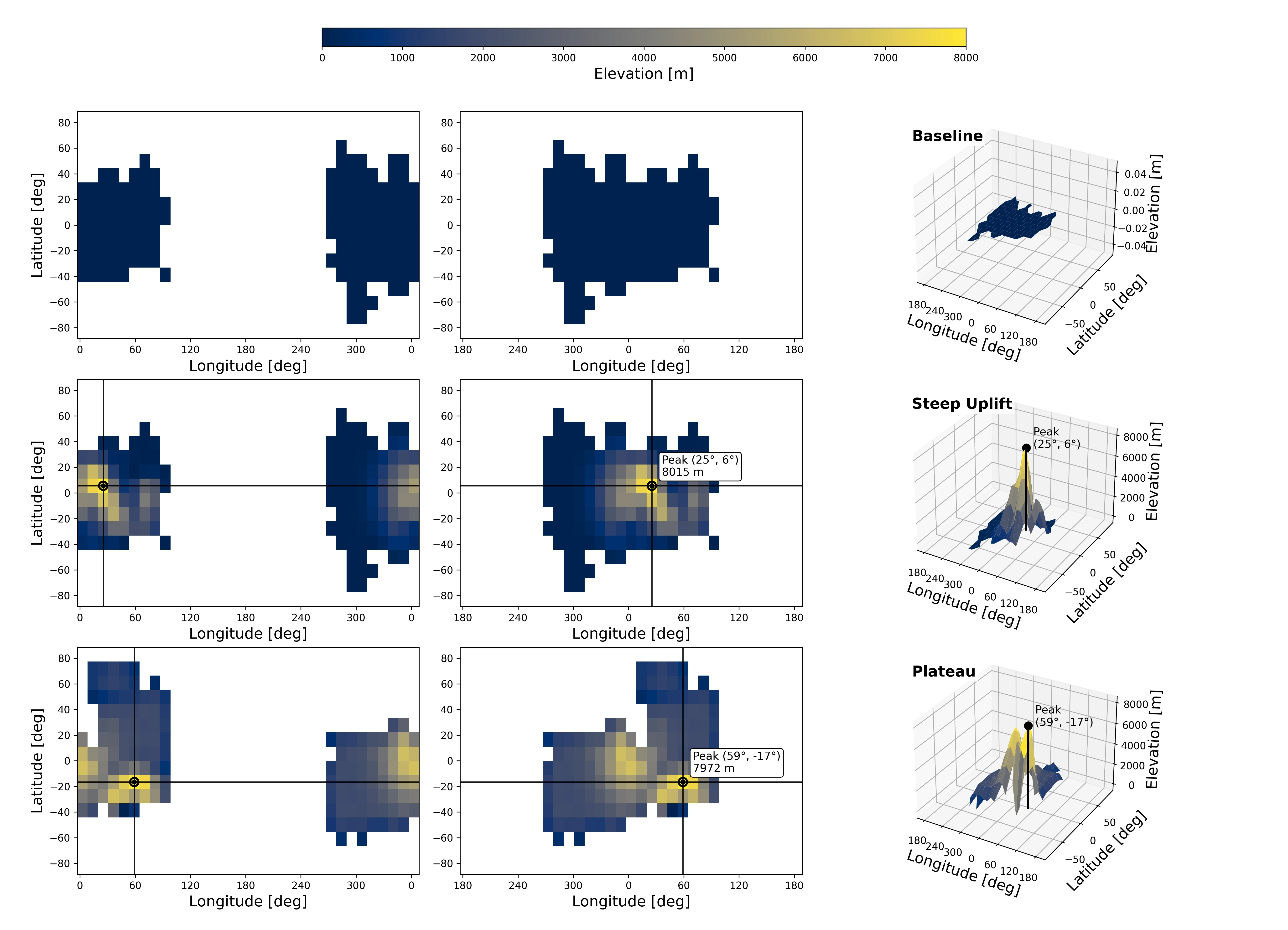
Les exoplanètes toujours tournées vers leur étoile d'un même côté condamnent leur moitié nocturne à un froid éternel. Mais les montagnes peuvent tout changer. Les irrégularités de la surface secouent l'océan d'air, dirigeant les flux d'humidité à travers la frontière entre le jour et la nuit. Une fois dans l'obscurité, l'eau gèle en nuages, et les nuages agissent comme une couverture : ils retiennent la chaleur et empêchent le monde de se refroidir. Les modèles informatiques ont montré que même de modestes collines – pas l'Himalaya, juste de petites élévations – brisent les vortex d'air symétriques et font naître un courant-jet. Tel un tapis roulant, il tire l'humidité vers la nuit, et la couverture s'épaissit. La planète dégèle, même si l'étoile chauffe faiblement. Le télescope James Webb pourra le vérifier en analysant la lumière qui traverse l'atmosphère (spectroscopie). Ainsi, le destin des mondes lointains ne dépend pas seulement de la distance à leur étoile, mais aussi de chaque pli de leur surface.
Résumé original
tel que rédigé par les auteurs, en anglais arXiv:2602.20155
Among potentially habitable worlds, rocky planets orbiting M dwarfs offer the most favorable prospects for atmospheric characterization, yet their climates may differ substantially from those of Earth analogs. In the tidally locked limit, the nightside's tendency to radiatively cool and potentially trap volatiles as permanent ice introduces a strong dependence of habitability on the planet's surface and atmospheric boundary conditions. We perform a suite of synchronously rotating experiments spanning a wide range of topographic and orographic realizations with different mean elevations and landmass distributions. Across a grid of $$p_{\mathrm{N2}} = 0.5$$-$$8~\mathrm{bar}$$ and $$F_{\star} = 1200$$-$$1700~\mathrm{W\,m^{-2}}$$, we find that surface relief breaks the flow symmetry, replacing the circumpolar vortices with mechanically forced stationary waves. Steep orography produces standing Rossby gyres that strengthen the cross-terminator jet and align vertical uplift with the day--night boundary. These new circulation regimes enhance moisture transport, increasing the infrared optical depth and promoting additional nightside cloud formation, which produces a stronger cloud-greenhouse feedback and lower the critical fluxes required for global planetary deglaciation. Broad, elevated plateaus drive a similarly fragmented but slightly weaker circulation, yielding less effective moisture transport. These results show that the relief and spatial distribution of landmasses, parameters unconstrained for most exoplanets, can exert strong controls on the climatic bifurcations of tidally locked M-dwarf exoplanets.
Sur Terre, les chaînes de montagnes génèrent des ondes atmosphériques qui provoquent sécheresse d'un côté et pluies torrentielles de l'autre. Mais sur les exoplanètes, ce même mécanisme peut faire fondre entièrement un monde de glace.