Des nanotubes de carbone dopés au calcium retiennent l'hydrogène express
L'hydrogène est un carburant idéal : lors de son utilisation, il ne produit que de l'eau, pas de dioxyde de carbone. Le problème, c'est que l'hydrogène est le gaz le plus léger qui soit ; ses molécules s'infiltrent à travers n'importe quel contenant. Actuellement, dans les voitures, on stocke l'hydrogène dans de lourdes bouteilles sous très haute pression, ce qui annule les avantages en termes de poids.
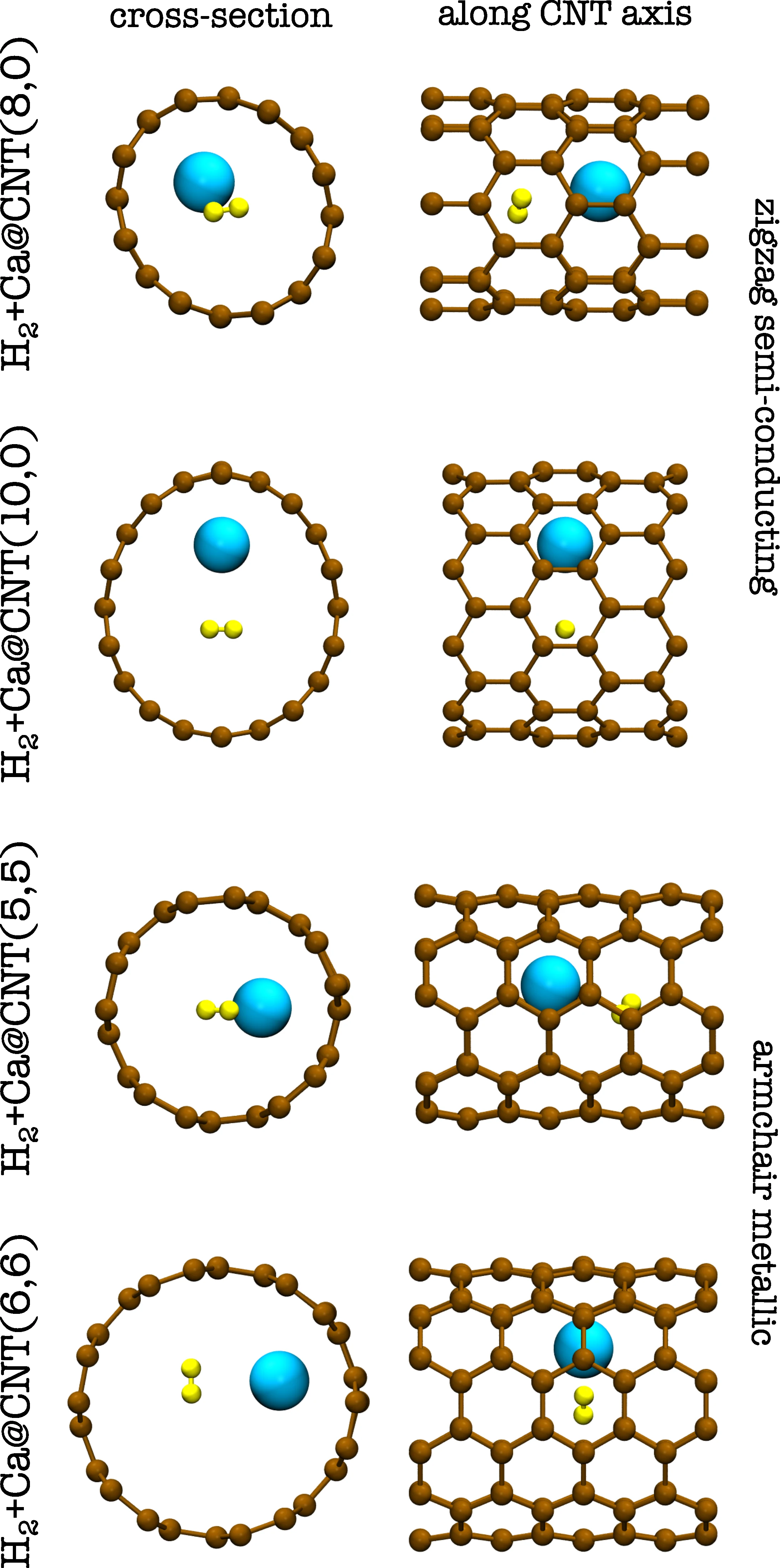
Les chercheurs ont contourné le problème sans recourir à la haute pression. Ils ont pris des nanotubes de carbone — des cylindres creux d'une épaisseur d'un atome, semblables à un treillis enroulé — et y ont placé des atomes de calcium. Le calcium, ce métal qui constitue notre squelette, s'est avéré être un « velcro » idéal : l'hydrogène s'y accroche juste assez pour ne pas s'échapper, mais se détache sans effort quand on en a besoin.
Ce principe donne des repères précis pour les matériaux. Si les ingénieurs parviennent à produire ces nanostructures à grande échelle, les voitures à hydrogène deviendront vraiment légères et pourront parcourir de longues distances.
Résumé original
tel que rédigé par les auteurs, en anglais arXiv:2604.07110
Hydrogen technology is set to be a key energy alternative for mitigating pollution and reducing CO$$_2$$ emissions. However, the current storage mechanism of hydrogen molecules in carbon fibre tanks detracts from the fuel economy of hydrogen in mobile applications, necessitating the development of alternative storage mechanisms. Adsorbing hydrogen in its molecular form (H$$_2$$) at typical operating conditions of proton exchange membranes can potentially meet storage requirements. However, H$$_2$$ is the smallest molecule with only two electrons and therefore it has very limited propensity to physisorb in a material within the binding energy window of $$-0.2$$ to $$-0.4$$ eV that is suitable for storage. Calcium atom decorators on graphene have previously shown promise for tunable H$$_2$$ binding, but the system is thermodynamically unstable toward the formation of calcium hydride. Moreover, the absolute adsorption of H$$_2$$ is challenging to predict accurately and is typically overestimated with van der Waals inclusive density functional approximations. In this work, we perform state-of-the-art fixed-node diffusion Monte Carlo alongside a selection of density functional approximations for two strategies of anchoring Ca: (i) Ca on boron doped graphene and (ii) Ca inside carbon nanotubes. We predict reliable Ca and H$$_2$$ binding energies, and establish that Ca is anchored inside carbon nanotubes and on boron doped graphene, while boosting the H$$_2$$ adsorption energy. Importantly, the H$$_2$$ adsorption energy is found to be improved by the anchoring strategies, with the energy inside a Ca decorated carbon nanotube reaching the viable storage window. The reference DMC binding energies provide much-needed benchmarks for developing data-driven methods and guiding experiment in the systematic design of hydrogen storage materials.
L'hydrogène est l'élément le plus abondant de l'univers, mais sur Terre, on le trouve rarement à l'état pur ; il faut l'extraire de l'eau ou des hydrocarbures.