Тёмный танец: как энергия и материя меняются ролями экспресс
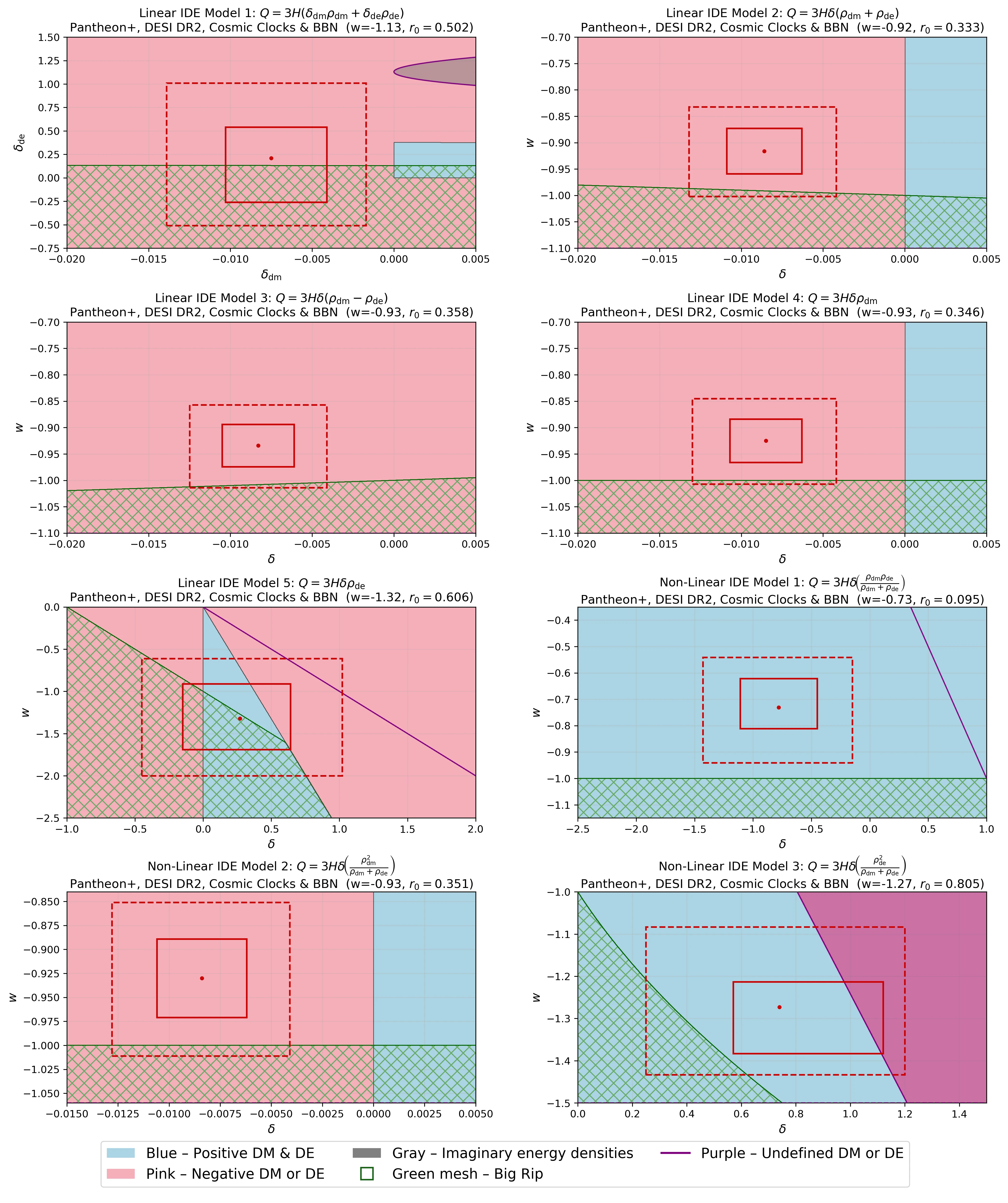
В космическом танце тёмная энергия и тёмная материя обмениваются энергией. Долгое время тёмная энергия считалась постоянной силой, разгоняющей Вселенную, — за это открытие Нобелевскую премию получили Риссу, Перлмуттеру и Шмидту. Но новые данные показывают, что танец изменчив.
Учёные проверили восемь моделей взаимодействия. Оказалось, что сейчас тёмная энергия отдаёт энергию тёмной материи, а в прошлом было наоборот. Но в некоторых версиях у тёмной энергии плотность становилась отрицательной — словно танцор тратит больше, чем имеет.
Оригинальная аннотация
как её написали авторы, на английском arXiv:2601.03122v1
In this study, we present observational constraints on a class of phenomenological interacting dark energy (IDE) models that admit analytical solutions for the Hubble parameter $$H(z)$$. We consider a set of five linear and three non-linear IDE scenarios, encompassing both interactions proportional to the dark matter and/or dark energy densities, as well as non-linear combinations of the two. For all eight IDE models, we find a better fit than $$\Lambda$$CDM from a $$\Delta\chi^2$$ analysis for both combinations of datasets considered. When using the Akaike Information Criterion ($$\Delta$$AIC), we find a similarly improved fit in all cases, except for one dataset combination in $$Q=3H\delta\rho_{\rm de}$$. Our analysis also shows a preference for sign-switching interactions, with energy transfer from dark energy to dark matter at low redshift, reversing direction at higher redshift. These results should be interpreted with caution, as the latter direction of energy transfer is accompanied by negative dark energy densities in the past, which may be unphysical. Models that do not allow sign-changing behaviour instead show a preference for energy flow from dark matter to dark energy, and hence negative dark energy densities. The only exceptions are $$Q=3H\delta\rho_{\rm de}$$ and $$Q=3H\delta\left(\tfrac{\rho_{\rm de}^2}{\rho_{\rm dm}+\rho_{\rm de}}\right)$$, which exhibit energy flow in the opposite direction. Furthermore, for all interactions considered, we find a phantom-divide crossing in the effective dark energy equation of state $$w^{\rm eff}_{\rm de}$$, with the dark energy density decreasing ($$w^{\rm eff}_{\rm de}>-1$$) at present and at low redshift, while increasing ($$w^{\rm eff}_{\rm de}<-1$$) in the past at high redshift. These results highlight the promising, but problematic, nature of dark sector interactions, as well as the need to extend the analysis using early-time physics and datasets.
В некоторых моделях плотность тёмной энергии в прошлом была отрицательной — танцор словно брал энергию в долг. Это ставит физиков в тупик.