Порошок, который запоминает движения экспресс
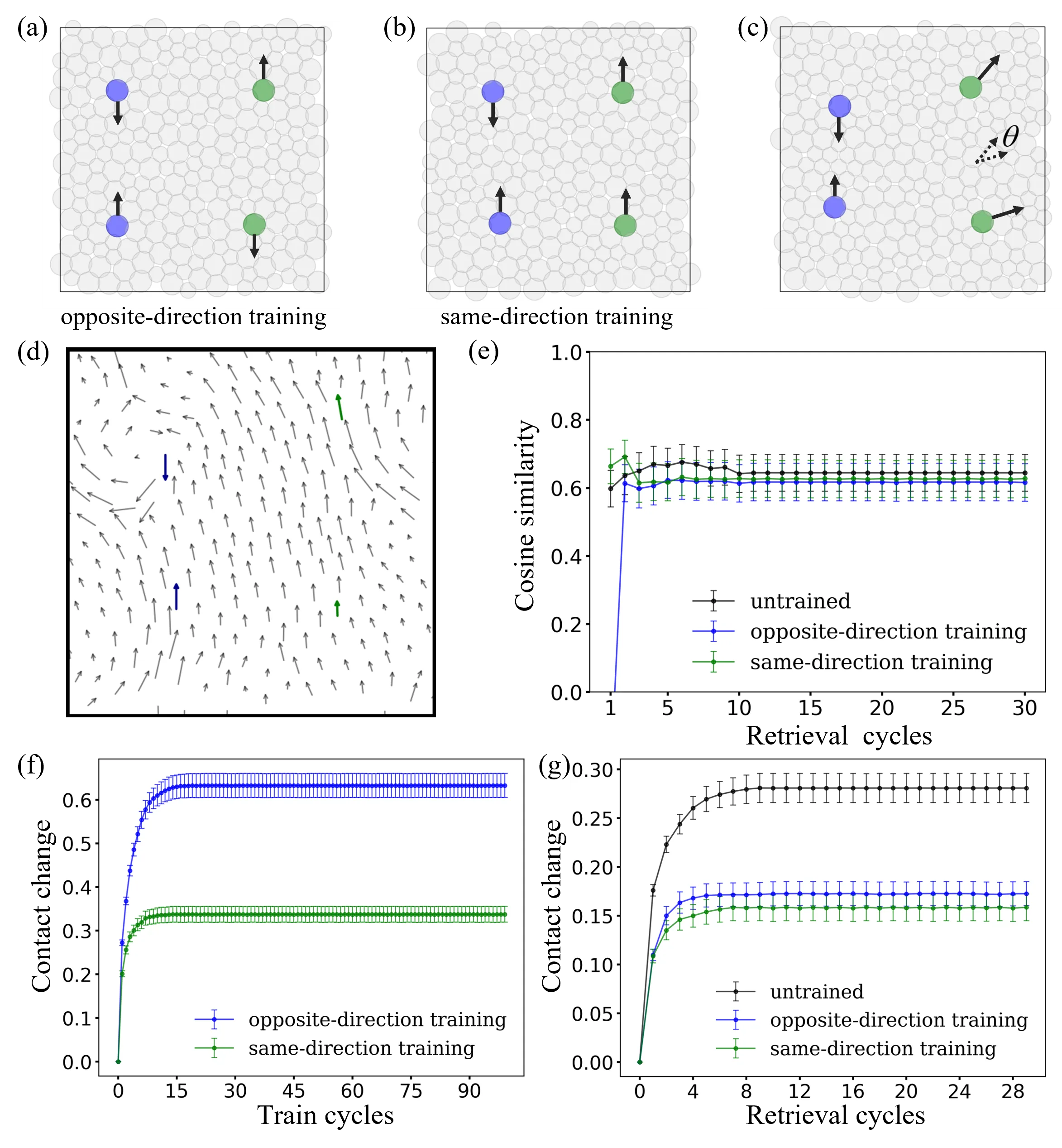
Горсть песка на столе — просто куча. Но если песчинки правильно потрясти, куча начинает вести себя как память: запоминает, какое движение за каким следует. В новом опыте частицы двигали циклически, и после тренировки они воспроизводили нужный узор даже без полной команды.
Секрет в контактах между частицами. Когда песчинки сдвигаются, они меняют соседей и силы взаимодействия — так в куче сама собой перестраивается «проводка». Это похоже на то, как тропинка в лесу становится заметнее, если по ней часто ходить: каждый шаг меняет почву, и путь запоминается.
Учёные проверили задачи разной сложности. Простая задача решалась сразу — частицы и так двигались в нужную сторону. В сложной задаче обучение почти не помогало, пока не добавили паузы: частицы успевали «успокоиться» и лучше запоминали. А в задаче средней сложности помогло просто изменить расположение входов и выходов.
Опыт показывает, что для ассоциативной памяти не нужны сложные схемы — достаточно сыпучей среды и правильного ритма. Возможно, в будущем появятся материалы, которые учатся на ходу, как этот песок.
Оригинальная аннотация
как её написали авторы, на английском arXiv:2603.14534
We investigate associative-memory behavior in a reconfigurable particle packing programmed by purely local cyclic driving. The system is a two-dimensional bidisperse Lennard--Jones particle assembly with periodic boundaries evolved under athermal quasistatic relaxation. During training, a fixed set of input particles is driven cyclically while output particles are selected on-the-fly by a region-driving rule and driven according to a prescribed flow pattern; during retrieval, only the inputs are driven. Associative-memory performance is quantified by the cosine similarity between realized and target output displacement directions. Unlike physical learning systems with fixed architecture, learning here arises through emergent weight updates: localized rearrangements modify the contact network and reshape the effective mechanical couplings between inputs and outputs. Across task difficulty we identify three regimes. In an easy setting, the intrinsic mechanical response already produces coherent motion in the right-hand region under input-only driving, yielding high performance without training. In a hard setting, the desired mapping conflicts with the dominant collective drift, resulting in low baseline performance and only modest training gains; introducing intermittent relaxation cycles reduces train--retrieval mismatch and improves performance. In an intermediate quadrupolar task, repositioning the input--output geometry stabilizes the desired response and converts initially stochastic trajectories into reproducible learned motions. Together these results identify minimal physical ingredients for association-based functionality in athermally driven particulate media and motivate an association learning phase diagram for reconfigurable matter.
В эксперименте частицы двигались без нагрева — только за счёт механического воздействия, как если бы вы встряхивали коробку с шариками.