Tao Zhang

7 articles · 30 co-authors · latest: 2026-09-09
4 citations · h-index 1 · 5 papersData: Semantic Scholar

We have retold 7 papers by this author. 2 of them with a full read. most often about: quantum optics, quantum dot, molecular property prediction. 30 co-authors across our retellings.

Links in the knowledge graph
Optics2025-05-023 minarXiv:2505.05490
Seven Lives of a Photon: Exceptional Points Control Spontaneous Emission
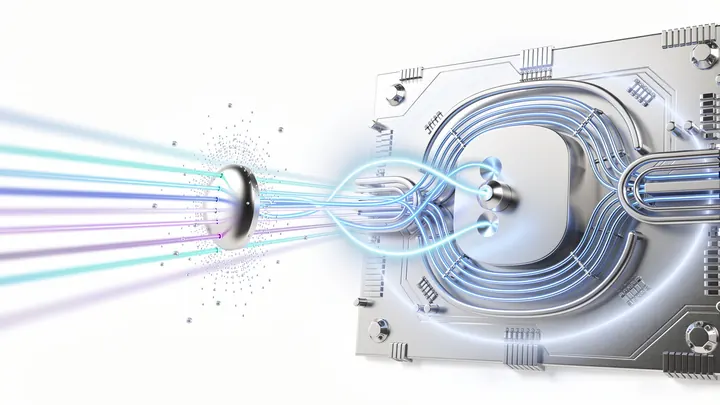
Spontaneous emission was long considered fickle: a quantum dot emits a photon, obeying only probability. The Purcell effect allowed amplifying it by placing the emitter in a resonator, but that only changed the rate, not the spectral shape.
Chemical Physics2026-01-181 minarXiv:2601.12268express
How Molecules Recognize Each Other Without Hints
When a guest molecule enters a host molecule, it's like a key going into a lock. But molecules don't have rigid shapes: they bend a little, charges on their surfaces attract or repel, and predicting exactly how they'll fit together has been very hard. DeepHostGuest learns from thousands of known host-guest pairs.
Disordered Systems2026-03-151 minarXiv:2603.14534express
A Powder That Remembers Motion
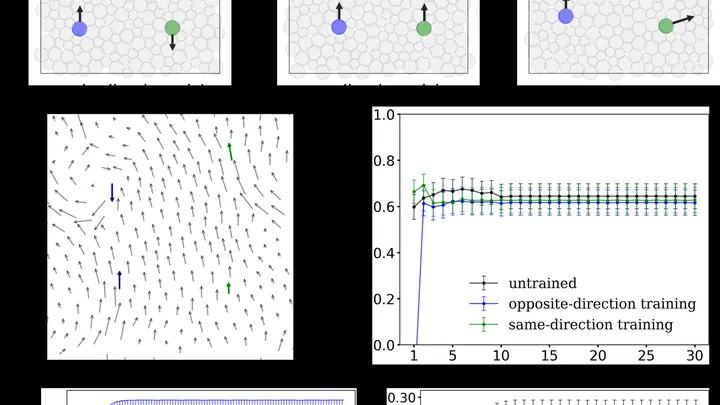
A handful of sand on a table is just a pile. But if you shake the grains just right, the pile starts behaving like a memory: it remembers which motion follows which. In the new experiment, particles were moved cyclically, and after training, they reproduced the desired pattern even without a full command. The secret lies in the contacts between particles.
Mesoscale2026-04-182 minarXiv:2604.16860express
Layers Change the Material's Character
A single-atom-thick sheet of tungsten telluride is like thin foil: electrons can't pass through because there's a band gap between their possible states, like a moat you can't jump across. Add two more layers, and the moat disappears; the material becomes a metal, and current flows. Add more layers, and the properties change again, as if someone is flipping modes with a single button.
Quantum Physics2026-06-011 minarXiv:2606.02715express
A Trap for 11,000 Atoms: A Step Towards a Quantum Computer
An invisible trap made of laser light held 11,000 atoms — a record for quantum engineering. Previously, physicists wrestled with a few dozen of these particles; now the count runs into the thousands. Each atom becomes a qubit — a quantum bit that is both zero and one at once, like a spinning coin balanced on its edge.
The Underground Guardian of Purity
A huge pool of clear liquid is hidden deep underground. Inside, there is nothing but a pristine 'broth' that flashes with faint light when an invisible particle flies through. This is the JUNO detector—20,000 tons of liquid scintillator built to hunt for neutrinos. The main enemy of such a hunt is not darkness but its own noise.
Silence in a Noisy Room: Hunting a Decay Nobody Has Seen
Picture a room where hundreds of people are talking at once while you strain to hear a pin drop. That is essentially how physicists with the PandaX-4T collaboration listened for silence inside 3.7 tonnes of liquid xenon.
