Жидкий металл в лабиринте экспресс
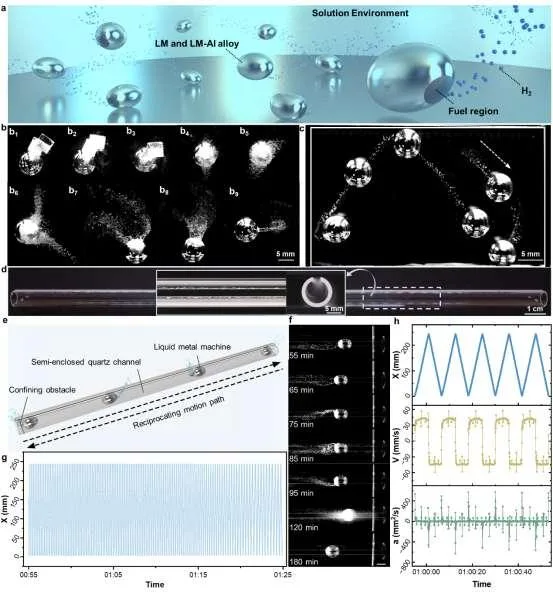
Капля жидкого металла скользит по узкому каналу, как ртуть из разбитого градусника. Ей не нужен мотор — топливом служит химическая реакция с окружающей жидкостью. Но что происходит, когда капля упирается в стенку? Раньше такие машины изучали в открытом пространстве, а в тесных каналах они ведут себя иначе.
Исследователи поместили жидкометаллические машины в каналы шириной с человеческий волос и снимали их сверхскоростной камерой. У закрытого конца капля не останавливалась, а разворачивалась и ползла обратно. Секрет — в неравномерном расходе топлива: с одной стороны капли реакция идёт быстрее, и она изгибается, как гусеница, меняющая направление.
Такие капли могут стать курьерами в микромире — переносить тепло, лекарства или заряды по тонким трубкам без проводов и батареек. Управляя формой канала и препятствиями, можно задавать маршрут. Это шаг к автономным роботам, которые работают в тесных местах — от сосудов до микросхем.
Оригинальная аннотация
как её написали авторы, на английском arXiv:2603.18705
Self-propelled liquid metal-aluminum hybrid machines represent a promising class of autonomous motion systems capable of sustained movement without external power sources. While interactions between machines and their environment inevitably occur, the fundamental question of how spatial confinement affects the motion dynamics and the controllability of speed, direction, and lifetime of such liquid metal machines (LMMs) remains underexplored. Understanding these confined dynamics is essential for practical applications. Here, we present a comprehensive investigation of the non-symmetrical fueling principle governing the direction-tuning effect in LMMs. By confining LMMs within one-dimensional semi-open channels, we thoroughly disclose their impact and turning dynamics with different end obstacles throughout their lifecycle, with particular focus on fuel region morphological evolution, overall motion, and local flow characteristics after reaction times exceeding one hour. Utilizing ultra-high-speed imaging techniques, we systematically clarify how fuel region evolution and end-obstacle interactions influence symmetry-breaking mechanisms and reciprocating dynamics. Our findings reveal complex interactions between material properties, charge transfer processes, and fluid dynamics during end-turning processes, establishing a theoretical foundation for LMM driving dynamics. Beyond the theoretical mechanisms, we further demonstrate that LMM exhibits efficient heat and mass transfer capabilities, paving the way for applications in controlled transport systems and autonomous robotics.
Жидкий металл галлий плавится уже при 29,8°C — его можно расплавить, просто зажав в ладони.