Гибкие нити превращают одежду в детектор радиации экспресс
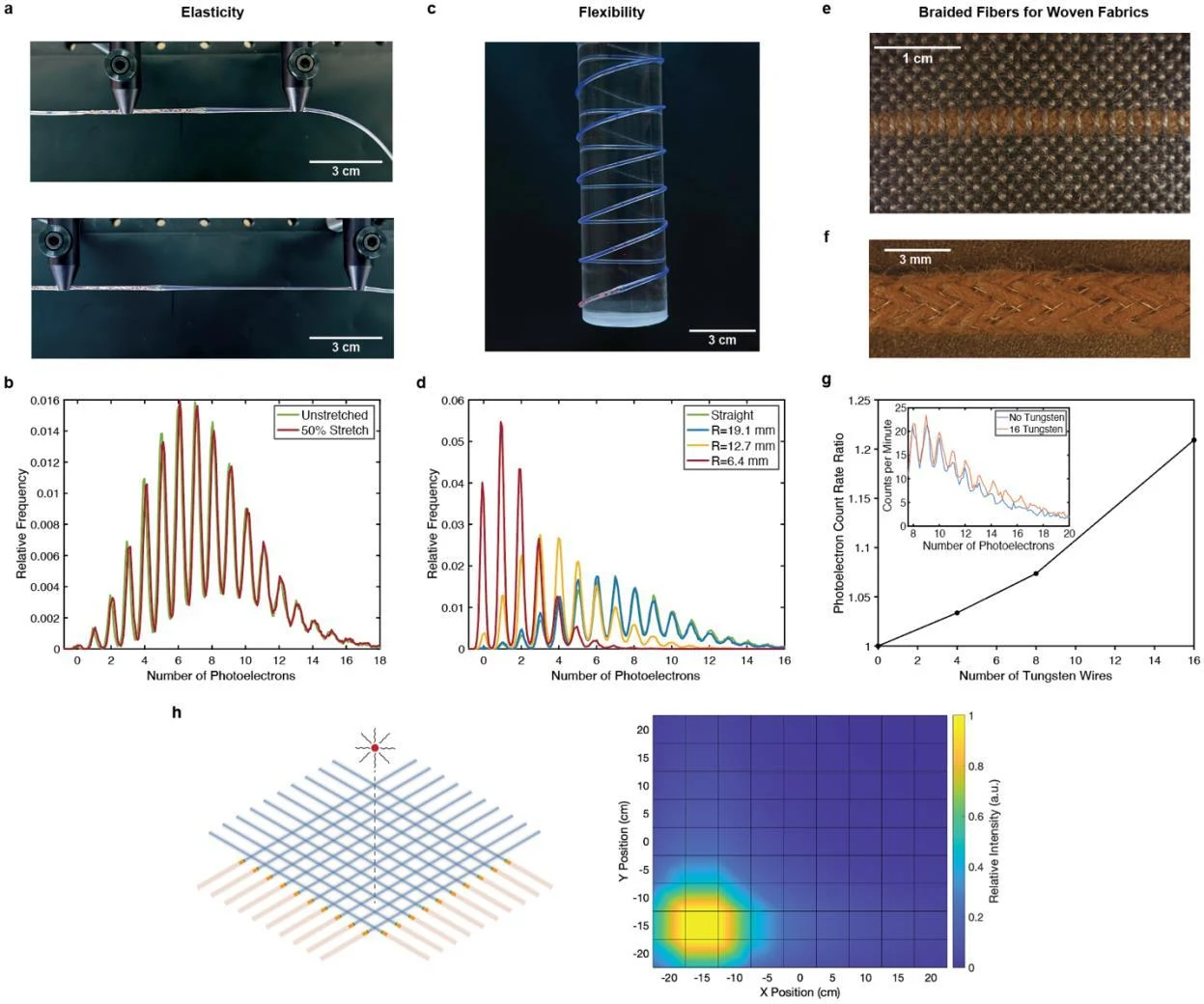
Внутри тончайшей нити из полимера заключены микроскопические кристаллы — сцинтилляторы. При попадании невидимой радиоактивной частицы они на мгновение вспыхивают, будто светлячки. Чувствительный датчик улавливает каждую такую вспышку, превращая нить в гибкий детектор.
Испытания со стронцием-90, цезием-137 и кобальтом-60 показали: ткань чует даже естественный фон. Чтобы усилить сигнал, в оплётку добавили вольфрам и шерсть мериноса — такое соседство металла с мягкой шерстью неожиданно повысило чувствительность на 20%. Вольфрам преобразует гамма-лучи в ливень электронов, которые кристаллы ловят охотнее. Это же помогает различать виды излучения, открывая путь к портативным исследованиям фундаментальных частиц и умной одежде, предупреждающей об опасности на атомных станциях и в лучевой терапии.
Оригинальная аннотация
как её написали авторы, на английском arXiv:2604.05061
Nuclear radiation detectors play a key role in applications spanning nuclear and particle physics, nuclear engineering, security, and medicine. With the expanded global interest in nuclear power, discreet, inconspicuous, and readily deployable nuclear detection capabilities are increasingly important. However, conventional dosimeters are often rigid, bulky, or lack spatial resolution, limiting their use for mobile, conformal, or large-area distributed mapping of dynamic fields. Here, we present flexible, radiation-sensitive optoelectronic fibres with up to 50% elasticity for real-time gamma dosimetry. Silicon photomultipliers are thermally drawn into the core of fibres composed of a scintillator waveguide, enabling electronic-photonic integration and detection of scintillation light with single-photon resolution. We show that these fibres are sensitive to localized nuclear radiation exposure from collimated 0.5 {\mu}Ci Sr-90 {\beta}-sources and 10 {\mu}Ci Cs-137 and Co-60 {\gamma}-sources, with extended responsivity measured over 30 cm, and estimated lower detection limits approaching near- background radiation levels (~14-41 nSv/hr). Co-locating the scintillator and detectors in the fibre eliminates past length limitations driven by optical losses and enabling a greater collection cone through capture of transient non- guided modes. We further enhance radiation sensitivity and mechanical robustness by covering the fibres with a tungsten-merino wool composite braid, enabling us to machine-weave them into fabrics alongside common textile yarns. The tungsten wires function as a gamma-electron converter, increasing the detection efficiency of the assembly by ~20%. Distributed woven arrays of fibres formed in this way present an opportunity to create large-area, conformal fabrics capable of real- time dosimetry of gamma radiation fields with high spatial resolution.
Первые детекторы радиации, с которыми работали Мари Кюри и Эрнест Резерфорд, требовали целых лабораторий. Теперь детектор можно надеть как свитер.
В романе Айзека Азимова «Основание» упоминаются личные дозиметры, но тканевые детекторы — это уже реальность.