Плазма в ловушке: как медь раздувает пузырь в гелии экспресс
Медная пластинка размером с монету испаряется под ударом лазера за миллиардные доли секунды. Горячее облако меди врезается в холодный гелий, как струя пара в морозный воздух. На снимках виден чёткий пузырь с тонкими нитями по краям — плазма не расширяется ровно, а распадается на волокна толщиной с человеческий волос.
Плазма — это газ, в котором электроны оторваны от атомов. Она проводит ток и реагирует на магнитные поля. В эксперименте медный пузырь толкает гелий, и на границе возникают завихрения. Протонная радиография показала: внутри пузыря есть магнитные поля, которые не видны обычной камере.
Такие пузыри возникают внутри термоядерных мишеней, где стенки камеры испаряются и мешают сжатию топлива. Понимание того, как плазма расширяется в газ, поможет точнее настраивать лазеры для будущих электростанций.
Оригинальная аннотация
как её написали авторы, на английском arXiv:2608.11664v1
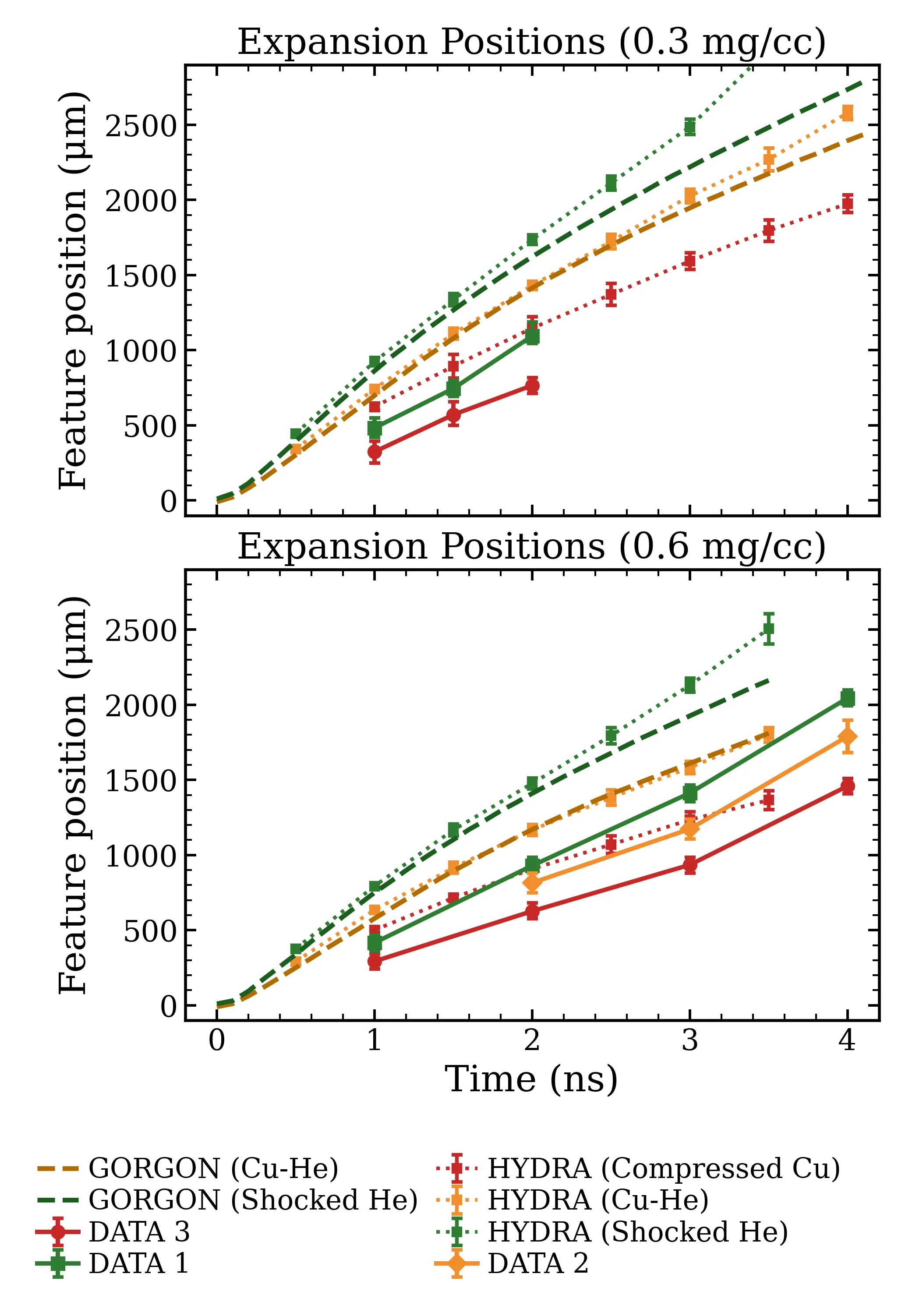
Experiments at the OMEGA EP laser facility were designed and executed to study plasma expansion into hohlraum-relevant gas fills (0.3-0.6 mg/cc of helium), providing a surrogate platform for investigating hohlraum wall blow-off, non-local transport, and magnetized plasma effects. We observe well-defined density features and filamentary structures as laser-driven copper plasma expands into a low-Z background gas. Shadowgraphy resolves sharp density features over time and reveals fine-scale filamentation in the laser spot region with characteristic transverse scales of 10-100 microns near the foil surface. Proton radiography provides sensitivity to path-integrated magnetic fields and density modulations throughout the bubble volume. We extract the bubble expansion as a function of time for two gas pressures, 350 psi (producing 0.3 mg/cc equivalent conditions) and 700 psi (0.6 mg/cc equivalent conditions), and compare the measured propagation to magnetohydrodynamic simulations performed with Gorgon and HYDRA. While the large-scale shape of the bubble is well reproduced by both codes, the time-dependent expansion rate shows significant discrepancies (20-50% faster) compared to experimental observations between 1 and 3 ns. This leads to increasingly larger differences in bubble sizes at later times. The optical measurements of bubble expansion and evolution of small-scale structures point to additional constraints required for Biermann-battery field generation, thermal transport, and instability growth in hohlraum-relevant plasmas, to ensure accurate, predictive modeling of gas-filled hohlraums.
Температура медной плазмы в эксперименте достигала сотен тысяч градусов — в десятки раз горячее поверхности Солнца.