أقمار دافئة حول الكواكب الشاردة سريع
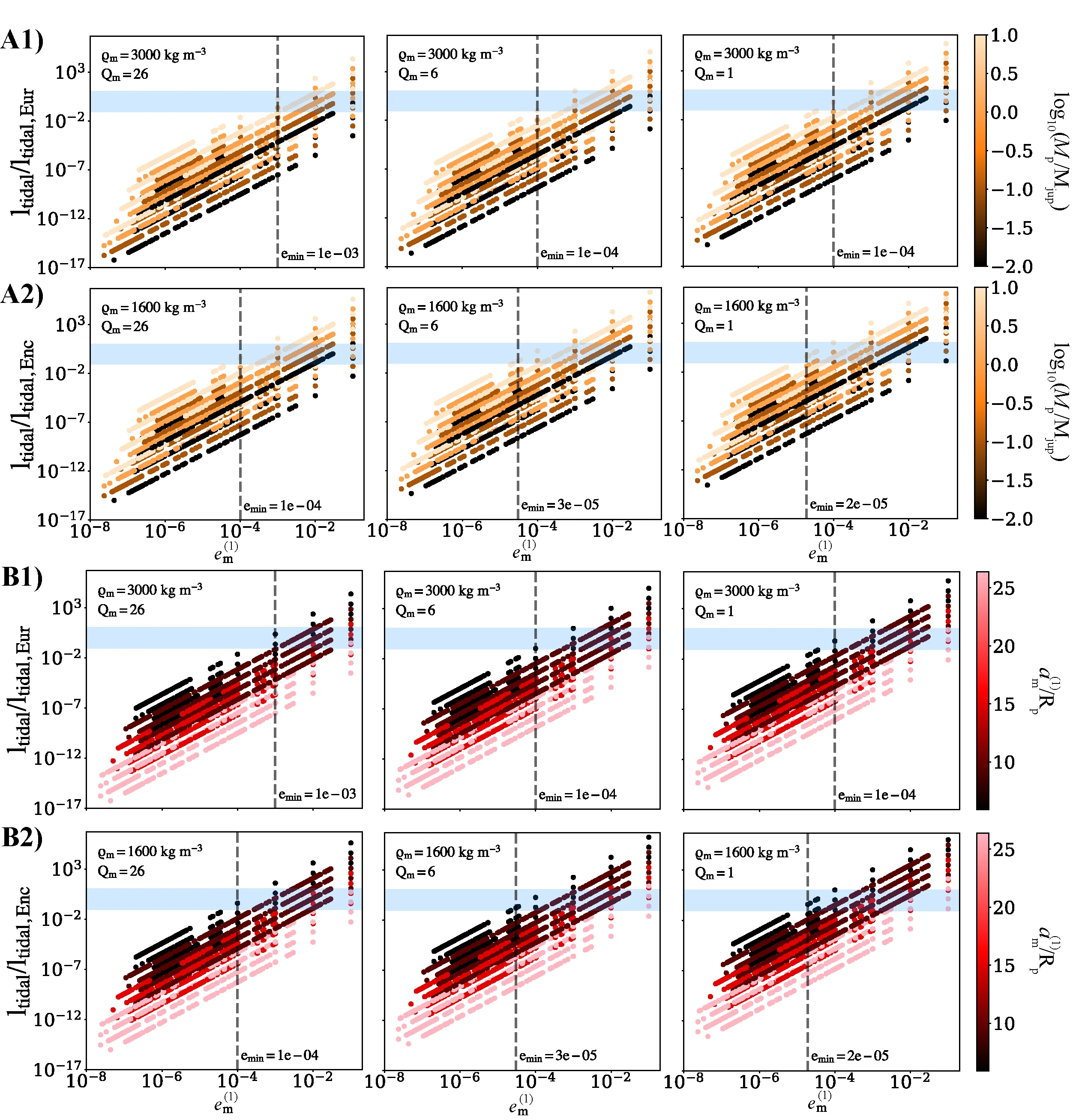
في المجرة، ثمة كم هائل من الكواكب الشاردة التي قُذفت بفعل انفجار مستعر أعظم. هذه الكواكب العائمة بحرية تخلو من شمس، لكنها غالباً ما تحتفظ بأقمارها. أظهرت النمذجة أنه بعد الكارثة، تصبح مدارات الأقمار بيضاوية قليلاً، وهذا يكفي لبدء التسخين الداخلي. في 12-15% من الحالات، تكون شدة هذا التسخين مماثلة لما يسخن محيطات أوروبا وإنسيلادوس. العجيب أن هذه العملية تخبو ببطء لا يصدق: بالنسبة للأقمار التي تبعد عن الكوكب أكثر من عشرة أضعاف نصف قطره، سيستمر التسخين أطول من عمر النظام الشمسي. لذا، يمكن لمحيطات الماء تحت القشرة الجليدية أن تظل سائلة لمليارات السنين. ربما يُكتشف الحياة خارج الأرض التالية ليس بالقرب من نجم، بل في الظلام الأبدي للفضاء بين النجمي.
الملخص الأصلي
كما كتبه المؤلفون، بالإنجليزية arXiv:2511.03392
Free-floating planets are thought to be numerous in the Galaxy and may retain their moons after ejection from their natal systems. If those satellites acquire or preserve orbital eccentricity, tidal dissipation could provide a long-lasting internal heat source, potentially creating urable environments (capable of enabling abiogenesis) in the absence of stellar radiation. We explore (i) whether moons remain bound to planets expelled by a core-collapse supernova, (ii) how the explosion reshapes their orbits, and (iii) under which circumstances tidal heating can sustain urable subsurface oceans. We carried out three-dimensional N-body simulations with an 8th-order Runge-Kutta scheme, modelling homologous stellar mass loss for progenitors of 10 M$$_{\odot}$$. Post-explosion orbital elements of single moons and resonant moon systems were analysed, and tidal heating power was estimated with a constant phase-lag model for several tidal dissipation functions and moon densities. All simulated moons survive the supernova and remain bound to their planets. The explosion excites moon eccentricities up to $$\sim7\times10^{-4}$$ and $$\sim3\times10^{-3}$$ for single moons of planets with circular and eccentric orbits, respectively. For resonant pairs, an eccentricity of $$\leq2\times10^{-2}$$ is preserved. The semi-major axis of the moons changes by $$\leq0.2\%$$. For 12-15\% of cases -- preferentially moons at $$a\leq15\,R_{\mathrm{planet}}$$ and with $$e\geq10^{-3}$$ -- the specific tidal heating power lies between 0.1 and 10 times what is estimated on Europa or Enceladus, sufficient to maintain liquid oceans beneath an ice crust. Eccentricity damping timescales exceed the age of the Solar System for $$a\geq10\,R_{\mathrm{planet}}$$, implying billions of years of continuous heating on the moons. Such worlds represent promising targets for future searches for extraterrestrial life.
قد يكون عدد الكواكب الشاردة في مجرتنا أكبر من عدد النجوم - ما يعني أن الأقمار الدافئة ذات المحيطات في الكون كثيرة بشكل لا يمكن تصوره، مثل حبات الرمل في جميع شواطئ الأرض.