عوالم بمحيطات صهارة دائمة سريع
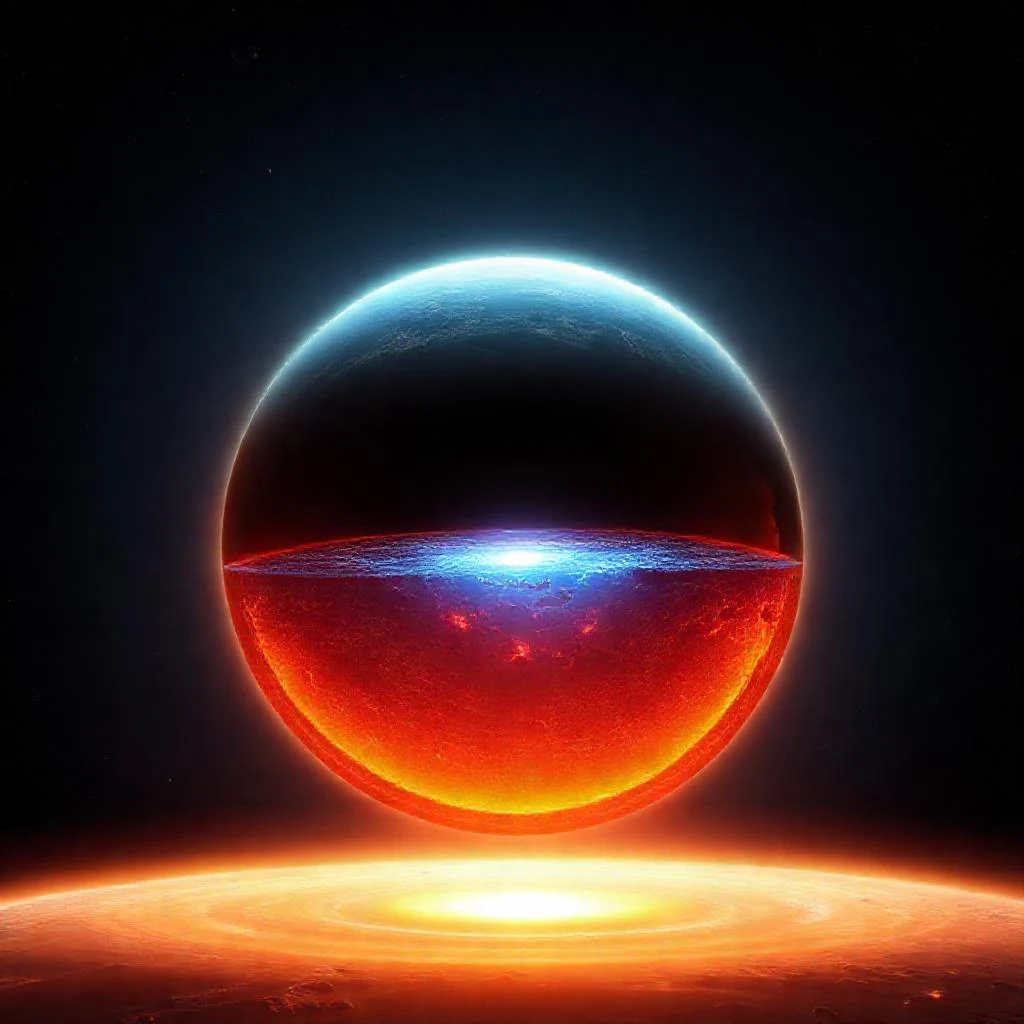
كما تُسخّن النارُ القدرَ، تدفئ النجم كوكبه. في معظم الكواكب شبه النبتونية (عوالم أكبر من الأرض وأصغر من نبتون)، تكفي الحرارة لجعل محيط من الصخور المنصهرة يغلي إلى الأبد تحت السماء الهيدروجينية. أظهر نموذج حاسوبي أن 98% من هذه الكواكب المكتشفة تبقى منصهرة في داخلها - إذا كانت تشبه بالفعل الكواكب الغازية القزمة ذات الغلاف الجوي الخفيف من الهيدروجين.
إذا كان داخل الكوكب غنياً بالأكسجين وخارجه بالكربون، يصبح الغلاف الجوي أثقل ويبرد بسرعة أكبر. لكن بالنسبة لمعظم العوالم، لم تنطفئ الحرارة الداخلية. وهذا يقلب المفاهيم: كنا نظن أن هذه الأجرام تتصلب على مدى مليارات السنين، لكن تبين أن أعماقها لا تزال متقدة حتى الآن.
الملخص الأصلي
كما كتبه المؤلفون، بالإنجليزية arXiv:2512.05816
Sub-Neptunes are the most common type of detected exoplanet, yet their observed masses and radii are degenerate with several interior structures. One possibility is that sub-Neptunes have silicate/iron interiors and H$$_2$$-dominated atmospheres ($$\mu$$<3.8 g mol$$^{-1}$$), i.e., they are 'gas dwarfs'. If gas dwarfs have molten interiors, interactions between their magma oceans and atmospheres will produce distinct observational signatures. These signatures may break the degeneracy in interior structure, while providing insight into their interior processes, history, and population trends. We expect all such planets are born molten, but under what conditions do they remain molten today? We use the coupled interior-climate evolution model, PROTEUS, to estimate the 'solidification shoreline': the instellation flux boundary (as a function of stellar $$T_{\rm eff}$$) that separates molten gas dwarfs from solidified ones. Our results show that 98% of detected sub-Neptunes occupy a region of parameter space consistent with their having permanent magma oceans, if they are gas dwarfs. While mantle $$f{\rm O}_2$$ and bulk volatile C/H ratio both influence magma ocean cooling, planets with oxidising mantles and carbon-rich atmospheres are likely to have high mean-molecular weight atmospheres ($$\mu$$>3.8 g mol$$^{-1}$$) and are thus outside the scope of this study. Therefore, most detected sub-Neptunes, if they are gas dwarfs, have permanent magma oceans. This result motivates further research into the interactions between molten interiors and overlying atmospheres, and campaigns to identify unambiguous signatures of these interactions.
الكواكب شبه النبتونية هي أكثر أنواع الكواكب شيوعاً في مجرتنا، رغم عدم وجودها في النظام الشمسي.