ثقب أسود «طباخ» يمنع النجوم من التولد سريع
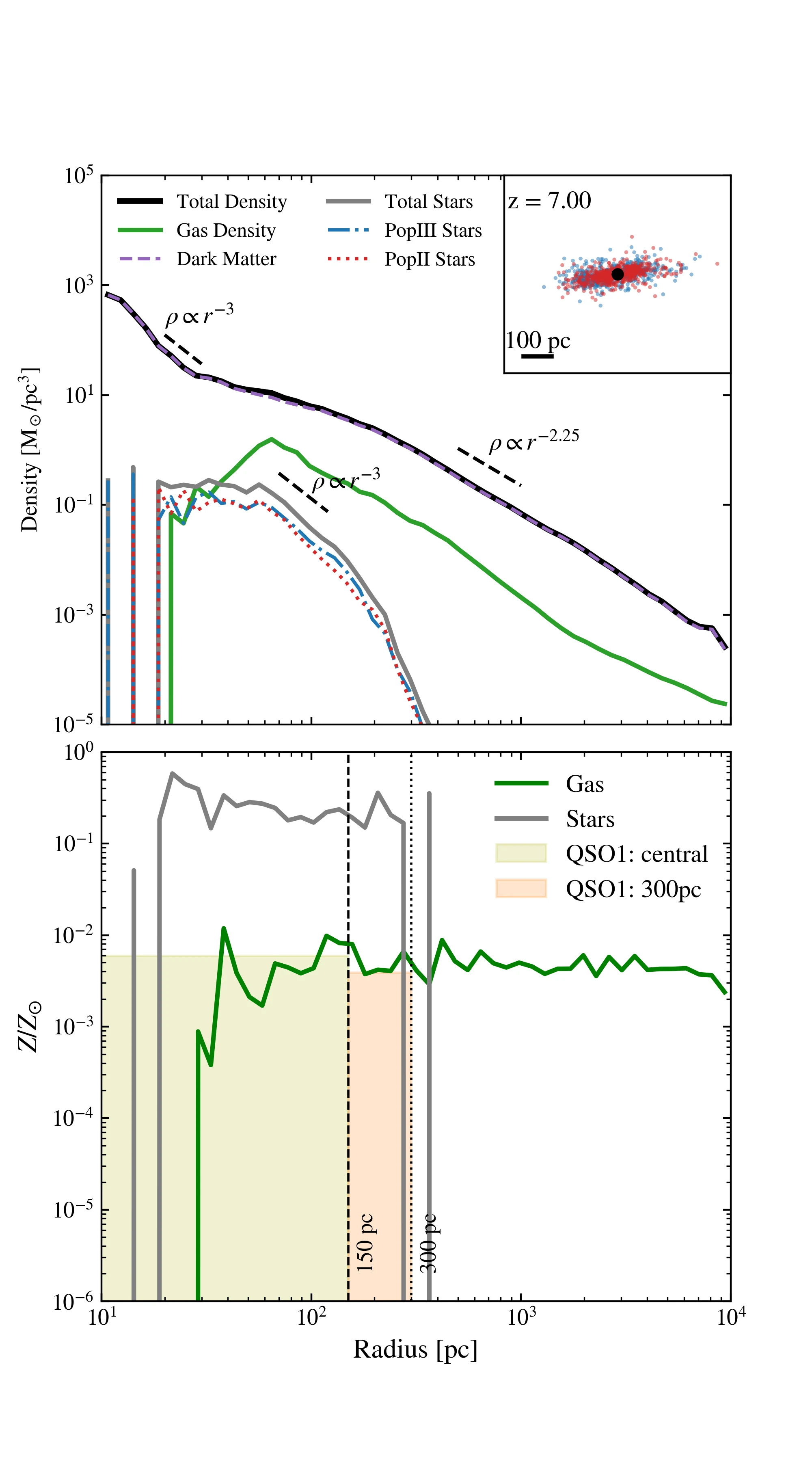
رصد تلسكوب جيمس ويب مجرة Abell 2744-QSO1، حيث لا توجد عناصر ثقيلة تقريبًا (يسميها علماء الفلك معادن)، وثقب أسود مركزي يزن مئات المرات أكثر من جميع النجوم مجتمعة. السيناريوهات العادية لا تفسر هذا الاختلال.
قد يكمن الحل في ثقب أسود من نوع خاص — لم يولَد من نجم، بل من كتلة من مادة فائقة الكثافة بعد الانفجار العظيم مباشرة. هذا الثقب العملاق (في النموذج نحو 50 مليون شمس) يتصرف كطباخ متطرف. يبتلع الغاز بشراهة، لكنه في الوقت نفسه يسخّن «فرن» المجرة بقوة لدرجة أن «عجين» النجوم لا يتماسك — فلا تشتعل النجوم. عندما تظهر النجوم الأولى في النهاية، فإنها تشبع الغاز بالمعادن بسرعة. يقذف الثقب هذه الدفعة «المملحة أكثر من اللازم» ويجذب وقودًا نظيفًا وطازجًا من الفضاء بين المجرّات. تتكرر الدورة، وتبقى المجرة خالية تقريبًا من المعادن، لكن بثقب أسود متضخم بشكل هائل.
مفاجأة غير متوقعة: هذا الطهي العاصف يجعل محيط الثقب ساطعًا بشكل مبهر — مثل فرن مفتوح يضيء كل ما حوله. هذا الضوء هو ما سمح لـ «ويب» برصد المجرة على حافة الكون المرصود.
الملخص الأصلي
كما كتبه المؤلفون، بالإنجليزية arXiv:2512.14066
The James Webb Space Telescope (JWST) has recently identified Abell 2744-QSO1 as a compact, metal-poor, black hole (BH) dominated galaxy at $$z\simeq 7$$. This system exhibits an extreme black-hole-to-stellar mass ratio and unusually low metallicity, posing significant challenges to BH seeding models. Motivated by these discoveries, we perform high-resolution cosmological simulations with a massive primordial black hole (PBH; $$M_{\rm BH}=5\times10^7\,M_\odot$$) seed, incorporating for the first time a fully coupled treatment of PBH accretion, BH feedback, and Population~III/II star formation and stellar feedback. Although PBHs accelerate structure formation through the seed effect, the associated strong thermal feedback from the accretion delays the onset of star formation to $$z\lesssim 10$$, producing short, bursty episodes throughout the subsequent evolution. PBH-driven outflows expel enriched gas from the nucleus, while sustained inflows from the intergalactic medium continuously replenish pristine material. This feedback-regulated cycle naturally yields low accretion rates ($$\dot{m}_{\rm BH}/\dot{m}_{\rm edd} \sim 1-10\%$$), subsolar metallicities ($$Z/Z_\odot\lesssim10^{-2}$$) and extreme $$M_{\rm BH}/M_\star$$ ratios during both the initial star-forming phase and the subsequent quenching phases, in excellent agreement with JWST observations. Our results demonstrate that massive PBHs offer a viable pathway for forming the most extreme high-redshift systems, providing a physically motivated explanation for the extraordinary properties of Abell 2744-QSO1, as a sub-class of the broader population of JWST-discovered "little red dots".
الثقوب السوداء الأولية وصفها لأول مرة بالتفصيل ستيفن هوكينغ في سبعينيات القرن العشرين. وافترض أنها قد تكون صغيرة جدًا، لكنها تتبخر مع مرور الوقت.