كيف حافظت الكواكب العملاقة على دورانها السريع سريع
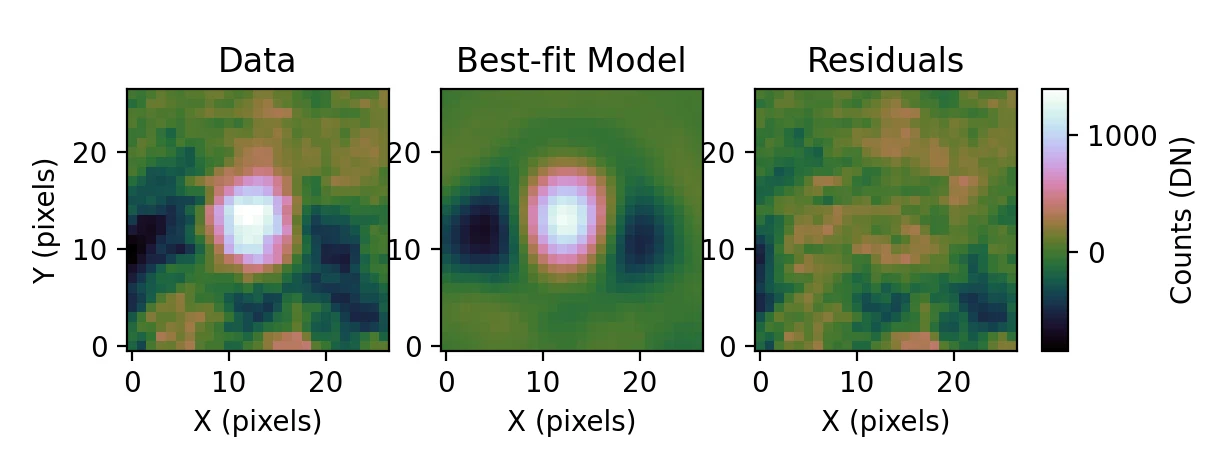
باستخدام تلسكوب كيك وطريقة التحليل الطيفي (تحليل الضوء الذي يكشف سرعة الدوران)، قاس علماء الفلك 32 جرمًا: من الكواكب العملاقة إلى الأقزام البنية — أجرام أثقل من الكواكب لكنها أخف من النجوم ولم تشتعل.
الكواكب العملاقة تدور تقريبًا عند حد التمزق: شرنقتها الغازية عند ولادتها بالكاد كانت تبطئها، مثل الثلج تحت دوّامة. أما الأقزام البنية فكانت تفقد دورانها بسرعة — كان قرصها يعمل كالرمل. علاوة على ذلك، الأقزام المرتبطة بنجوم كانت تتباطأ أكثر من المنعزلة؛ بينما الكواكب تدور بنفس الطريقة بغض النظر عن قربها من نجم.
المفاجأة: الأجرام التي تتراوح كتلتها بين 5 و40 كتلة مشتري حافظت على دوران أكبر من تلك الأكثر كتلة (40–100 كتلة مشتري). يبدو أنه أثناء التكوّن، يؤدي تجاوز عتبة معينة إلى تشغيل فرملة قوية. كوكب المشتري بنهاره الذي يدوم 10 ساعات ليس سوى مثال متواضع: العديد من الكواكب العملاقة تدور أسرع، متوازنة على حافة التدمير الذاتي.
الملخص الأصلي
كما كتبه المؤلفون، بالإنجليزية arXiv:2601.05976v3
We present a rotational velocity (vsini) survey of 32 stellar/substellar objects and giant planets using Keck/KPIC high-resolution spectroscopy, including 6 giant planets (2-7 M$$_\mathrm{Jup}$$) and 25 substellar/stellar companions (12-88 M$$_\mathrm{Jup}$$). Adding companions with spin measurements from the literature, we construct a curated spin sample for 43 benchmark stellar/substellar companions and giant planets and 54 free-floating brown dwarfs and planetary mass objects. We compare their spins, parameterized as fractional breakup velocities at 10 Myr, assuming constant angular momentum evolution. We find the first clear evidence that giant planets exhibit distinct spins versus low-mass brown dwarf companions (10 to 40 M$$_\mathrm{Jup}$$) at 4-4.5 $$\sigma$$ significance assuming inclinations aligned with their orbits, while under randomly oriented inclinations the significance is at 1.6-2.1 $$\sigma$$. Our findings hold when considering various assumptions about planets, and the mass ratio below 0.8% gives a clean cut for rotation between giant planets and brown dwarf companions. The higher fractional breakup velocities of planets can be interpreted as less angular momentum loss through circumplanetary disk braking during the planet formation phase. Brown dwarf companions exhibit evidence of slower rotation compared to isolated brown dwarfs, while planets and planetary mass objects show similar spins. Finally, our analysis of specific angular momentum versus age of 221 stellar/substellar objects below 0.1 M$$_{\odot}$$ with spin measurements in the literature indicates that the substellar objects of 5-40 M$$_\mathrm{Jup}$$ retain much higher angular momenta compared to stellar and substellar objects of 40-100 M$$_\mathrm{Jup}$$ after 10 Myr, when their initial angular momenta were set.
يوم على المشتري يدوم 10 ساعات فقط — أسرع من أي كوكب آخر في النظام الشمسي.