كيف يكسر دوران النجوم الشابة مجالها المغناطيسي سريع
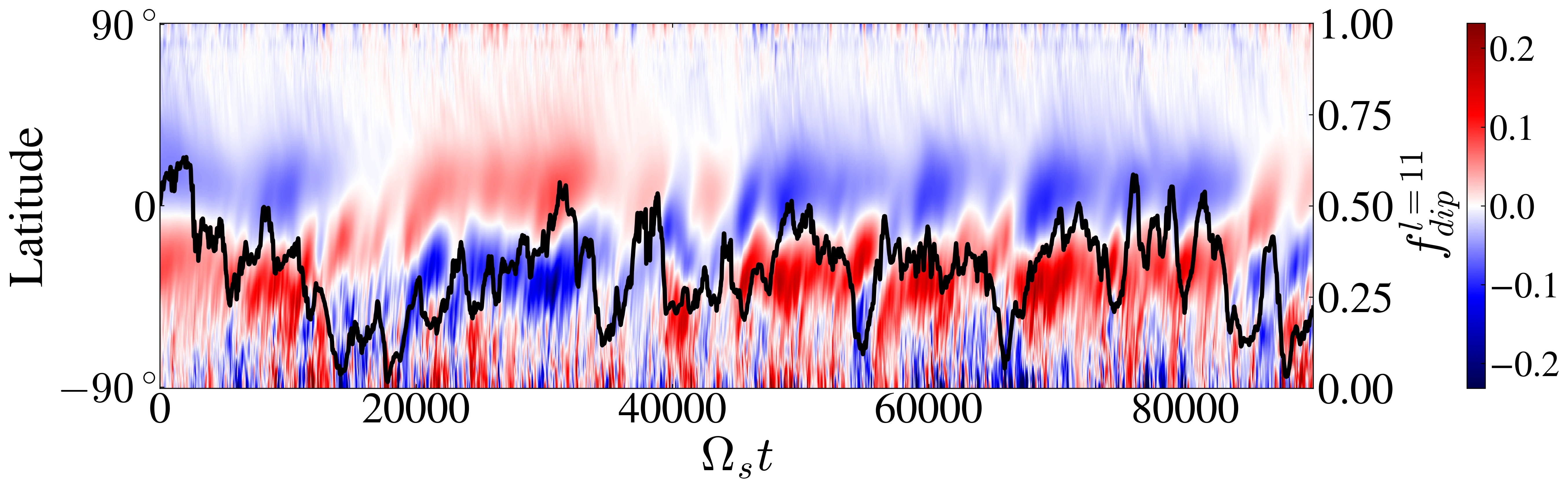
النجم الصغير يشبه الدوامة متعددة الطبقات: طبقاته الخارجية تدور ببطء، والداخلية أسرع. المجال المغناطيسي هنا يشبه خيوطاً قوية تربط هذه الطبقات. عندما تختلف السرعات، تبدأ الخيوط بالالتواء والتمدد أكثر فأكثر. وفي لحظة ما تنقطع، فيتحطم المجال البسيط ثنائي القطب (مثل المغناطيس المستقيم) ويحل محله مجال ضعيف وفوضوي.
هذا بالضبط ما يحدث في باطن النجوم، التي تتكون أساساً من الهيدروجين والهيليوم. تحليل ضوئها (التحليل الطيفي) يؤكد: أن المجالات فوضوية وغير مستقرة. المفارقة أن الدوران السريع، الذي يفترض أن يعزز المغناطيس، في الواقع يحطمه.
بالنسبة للنجوم الشبيهة بالشمس، أصبح هذا الارتباط بين سرعة الدوران والفوضى المغناطيسية مفتاحاً لماضيها: فمن خلال المجال الحالي يمكن معرفة مدى سرعة دوران النجم في شبابه.
الملخص الأصلي
كما كتبه المؤلفون، بالإنجليزية arXiv:2601.05980v1
Despite progress in the observations of stellar magnetic fields, their physical mechanisms remain poorly understood. During the pre-main sequence (PMS) phase, the inner layers of stars contract and a radiative core gradually develops. In contrast, the convective envelope is gradually braked through magnetic interactions with the accretion disk and winds. With developing differential rotation inside the star, PMS phase is thus a critical period for magnetic properties of stars when strong initial dipoles can get perturbed, leading to the observed diversity in the magnetism on the main sequence (MS). In this work, we study the impact of differential rotation on such fields. We perform three-dimensional anelastic convective dynamo simulations of rotating spherical shells with an imposed differential rotation (shear) between the boundaries. Density, gravity profiles and convective zone thicknesses were set close to those predicted in PMS low-mass stars by one-dimensional stellar evolution code Cesam2k20. Our results show that radial differential rotation can induce dipole collapse leading to weaker, oscillatory magnetic fields. Differential rotation seems to perturb $$\alpha^2$$ dynamo mechanism, responsible for dipolar magnetic fields, by shearing poloidal field lines and by affecting turbulent magnetic transport processes. This collapse is moderated by the relative importance of shear compared to the vigor of convective motions, with exact stability criterion depending on the field strength and the size of the radiative core. Applying DNS-based stability criterion in PMS stellar evolution models, we qualitatively reproduce the trends observed in the magnetic topologies of low-mass stars when assuming an efficient internal angular momentum redistribution. This suggests that stellar magnetic properties are intimately related to the PMS angular momentum evolution.
الشمس تقلب مجالها المغناطيسي كل 11 عاماً، مثل مفتاح عملاق. لكن في العديد من النجوم، بسبب الالتواء الداخلي، يضطرب هذا الدورة، ويعيش المجال حياة غير متوقعة.