عندما غاصت الشمس في سحابة سريع
تتحرك المجموعة الشمسية عبر المجرة، وتغوص أحياناً في سحب بينجمية كثيفة – تجمعات من الهيدروجين المخلخل والغبار. عادةً ما يحمينا الشمس:
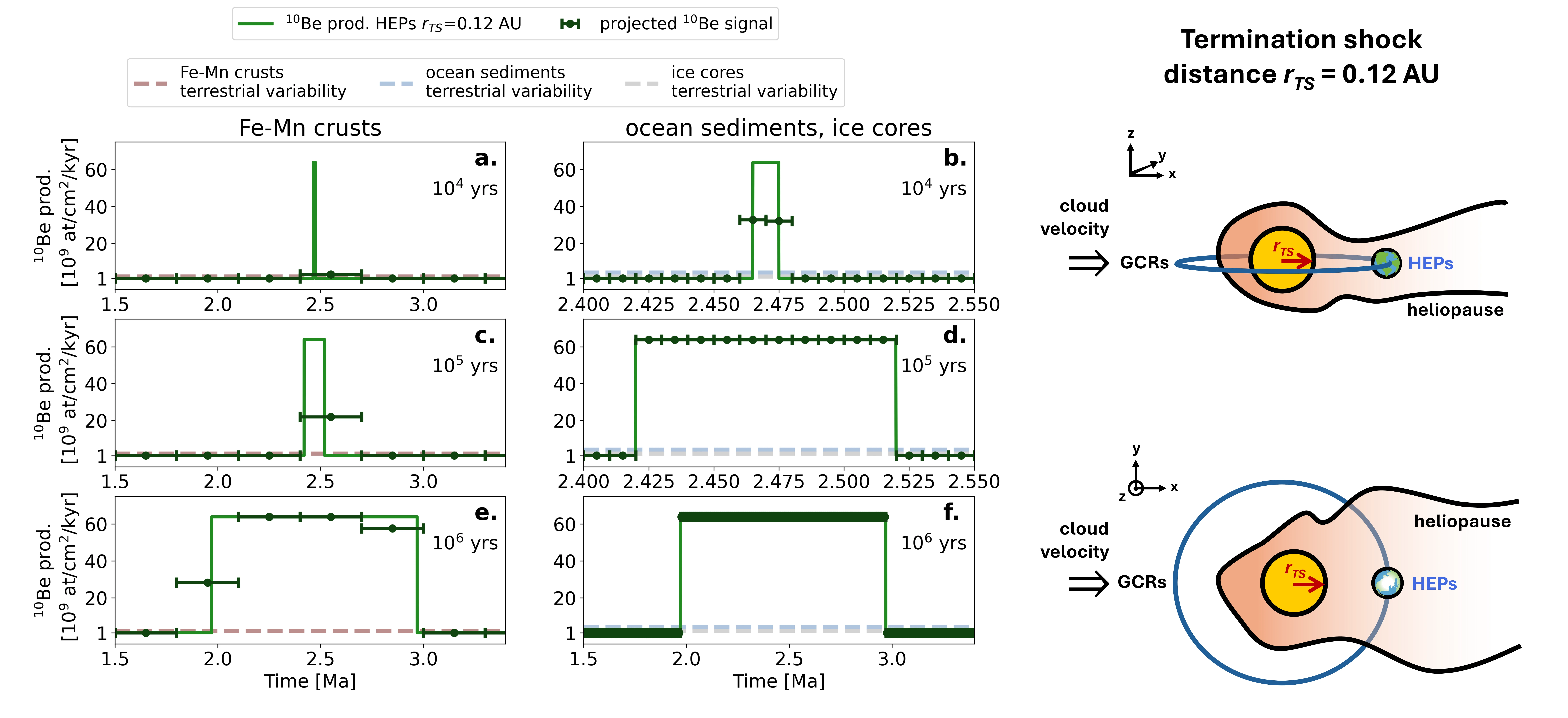
لكن السحابة الضخمة تضغط على الفقاعة – فتتقلص أحياناً إلى حجم أصغر من مدار الأرض – فيتعرض الكوكب لوابل من الجسيمات من الفضاء. في الهواء يتولد البيريليوم-10 – نظير مشع لعنصر البيريليوم. يترسب في رواسب المحيطات وطبقات الجليد، كعلامة على الحدث. قام العلماء بقياس هذه العلامة واكتشفوا: السحب الصغيرة تكاد لا تُرى في القشرة البحرية، لكن العينات الجليدية تحتفظ بذكراها عند القياسات الدقيقة. أما ارتفاع البيريليوم قبل 10 ملايين سنة فلم يسببه سوبرنوفا، بل المرور عبر سحابة.
الملخص الأصلي
كما كتبه المؤلفون، بالإنجليزية arXiv:2601.07983v2
Recent works suggest there are periods when the Sun encountered massive interstellar cold clouds which compressed the heliosphere to within Earth's orbit. This would expose Earth to increased galactic cosmic rays (GCRs) and energetic particles of heliospheric origin (HEPs). We model 10Be production in Earth's atmosphere during possible interstellar cloud encounters and supernovae, and estimate their detectability in marine and ice records of variable temporal resolution. We find that encounters with sub-parsec-scale clouds cannot be detected via 10Be measurements in iron-manganese crusts. GCR signal is not detectable in ocean sediments; only parsec-scale clouds can be detected in iron-manganese crusts. Encounters with sub-parsec-scale clouds can be detected if Earth is exposed to HEPs, or by measuring ice cores with less than or equal to 10 kyr temporal resolution. We find that the peak observed by Koll et al. (2025) 10 Ma cannot be attributed to a supernova, but could be attributed to an interstellar cloud crossing.
البيريليوم-10 هو ساعة كونية: تحلله البطيء يحفظ ذكرى العواصف الشمسية ولقاءات السحب لعشرات ملايين السنين.