أنهار غازية تغذي نجماً مستقبلياً سريع
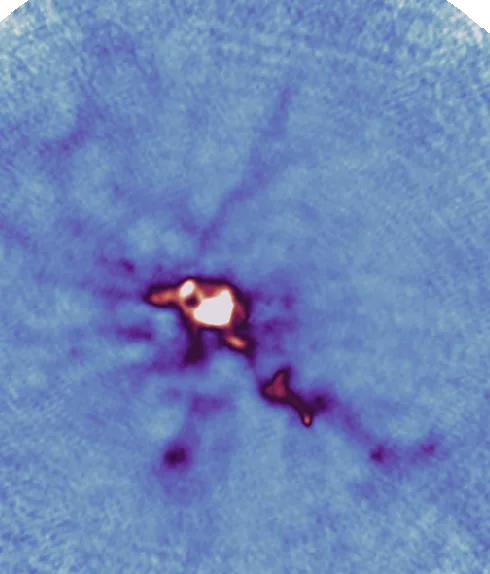
في السحابة المظلمة G318.049+00.086، حيث لا يوجد نجم واحد بعد، اصطف الغبار والغاز في أربعة خيوط طويلة. تتلاقى هذه الخيوط في عقدة مركزية كثيفة، مثل أربعة أنهار تصب في بحيرة. عبر هذه الخيوط، يتدفق الغاز نحو المركز: تصل سرعة التدفق إلى 10–20 كيلومتراً في الثانية لكل فرسخ فلكي من الطول. هذا يعني أن أكثر من ألف كتلة شمسية من المادة تصل إلى العقدة كل مليون سنة.
داخل العقدة، وجد علماء الفلك تكثفات، وهي نجوم المستقبل. معظمها يُظهر انزياحاً أزرق في ملف إشعاعه. ينشأ هذا الانزياح عندما تسقط الطبقات الخارجية للتكثف نحو الداخل، ونحن نرى فقط النصف الأقرب إلينا. هذا يعني أن هذه التكثفات تنضغط تحت ثقلها الذاتي. لكن بعض التكثفات أظهرت انزياحاً أحمر: غازها يتمدد بالعكس.
هذا المشهد يشبه سباقاً لا يفوز فيه الأقوى، بل من وجد نفسه في المكان المناسب. التكثفات على الخيوط تفقد مادتها، بينما العقدة في المركز تجمعها، وعلى الأرجح ستنجب نجماً أو أكثر من النجوم الضخمة. هكذا تولد العمالقة التي تضيء لاحقاً عناقيد نجمية بأكملها.
الملخص الأصلي
كما كتبه المؤلفون، بالإنجليزية arXiv:2602.01238
We present a gas kinematic study of the massive protocluster G318.049+00.086. The protocluster is reported to contain 12 prestellar core candidates and 4 protostellar cores. Filamentary structures are identified using the 1.3 mm dust continuum map, with four of them converge into a dense central region, forming a hub-filament system (HFS). High velocity gradients (10 - 20 km s$$^{-1}$$ pc$$^{-1}$$) derived from PV analysis of H$$^{13}$$CO$$^{+}$$ emission along three of those filaments are suggestive of mass inflow onto the central hub. A mass inflow rate higher than $$10^{3}$$ M$$_{\odot}$$ Myr$$^{-1}$$ along the filaments is indicating that the central hub is capable of forming massive star(s). Investigation of H$$^{13}$$CO$$^{+}$$ and CCH spectral profiles revealed the majority of the cores having the characteristic blue asymmetric line profiles, typical signature of gravitational collapse. The remaining few cores showed red asymmetric profiles, indicative of gas expansion. Also, the derived mass infall rates for the protostellar cores in hub-region is significantly higher in comparison to those located along the filaments. The mass-radius relationship of the cores revealed that the cores with red profiles reside in the massive star formation regime. However, the global velocity gradient along the filaments suggests that these particular cores are losing material to the hub. Our results are supporting a competitive accretion scenario of massive star formation where gas is expected to be funnelled from less gravitationally dominant cores to the cores located at the gravitationally favorable position.
سرعة سقوط الغاز في هذه السحابة تجعل كتلة تعادل ألف شمس تتدفق إلى المركز خلال مليون سنة. للمقارنة: شمسنا ستفقد خلال حياتها كلها جزءاً صغيراً فقط من مادتها.