كيف تقذف النجوم ضيوفها سريع
المسافرون بين النجوم هم صخور وكتل جليدية انطلقت من أنظمتها الكوكبية الأصلية وتطير الآن عبر المجرة. أول ضيف من هذا القبيل، أومواموا، مرّ بالقرب من الشمس في عام 2017، وتبعه مذنب بوريسوف وجسم ATLAS. من أين تأتي؟ في أغلب الأحيان تقذفها جاذبية الكواكب العملاقة — مثل حصاة من مقلاع إذا أُديرت بسرعة كبيرة.
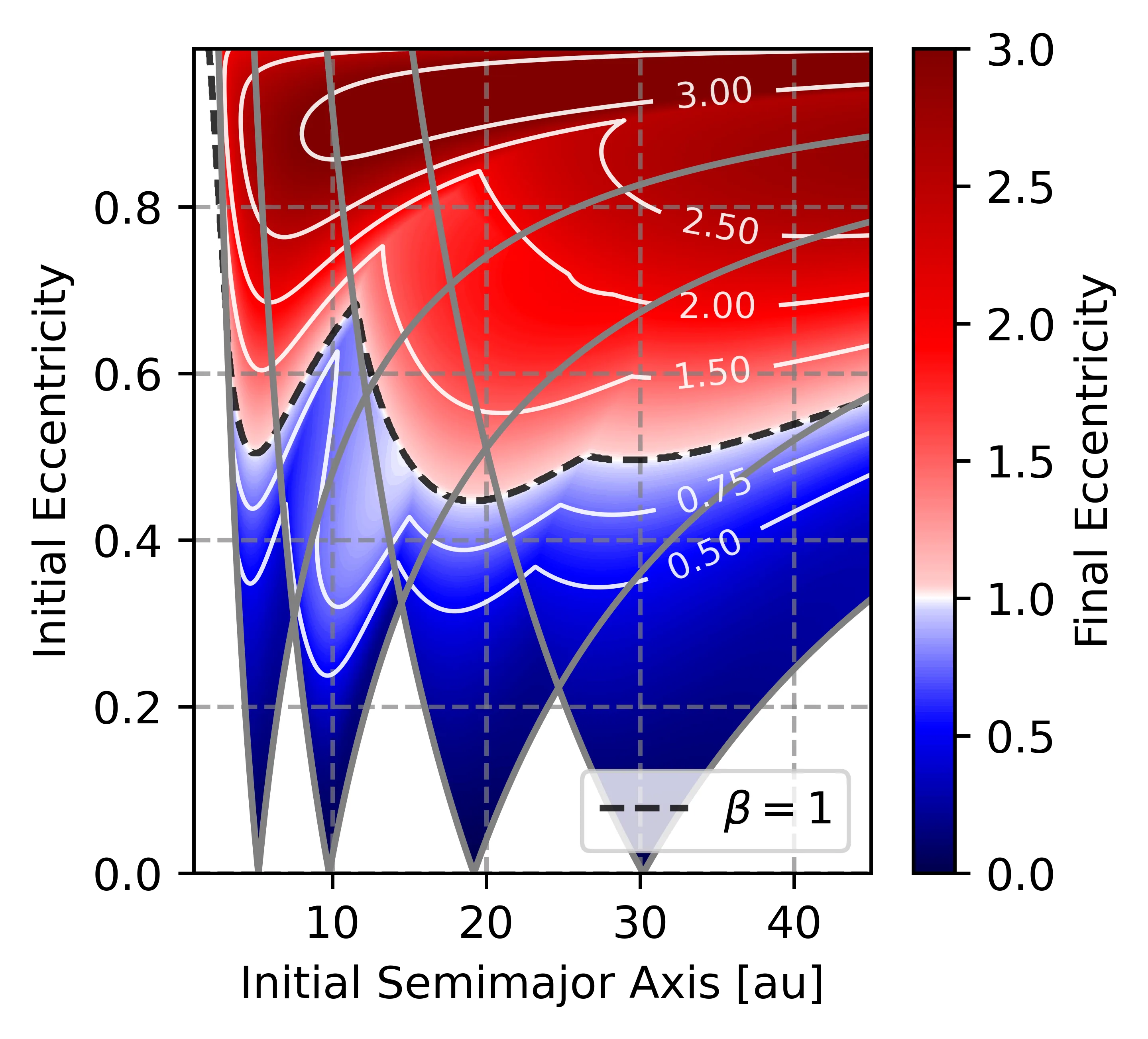
أخذ مؤلفو العمل مسألة مبسطة: نجم، وكوكب ضخم واحد، وجسم صغير. اشتقوا معادلات تربط مدار الجسم قبل لقائه بالكوكب وبعده. الاستنتاج الرئيسي: للهروب، يجب أن يكون المدار ممدودًا — انحرافه المداري لا يقل عن 0.4. هذا يعني أن الجسم يقترب أحيانًا من النجم ثم يبتعد كثيرًا. عندما يمر بالقرب من كوكب عملاق، قد يمنحه هذا الكوكب سرعة كافية لمغادرة النظام نهائيًا.
تم اختبار المعادلات بحسابات عددية: فهي تتنبأ جيدًا بسلوك الأجرام، رغم أن المحاكاة ضرورية للتفاصيل الدقيقة. ثم طُبقت الطريقة على النظام الشمسي ونظام بيتا الرسام وHR 8799. وتبين أن في كل منها مناطق تُقذف منها الأجرام بسهولة خاصة. هذا يشبه إيجاد نقطة في المقلاع تنطلق منها الحصاة بأقصى سرعة.
الآن يستطيع علماء الفلك تقييم أي الأنظمة الكوكبية تزودنا بالأجرام بين النجوم بشكل أسرع. الضيف القادم من نظام نجمي آخر لن يفاجئنا بعد الآن — سنعرف من أين أتى.
الملخص الأصلي
كما كتبه المؤلفون، بالإنجليزية arXiv:2602.04806
The discovery of interstellar interlopers such as 1I/`Oumuamua, 2I/Borisov, and 3I/ATLAS have highlighted the necessity of understanding the dynamical pathways that eject small bodies from planetary systems into hyperbolic trajectories. In this paper we examine the orbital elements of particles in the restricted three-body problem prior to and post scattering onto hyperbolic trajectories by massive perturbers. Building on previous work, we calculate closed-form -- but approximate -- analytic criteria that map pre- to post-encounter orbital elements. An application of these equations demonstrates that ejection occurs most efficiently when the orbital eccentricity of the massless test particle exceeds a minimum threshold, $$e\gtrsim0.4$$. The primary driver of the final eccentricity is the component of the perturber-centric velocity projected along the direction of motion of the perturber. These analytic criteria are then benchmarked and validated against numerical simulations which demonstrate that they provide a reasonably good zeroth-order approximation for ejection behavior. However, system-specific cases will generally require numerical simulations in addition to this analytic construction. The methodology is applied to (i) the solar system and exoplanetary systems (ii) $$\beta$$ Pictoris and (iii) HR 8799 to evaluate the pre-scattering orbits of ejected particles. This method provides a transparent and computationally efficient tool for identifying orbits within a given system from which interstellar objects are efficiently ejected via a single scattering event from a massive perturber.
تحرك أومواموا بسرعة كبيرة حتى أن جاذبية الشمس لم تستطع إبقاءه — فقد غادر نظامنا إلى الأبد.
في رواية آرثر كلارك «موعد مع راما»، يتبين أن الجسم بين النجوم هو سفينة اصطناعية — كما اشتبه بعض العلماء بشأن أومواموا.