الراديو يكشف ولادة النجوم في الكون المبكر سريع
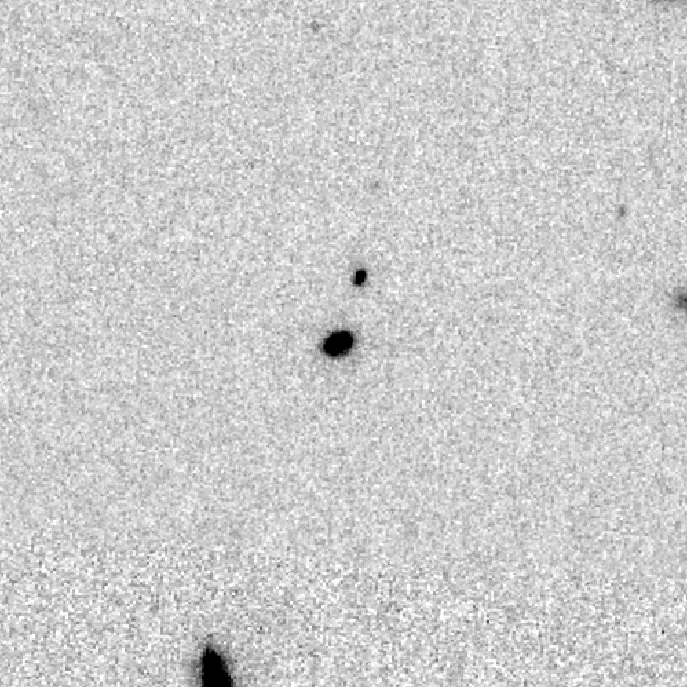
التقط التلسكوب الراديوي إشارة من ثلاث مجرات كانت موجودة عندما كان عمر الكون أقل من مليار سنة. توهجها الراديوي قوي جدًا لدرجة أنه يبدو وكأن كلًا منها أنجب ألف شمس في السنة خلال فترة قصيرة. للمقارنة: مجرتنا درب التبانة تنجب فقط نجمين في السنة.
في البداية، رُصدت هذه المجرات في صور التلسكوبات الفضائية «هابل» و«جيمس ويب» — بدت حمراء بشكل غير عادي بسبب المسافة الهائلة. ثم أكد المطياف أن الضوء استغرق 12,8–13,1 مليار سنة للوصول إلينا. بعد ذلك، دخلت التلسكوبات الراديوية على الخط، وأظهرت أن كل الإشعاع ناتج عن النجوم، وليس عن ثقب أسود في المركز.
اثنتان من المجرات الثلاث لهما شكل ممزق متعدد المكونات. يبدو أنهما تعرضتا للتو لاصطدام مع مجرة مجاورة، وهذا الاصطدام ضغط الغاز، مما أطلق انهيارًا جليديًا من تكوين النجوم. هكذا أضاءت أول التجمعات النجمية الكبيرة في الكون المبكر.
الملخص الأصلي
كما كتبه المؤلفون، بالإنجليزية arXiv:2602.05808
Radio observations offer a dust-independent probe of star formation and active galactic nucleus (AGN) activity, but sufficiently deep data are required to access the crossover luminosity between these processes at high redshift ($$z>4.5$$). We present three spectroscopically confirmed high-redshift radio sources (HzRSs) detected at 1.3 GHz at $$z=4.9$$-$$5.6$$, with radio luminosities spanning $$L_{\rm 1.3 \, GHz}\approx2$$-$$5\times10^{24} \, \rm W \, Hz^{-1}$$. These sources were first identified as high-redshift candidates through spectral energy distribution (SED) fitting of archival Hubble, JWST NIRCam+MIRI, and ground-based photometry, and then spectroscopically confirmed via the $$\rm H\,\alpha$$ emission line using wide-field slitless spectroscopy from JWST COSMOS-3D. The star formation rates (SFRs) measured from SED fitting, the $$\rm H\,\alpha$$ flux, and the 1.3 GHz luminosity, span $$\sim100$$-$$1800\, M_{\odot} \, \rm yr^{-1}$$, demonstrating broad agreement between these SFR tracers. We find that these three sources lie either on or $$0.5$$-1.0 dex above the star-forming main sequence at $$z=4$$-6 and have undergone a recent burst of star formation. The sources have extended rest-UV/optical morphologies with no evidence for a dominant point source component, indicating that an AGN is unlikely to dominate their rest-UV and optical emission. Two of the sources have complex, multi-component rest-frame UV/optical morphologies, suggesting that their starbursts may be triggered by merging activity. These HzRSs open up a new window towards probing radio emission powered by star formation alone at $$z> 4.5$$, representing a remarkable opportunity to begin tracing star formation, independent of dust, in the early Universe.
الضوء القادم من هذه المجرات استغرق ما يقرب من 13 مليار سنة للوصول إلينا — أي ثلاثة أضعاف عمر الأرض.