سبيكيولات الشمس: كيف تكتسب الهالة حرارتها سريع
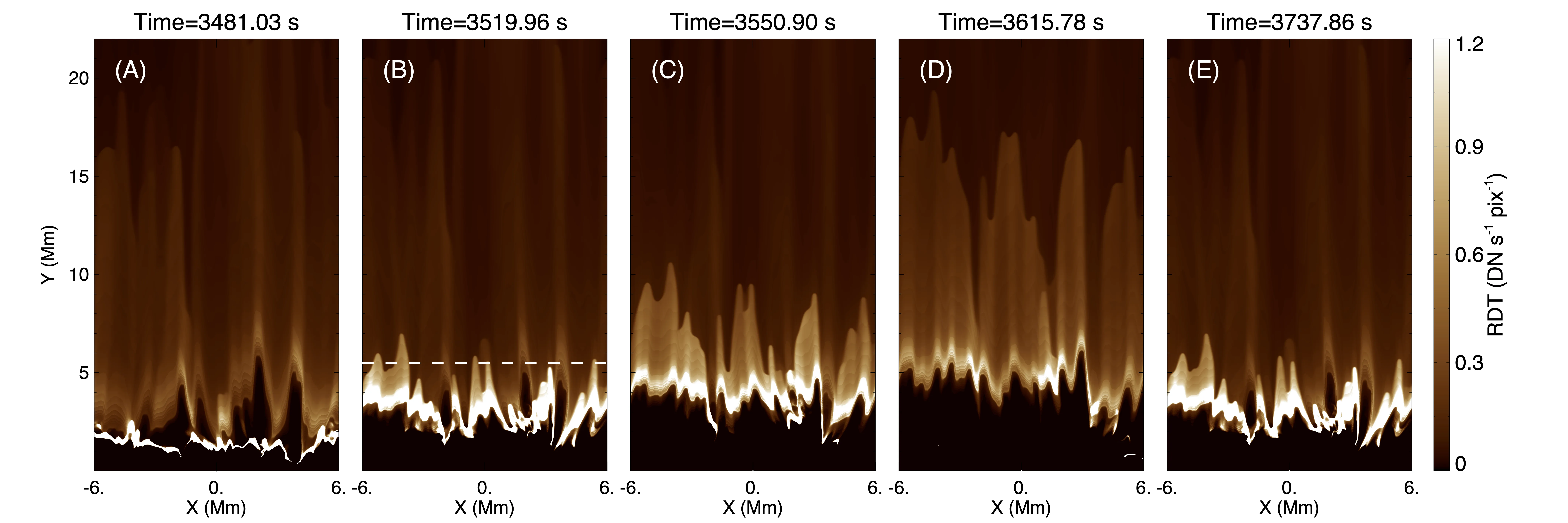
سطح الشمس يغلي كالماء في قدر. الغاز الساخن يصعد ويبرد ثم يهبط — هذا هو الحمل الحراري. حوله تتقلقل حقول مغناطيسية تتمزق وتتصل من جديد. وفي خضم هذه الضوضاء تولد السبيكيولات — نفثات بلازما ضيقة تنطلق آلاف الكيلومترات إلى الأعلى. تعيش هذه النفثات بضع دقائق فقط، لكنها تنجح في نقل الطاقة إلى الغلاف الجوي الخارجي للشمس.
السبيكيولات لا تنطلق فحسب، بل تدفع أمامها موجات وجبهات صدمية. هذه الموجات تضغط الغاز وتسخّنه. وهكذا تصل الطاقة من السطح إلى الهالة — الطبقة الخارجية المتخلخلة التي تزيد حرارتها مئات المرات عن حرارة السطح نفسه. وبدون السبيكيولات، لبردت الهالة ولنضبت الرياح الشمسية في الثقوب الإكليلية.
وهكذا، نفثة صغيرة تلو الأخرى، تضخ الحرارة إلى الهالة كما تضخ المضخة. السبيكيولات ليست مجرد مشهد جميل على حافة قرص الشمس، بل هي مفتاح لغز حيّر الفيزيائيين الفلكيين طوال 80 عامًا: لماذا الهالة أسخن من السطح؟
الملخص الأصلي
كما كتبه المؤلفون، بالإنجليزية arXiv:2602.19953
How the solar atmosphere is heated from a temperature of about $$5,000-6,000$$\,K in the lower atmosphere to about $$1-2$$\,MK in the corona has challenged the astrophysical community for about 80 years. The same puzzle exists for the stellar coronae heating as well. In this study, we present a series of findings on solar spicules and their subsequent impact on the corona within a coronal hole environment, characterized by locally open magnetic field lines, combining insights from MHD simulations with observations. We find that the convective and turbulent motions around the solar surface cause plenty of shocks and small-scale magnetic reconnection in the lower atmosphere. The combined effects of shock compression and reconnection outflows then drive the formation of groups of spicules with a quasi-period of about $$300$$\,s and width of $$\sim 200-500$$\,km. The spicule upflows provide an averaged mass flux above $$10^{-9}$$\,kg\,m$$^{-2}$$\,s$$^{-1}$$ in the lower corona to sustain the solar wind in coronal holes, and they continuously trigger further new local slow-mode waves and shocks. These waves supply an energy flux of $$10-100$$\,W\,m$$^{-2}$$ in the lower corona, and they are dissipated by heat conduction and compression heating to sustain the corona temperature of about $$1$$\,MK. The results also indicate that the upward propagating disturbances (PDs) observed in extreme ultraviolet (EUV) passbands are caused by both spicule upflows and slow-mode waves and shocks. Our findings help to understand the long standing problem of coronal heating and the origin of solar winds in coronal hole regions.
تبلغ حرارة هالة الشمس نحو مليون درجة، بينما لا يتجاوز سطحها 5500 درجة. الأمر أشبه بأن يكون الهواء حول النار أسخن من اللهب نفسه.