كوكب مُبتلَع يُسرع دوران نجم سريع
النجم GJ 504، وهو توأم لشمسنا الشمس في العمر، يتصرف كمُدوِّر محترف: يُتم دورة كاملة كل 3.4 أيام، متوهجاً بأشعة سينية. عادةً ما تدور النجوم النظيرة للشمس ببطء، لكن هذا النجم يبدو وكأنه تلقى دفعة كونية.
وكشف النموذج الحاسوبي السر. أظهر تحليل الضوء (التحليل الطيفي) أن الكبح العادي بفعل الرياح النجمية ما كان ليُبطئه. التفسير الوحيد هو أن النجم ابتلع في الماضي كوكباً خارج المجموعة الشمسية بحجم المشتري. هذا 'الشريك في الدوران' نقل إليه زخمه المداري، فدار النجم مثل قمة تلقت دفعة قوية. لولا ذلك لكان يدور ببطء، دورة كاملة في الشهر.
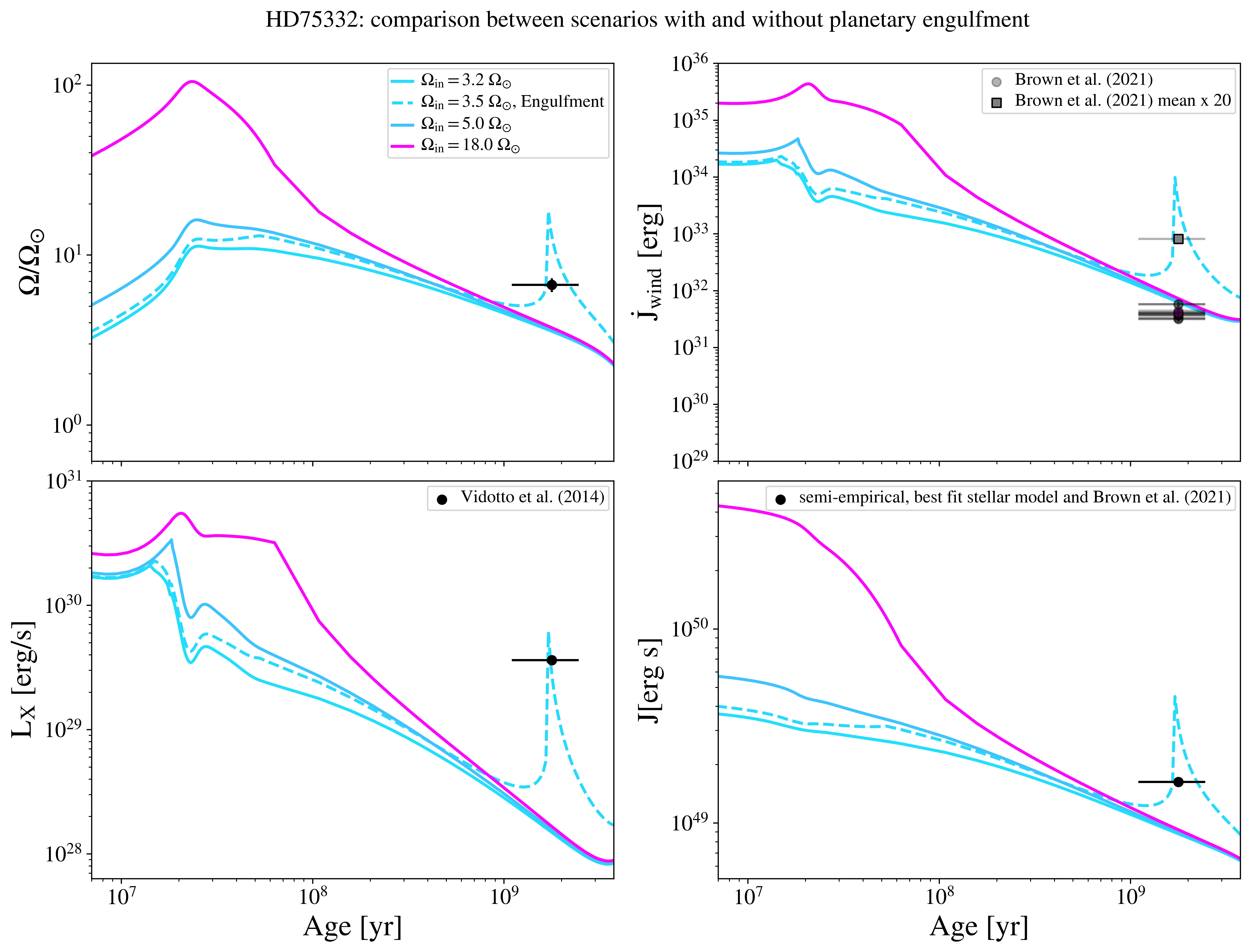
وُجد نجم سريع الدوران أيضاً في HD 75332، ويبدو أن الكوريغرافيا السماوية أكثر شيوعاً مما كان متوقعاً.
الملخص الأصلي
كما كتبه المؤلفون، بالإنجليزية arXiv:2602.22979
With the discovery of a few thousand exoplanets, questions have been raised regarding star-planet interactions and whether the presence of a companion may affect stellar properties. GJ 504 is an evolved (2 Gyr) Sun-like star with a short rotation period (3.4 d) and an intense magnetic activity, which is in stark contrast with what would be expected at such an evolutionary stage. One possible explanation is that a close-in, Jupiter-mass planet was pushed starwards by the action of stellar tides, inducing a stellar spin-up and ultimately a rejuvenation of the stellar magnetic dynamo. By characterising the large-scale magnetic field and magnetised wind of GJ 504, we aim to provide additional observational constraints to test such scenario. We analysed spectropolarimetric observations of GJ 504 collected with ESPaDOnS. Using Zeeman-Doppler imaging, we found a large-scale, dipolar, non-axisymmetric magnetic field with an average strength of 5.3 G, similar to that of evolved early-G type stars. We fed the magnetic field information into our 3D MHD simulation of the stellar wind and space environment of GJ 504, from which we constrained the wind-driven angular momentum loss ($$\rm \dot{J}$$). We then compared $$\rm \dot{J}$$ to rotational evolutionary tracks of GJ 504 for two scenarios: evolution with and without the engulfment of a close-in, Jupiter-mass companion. Between the two scenarios, only the planet engulfment can explain the observational constraints obtained previously in the literature, such as the stellar rotation and X-ray luminosity, and the $$\rm \dot{J}$$ we derived and rescaled to account for underestimated magnetic field strength. Although there are many other stars with similar masses and rotation periods whose rotation evolution does not require planet engulfment, we also identified HD 75332 as a candidate for planet engulfment, suggesting that GJ 504 may not be an isolated case.
يُتم النجم GJ 504 دورة كاملة كل 3.4 أيام، أي أسرع بسبع مرات من شمسنا.