التوهجات الشمسية الخفية: كيف يرتجف المجال المغناطيسي للبقعة سريع
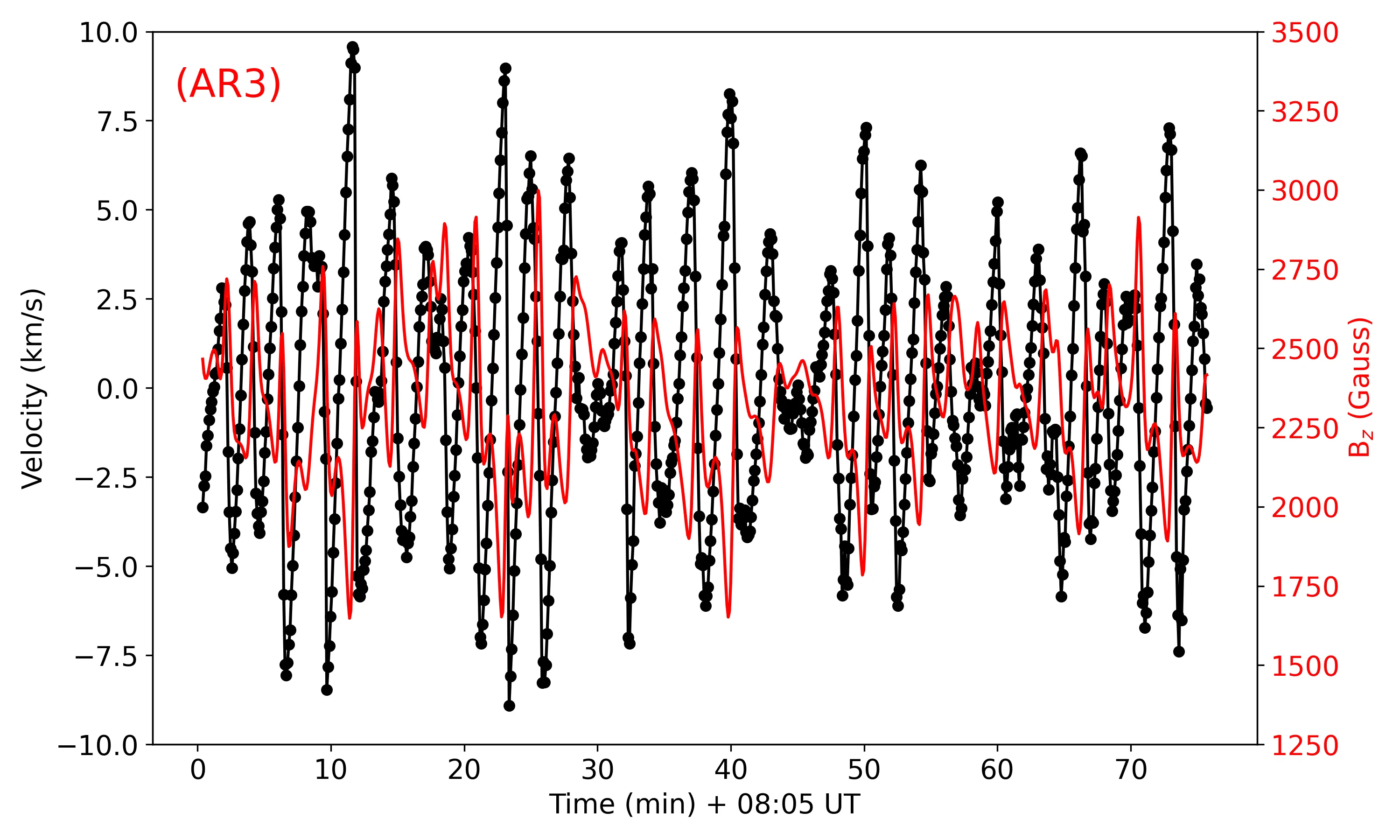
توجد على سطح الشمس بقع داكنة — مناطق ذات مجال مغناطيسي قوي جدًا يكبح غليان الغاز الملتهب. ومن وقت لآخر تجتاز الغلاف الجوي للبقعة موجات صادمة — مثل هبة ريح تضغط الهواء أمامها. عندها يتوهج الغاز ساطعًا لفترة قصيرة، ويطلق علماء الفلك على هذه الأحداث اسم التوهجات الظلية (umbral flashes).
رصد العلماء خمس بقع مختلفة باستخدام تلسكوب GREGOR وجهاز GRIS. وقاسوا حركة الغاز وتغير المجال المغناطيسي لحظة التوهج. وتبين أنه في ثلاث بقع يشتد المجال فجأة عند الصدمة، بينما في البقعتين الأخريين يضعف على العكس. بدا هذا غريبًا: لماذا تعمل الموجة نفسها بشكل مختلف؟
لكن هناك تفسيرًا آخر. فعندما تمر الموجة الصادمة عبر الغاز، قد تدفعه ببساطة إلى الأمام والخلف بسرعة. عندها لا يرى الجهاز تغيرًا في المجال المغناطيسي، بل مجرد لعبة سرعات. اختبر الباحثون هذه الفكرة: سمحوا للنماذج بأن تفترض أن المجال ثابت طوال الوقت، وأن سرعة الغاز فقط هي التي تتغير. وقد تطابقت النماذج تمامًا مع الأرصاد.
إذن، قد تكون الحقيقة أن المجال المغناطيسي للبقعة لا يتغير تقريبًا أثناء التوهج — بل يبدو لنا كذلك بسبب الحركة السريعة للغاز. لكن النسخة الأولى التي تتحدث عن قفزات قوية في المجال لم تُستبعد أيضًا. والآن نحتاج إلى أرصاد جديدة لفهم ما يحدث حقًا في قلب البقعة الشمسية.
الملخص الأصلي
كما كتبه المؤلفون، بالإنجليزية arXiv:2603.12213
Umbral flashes are manifestations of magnetoacoustic shocks in the solar chromosphere. These phenomena are thought to influence the evolution of chromospheric umbral magnetic fields. However, the impact of these shocks on inferred chromospheric magnetic field oscillations remains unclear. We examined five different sunspots located near the solar disk center, observed with the GRIS instrument installed at the GREGOR telescope. The HAZEL2 Spectropolarimetric inversion code is used to obtain the photospheric and chromospheric line-of-sight velocities and magnetic fields in Si 10827 {\AA} and He 10830 {\AA} spectral lines, respectively, using various inversion strategies. In the inversions with one chromospheric component, three of the sunspots exhibit remarkably stronger magnetic fields accompanying the shocks, while the other two sunspots show striking reductions in the magnetic field. Alternatively, the Stokes profiles can be reproduced by models with two chromospheric slabs, one on top of the other, through two-component inversions. These inversions provide excellent fits even when magnetic field fluctuations are discarded by imposing a constant magnetic field during the whole temporal series. In this scenario, the observed Stokes profiles are interpreted as the result of strong velocity gradients, where the He 10830 {\AA} line is sensitive to both sides of the shock front. Both competing models explaining the spectral profiles during the shocks, either large magnetic field fluctuations or velocity gradients, are critically discussed.
الموجات الصادمة في الغلاف الجوي للشمس تسخن الغاز إلى عشرات الآلاف من الدرجات — أكثر حرارة من سطح الشمس نفسه.