مطاردة النيوترينوات العقيمة سريع
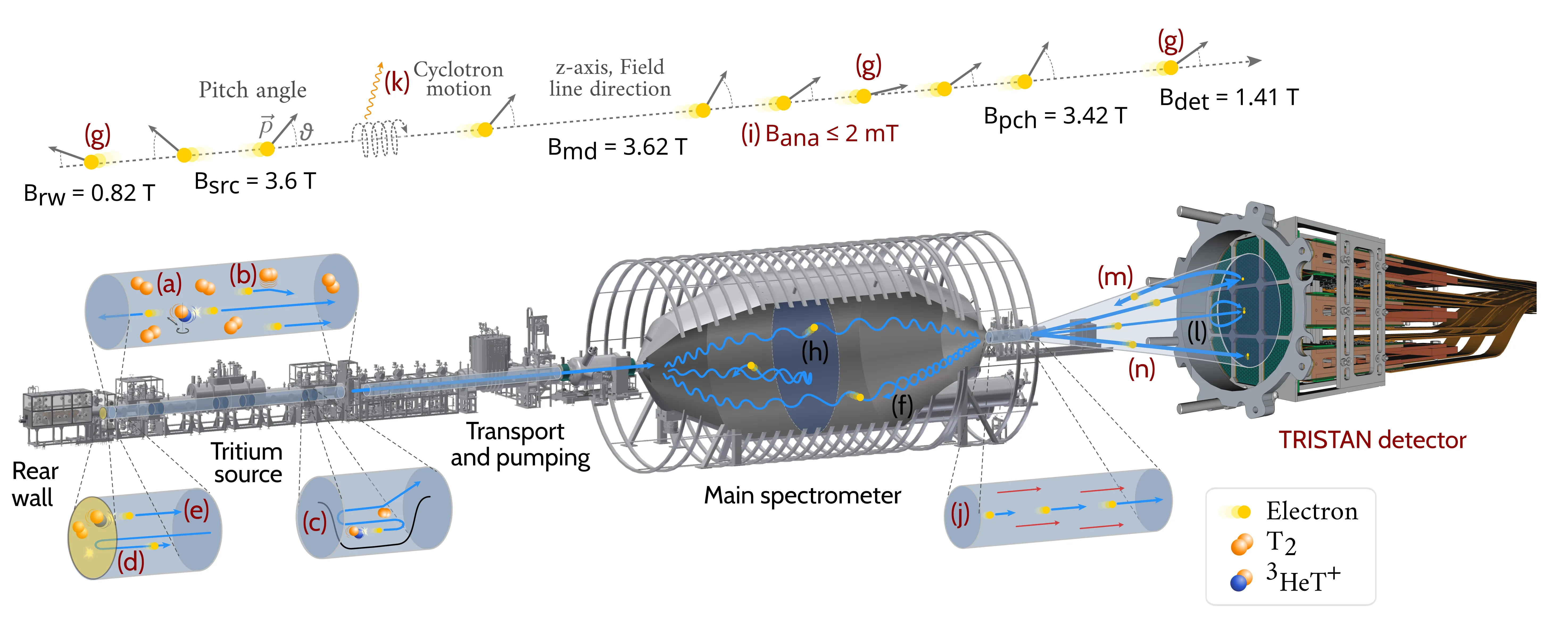
يضمحل التريتيوم المشع، وينبعث منه إلكترون. طاقته دائمًا متشابهة تقريبًا، لكنها أحيانًا تكون أقل قليلًا. هذا «النقص» قد يعني أنه إلى جانب النيوترينو العادي، وُلد جسيم آخر خفي.
النموذج القياسي يصف ثلاثة أنواع من النيوترينوات، لكن العلماء يشتبهون في وجود رابع — عقيم. لا يشارك في أي تفاعل سوى الجاذبية، لذلك لا يمكن التقاطه مباشرة. لكن يمكن استنتاجه من الانحناء في طيف الإلكترونات: كما لو كانت هناك درجة ناقصة في سلم مستقيم.
خلال أربعة أشهر من التشغيل، ستتمكن KATRIN من رصد أثر النيوترينو العقيم حتى لو كان يشكل جزءًا من مليون فقط. هذا أفضل بعشرات المرات من عمليات البحث السابقة.
إذا وُجد الانحناء، فسيكون هذا أول أثر حقيقي لجسيم قد يتكون منه المادة المظلمة — المادة غير المرئية التي تربط المجرات ببعضها.
الملخص الأصلي
كما كتبه المؤلفون، بالإنجليزية arXiv:2603.23256
Sterile neutrinos in the keV mass range are a well-motivated extension of the Standard Model and viable dark matter candidates. Their existence can be probed in laboratory experiments, as the admixture of a sterile state would induce a characteristic kink-like distortion in the $$\beta$$-decay electron energy spectrum. The KATRIN experiment is designed to measure the effective electron neutrino mass with sub-eV sensitivity by analyzing the endpoint region of the tritium $$\beta$$-decay spectrum. Following the completion of its neutrino mass program, KATRIN will extend its physics reach to the search for keV-scale sterile neutrinos. This effort will be enabled by the TRISTAN detector, a newly developed silicon drift detector array optimized for differential measurements at high rates and energies well below the endpoint. In this article, we present the projected sensitivity of KATRIN to keV-scale sterile neutrinos using a dedicated simulation framework. With four months of detector livetime, KATRIN has the statistical power to probe mixing amplitudes at the level of $$|U_{e4}|^2 \sim 10^{-6}$$ for sterile neutrino masses in the (4$$-$$13) keV range, significantly extending the reach of previous laboratory searches. The major experimental systematic uncertainties investigated in this work reduces the sensitivity by a factor of 10$$-$$50 over the same mass range.
سُمي النيوترينو العقيم بهذا الاسم لأنه «عقيم» تجاه التفاعل الضعيف — التفاعل الوحيد الذي تشارك فيه النيوترينوات العادية.